
Content analysis sorts data into categories and counts how often each one appears. Thematic analysis reads the data closely for patterns of meaning and organises them into themes. Both code text, but content analysis answers how much of something is there, while thematic analysis answers what it means.
That one distinction cascades into everything else: what you code, how you check the analysis, what your results section looks like, and what an examiner will accept. Pick the wrong label and the work can be sound but undefendable, which is the version of this problem that shows up constantly in research forums.
The most common confusion runs the other way: people say content analysis is quantitative, but it is not necessary. That is a misunderstanding. It can be qualitative. The rest of this guide explains exactly where that flexibility comes from and what it costs you.
Below is a comparison table first, then the two methods explained on their own terms, then the same short interview transcript run through both so you can see the identical data produce two different but equally defensible analyses.
Table of Contents
- 1Difference Between Content Analysis and Thematic Analysis at a Glance
- 2What Is Content Analysis?
- 3Content analysis is not inherently quantitative
- 4Manifest content and latent content
- 5Three approaches and the coding frame
- 6What Is Thematic Analysis?
- 7The six steps of Braun and Clarke’s framework
- 8Reflexivity, and the 2021 update
- 9Four flavours, one method
- 10What Is the Main Difference Between Content Analysis and Thematic Analysis?
- 11Content Analysis vs. Thematic Analysis: Which Method Fits Your Research?
- 12Type of research question
- 13Inductive versus deductive orientation
- 14How much researcher judgement you are willing to defend
- 15Data type and volume
- 16Methodological tradition of your field
- 17Content Analysis vs. Thematic Analysis: Coding and Analysis Compared
- 18Content analysis step by step
- 19Thematic analysis step by step
- 20Where the two processes genuinely differ
- 21Content Analysis vs. Thematic Analysis: How the Findings Are Reported
- 22Content Analysis vs. Thematic Analysis: Examples From Research
- 23Which Should You Choose?
- 24Frequently Asked Questions
- 25Can content analysis and thematic analysis be used together?
- 26Is thematic analysis a type of content analysis?
- 27Can thematic analysis include code frequencies and statistics?
- 28Which method is more suitable for open-ended interview transcripts?
- 29Can content analysis and thematic analysis be performed in SPSS, R, or Stata?
- 30Conclusion
Difference Between Content Analysis and Thematic Analysis at a Glance
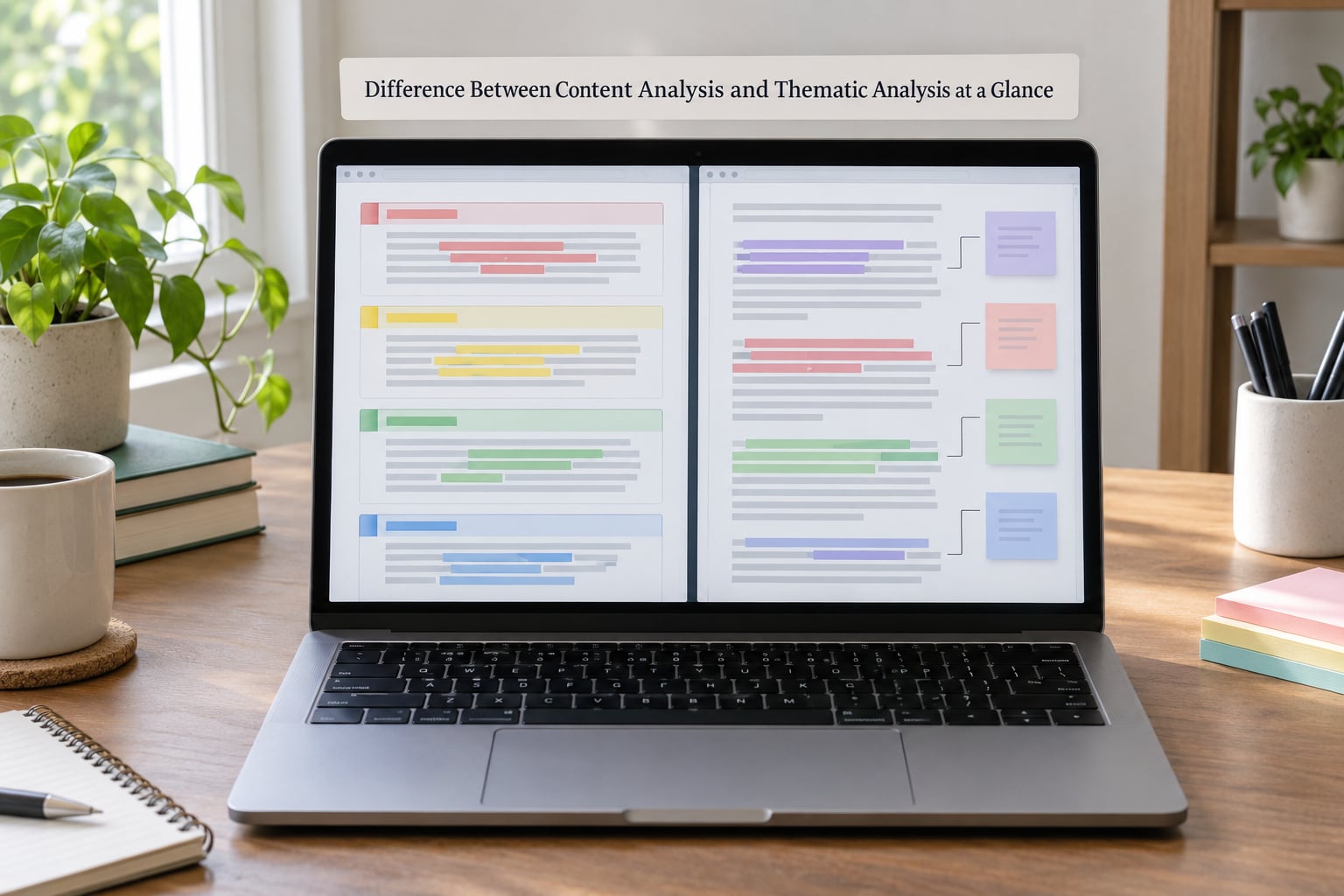
If you read nothing else, read this table. It answers the question that every comparison page on the search results has to answer, with the rows that actually decide the choice.
| Point of difference | Content analysis | Thematic analysis |
|---|---|---|
| Central aim | Classify content into categories and quantify its presence | Identify patterns of shared meaning and interpret their significance |
| Typical research question | How often, how much, which categories, how do two groups differ | How, why, in what ways, what does this experience mean |
| Unit of analysis | The coding unit defined in advance: word, sentence, paragraph, whole document | The stretch of talk that carries a complete idea, usually a clause or several sentences |
| Where categories come from | A codebook or coding frame, usually built before or alongside coding | Generated from the data, then refined; a codebook is optional and not the point |
| Inductive or deductive | Either, though deductive category systems are the norm | Either, and often both in the same study |
| Researcher’s position | Ideally a stable observer applying a fixed frame | An active instrument; reflexivity is a documented requirement |
| Epistemological stance | Usually realist or post-positivist, sometimes interpretivist | Interpretivist or constructivist by default |
| Main output | Frequency tables, co-occurrence matrices, distributions, codebook appendix | Thematic map, analytic narrative, data extracts and participant quotations |
| Quality check | Intercoder reliability or coding reliability, for example Krippendorff’s alpha | Reflexive memos, peer challenge, a coherent and non-cherry-picked write-up |
| Data volume it suits | Small corpora to very large text collections | Typically 6 to 60 interviews, focus groups or documents; depth over volume |
| Manifest or latent | Both exist as named variants: manifest counts what is said, latent codes what is meant | Both exist as named flavours: semantic codes surface meaning, latent codes implied meaning |
| Common pitfall | Categories that overlap, so one passage lands in two bins | Labelling a simple frequency count as an analysis and calling it thematic |
Two rows in that table do most of the work. The unit of analysis row explains why the methods handle the same paragraph differently, and the quality-check row explains why asking for intercoder agreement in a reflexive thematic analysis is a category error.
What Is Content Analysis?
Content analysis is a systematic method for classifying text, images, audio or video into categories and describing what the set contains. The systematic part is not optional. It means an explicit decision rule about what gets counted, applied consistently across the whole dataset, with the categories either fixed in advance or built and frozen early enough that they still apply to data coded later.
Content analysis is not inherently quantitative
The most persistent myth in this field is that content analysis means counting and thematic analysis means interpreting. Krippendorff’s 2004 treatment of content analysis includes both descriptive counting and inferential statistics, but the broader literature has always allowed a descriptive, qualitative version of the same technique. Graneheim and Lundman (2004) describe a qualitative content analysis built on manifest versus latent content, where the unit of analysis is a meaningful unit of text rather than a frequency.
The distinction that matters is not numbers versus no numbers. It is description versus interpretation, and whether you are measuring the presence of something or working out what it signifies.
Manifest content and latent content
Manifest content is the visible, surface meaning: the words a participant actually used. Latent content is what those words point to, which the analyst has to infer. Coding for manifest content produces cleaner counts because two coders can usually agree on whether a phrase appeared. Coding for latent content produces richer interpretation and needs a written decision rule, otherwise the categories drift.
You can mix the two, but you should say which you are doing, because the reliability claim you can make depends on it.
Three approaches and the coding frame
Hsiao and Shannon (2005) set out three approaches to qualitative content analysis that are still useful labels today: conventional, directed and summative. Conventional content analysis develops categories from the data itself. Directed content analysis starts from an existing theory or framework and uses it as the category structure. Summative content analysis counts keywords and then interprets the surrounding context, which is a hybrid worth naming explicitly when you use it.
Whatever approach you pick, the practical artefact is the coding frame, sometimes called a codebook. It lists every category, its definition, inclusion and exclusion rules, and worked examples of text that should and should not be assigned to it.
Researchers regularly ask whether content analysis can be applied to interview transcripts. It can. The category system has to be defensible for that material, and the categories need to be exhaustive enough that a passage never falls between them. That is the actual constraint, not the type of data.
What Is Thematic Analysis?
Thematic analysis is a method for identifying, analysing and reporting patterns of meaning across a dataset. The unit is the theme: a pattern of shared meaning that recurs across participants and matters to the research question. Codes come first and themes follow, which is the single most useful thing to hold on to.
The six steps of Braun and Clarke’s framework
The framework most researchers are being asked to name is Braun and Clarke’s (2006). Its six steps are:
- Familiarisation — read and re-read the data, note initial ideas.
- Initial coding — generate short labels for meaningful units of the data.
- Searching for themes — collate related codes into candidate groupings.
- Reviewing themes — check the groupings against the coded data and the research question.
- Defining and naming themes — refine what each theme covers and what it means.
- Producing the report — write the account, with extracts and an analytic narrative.
Later papers add familiarisation and writing as their own phases, but the six-step version is the one examiners recognise.
Reflexivity, and the 2021 update
Reflexivity means treating your own position, assumptions and reactions as analytic data that shape the codes. You keep a reflexive memo recording what you noticed, what surprised you, and what you decided not to code. Braun and Clarke’s 2021 paper, One size fits all? What counts as quality practice in (reflexive) thematic analysis, makes the point sharply: their reflexive approach has no codebook and no coding-reliability requirement, because consensus between coders would defeat the purpose.
That position put a target on the debate. There is a second strand, template analysis and code-reliability thematic analysis, that does require an analytic template and intercoder agreement. Both are called thematic analysis in practice, and you should state which tradition you are working in, especially since your supervisor may be expecting the reliability version.
Four flavours, one method
Thematic analysis is described along two axes: inductive, where codes and themes are generated from the data, or deductive, where they are framed by an existing theory or research question; and semantic, where you code the explicit, stated meaning, or latent, where you code what the statement implies. Any study can sit anywhere in that grid. A doctoral thesis is frequently inductive and latent at the start, then moves toward a deductive framework at the stage of theme definition, which is normal practice as long as you describe the shift.
Researchers often note that a sample of a few participants can still support thematic analysis, since saturation rather than statistical power governs the design. The trade-off is that a small sample leaves no margin for a loose coding frame.
What Is the Main Difference Between Content Analysis and Thematic Analysis?
The main difference is what the codes are for. In content analysis, the category is the finding. In thematic analysis, the category is raw material, and the finding is the meaning the pattern carries.
Run a sentence through each method and the contrast is immediate. Suppose you are analysing nurse interviews about discharge after surgery and one participant says, “I was told I could go home, but nobody told me what to watch for, so I just waited and hoped.”
A content analysis assigns that sentence to a category such as inadequate discharge information. If your codebook is good, the assignment is stable: another coder reading the same sentence lands in the same category, because the definition of the category fixes the decision. The number of participants in that category becomes a result you can report, compare across hospitals, or feed into a statistical test.
A thematic analysis asks something else. How does a person rebuild confidence after a handover that technically happened but felt empty? That sentence might produce codes like reorienting to home, absence of actionable guidance, and holding responsibility without a plan. Those codes collate into a theme about the gap between a completed discharge and a usable one. The theme is the finding, and the sentence stays in the write-up as evidence for it.
Three further differences follow from that one.
Role of categories. In content analysis the category is defined in advance and applied. In thematic analysis categories emerge, get revised, and are only fixed once the analyst has decided what story the data is telling. A researcher who freezes categories in week two is no longer doing reflexive thematic analysis.
Treatment of context. Content analysis can be designed to strip context away, because a code counts the same wherever it appears. Thematic analysis needs context, since a theme is defined by what surrounds it and by how it functions in the participant’s account.
Role of the analyst. Content analysis asks how consistently the frame was applied. Thematic analysis asks whether the interpretation is coherent and adequately evidenced. Those are different validity questions, and they produce different reviewer requests.
Put simply: content analysis asks how much and how often, thematic analysis asks what and why. Neither is the more rigorous of the two. They answer different questions.
Content Analysis vs. Thematic Analysis: Which Method Fits Your Research?
Match the method to the shape of the question. If your question contains how often, how many or which categories, content analysis fits. If it contains how, why or in what ways, thematic analysis fits.
Type of research question
This is the cleanest test, and it holds more often than students expect. A question asking whether themes differ between two groups of patients is a content analysis question wearing a thematic label. A question asking what it means to recover from surgery at home, without predicting or counting, is a thematic analysis question.
Inductive versus deductive orientation
If your theoretical framework tells you which categories matter, deductive content analysis gives you a defensible structure and a clean audit trail. If the framework is the thing you are building, inductive thematic analysis lets the data lead and the framework emerge at the end. You can combine them, which is common: deductive content analysis to test existing categories, then thematic analysis on what the categories failed to capture.
How much researcher judgement you are willing to defend
Thematic analysis requires you to stake your interpretive claim openly, including your own position as a researcher. If that sits badly with you or with your discipline, content analysis gives you a frame that holds up independently of who applied it. That is a legitimate reason to choose content analysis, and it is worth saying so in your methods chapter rather than hoping nobody asks.
Data type and volume
Content analysis scales well, which matters for large corpora: social media posts, policy documents, a decade of incident reports. It also handles mixed data, since a coded frame can be applied to text, images and video with the same rule. Thematic analysis is built for a manageable volume of rich material, usually tens of interviews or a small set of documents where you can read everything closely.
Methodological tradition of your field
Nursing, healthcare and some social science programmes frequently expect qualitative content analysis, with Hsiao and Shannon cited directly. Psychology programmes frequently expect Braun and Clarke. Matching the local convention removes a whole class of avoidable friction at proposal and viva stage.
The supervisor conflict that comes up repeatedly in research forums, where one supervisor says content analysis works on interview data and another says it does not, is really this issue wearing a disguise. Both are defensible. The disagreement is about fit, not correctness, and it gets settled by making the research question explicit and naming the tradition you are following.
Content Analysis vs. Thematic Analysis: Coding and Analysis Compared
Both methods are more procedural than students expect. Here is how the two processes actually run.
Content analysis step by step
- Prepare the data. Transcribe, clean and standardise the corpus, then define the unit of analysis: word, sentence, paragraph or document.
- Build or select the coding frame. Take categories from theory, from prior research, from a pilot sample, or from the literature, then write definitions and inclusion rules.
- Pilot the frame. Code a small subset, check that categories do not overlap and that nothing falls through, then revise.
- Code the full dataset. Apply the frozen frame consistently across all material.
- Count and test. Produce frequencies, co-occurrence matrices and, where appropriate, intercoder reliability such as Krippendorff’s alpha.
- Interpret the pattern. Explain what the distribution means, with reference to context and theory.
Thematic analysis step by step
- Familiarise. Read the data repeatedly, actively looking for what might matter to the question.
- Code. Label meaningful units briefly and iteratively, coding the same passage more than once where needed.
- Collate. Group codes into candidate themes without fixing definitions yet.
- Review. Check the themes against the coded data and against the research question, discarding what does not hold.
- Define. State what each theme includes, what it excludes and why it matters to the question.
- Write. Build the analytic narrative, choosing extracts that show the theme in full, including cases that complicate it.
Where the two processes genuinely differ
Steps three and five are where the divergence shows. In content analysis, the category system stops changing once coding proper begins, so the remaining work is application and counting. In thematic analysis, the category system keeps changing until the writing stage, so the remaining work is judgement and coherence. A themed analysis that stops refining categories halfway has quietly become a coded frequency count with an interpretive label on top.
The other difference is documentation. Content analysis lives in the codebook and reliability statistics. Thematic analysis lives in the memos, the code-to-theme hierarchy and the analytic narrative, and the audit trail is expected to show how the interpretation developed rather than how consistently it was applied.
Content Analysis vs. Thematic Analysis: How the Findings Are Reported
The reporting formats differ enough that a reader can usually tell which method produced a results section without being told.
A content analysis results section leads with tables. Frequencies per category, co-occurrence between categories, breakdowns by group, and a codebook in the appendix showing category definitions and the coder agreement statistic if one was calculated. Claims are usually phrased as associations or differences between counts.
A thematic analysis results section leads with a thematic map or a hierarchical table showing the path from codes to themes, then an analytic narrative in which each theme is defined, explained and evidenced with short data extracts. Claims are phrased as patterns of experience, and a single contradictory case is usually discussed rather than hidden, since cherry-picked extracts are the fastest way to lose a reviewer.
Some things only one format supports. Statistical testing on category frequencies needs content analysis. An account of how meaning was negotiated between researcher and text needs thematic analysis. Trying to run a significance test on theme counts, or to write a thematic analysis with no extracts, produces a results section that matches neither method’s conventions and reads as thin in either.
Software follows the output. Content analysis leans on the counting and matrix features in NVivo, ATLAS.ti, MAXQDA or Delve, and on R for the statistics. Thematic analysis leans on the code-to-theme hierarchy and the retrieval of extracts in the same tools. A survey-only workflow in SPSS or Stata can hold category counts comfortably; it cannot hold a thematic map, which is why that question comes up so often in research forums.
Content Analysis vs. Thematic Analysis: Examples From Research
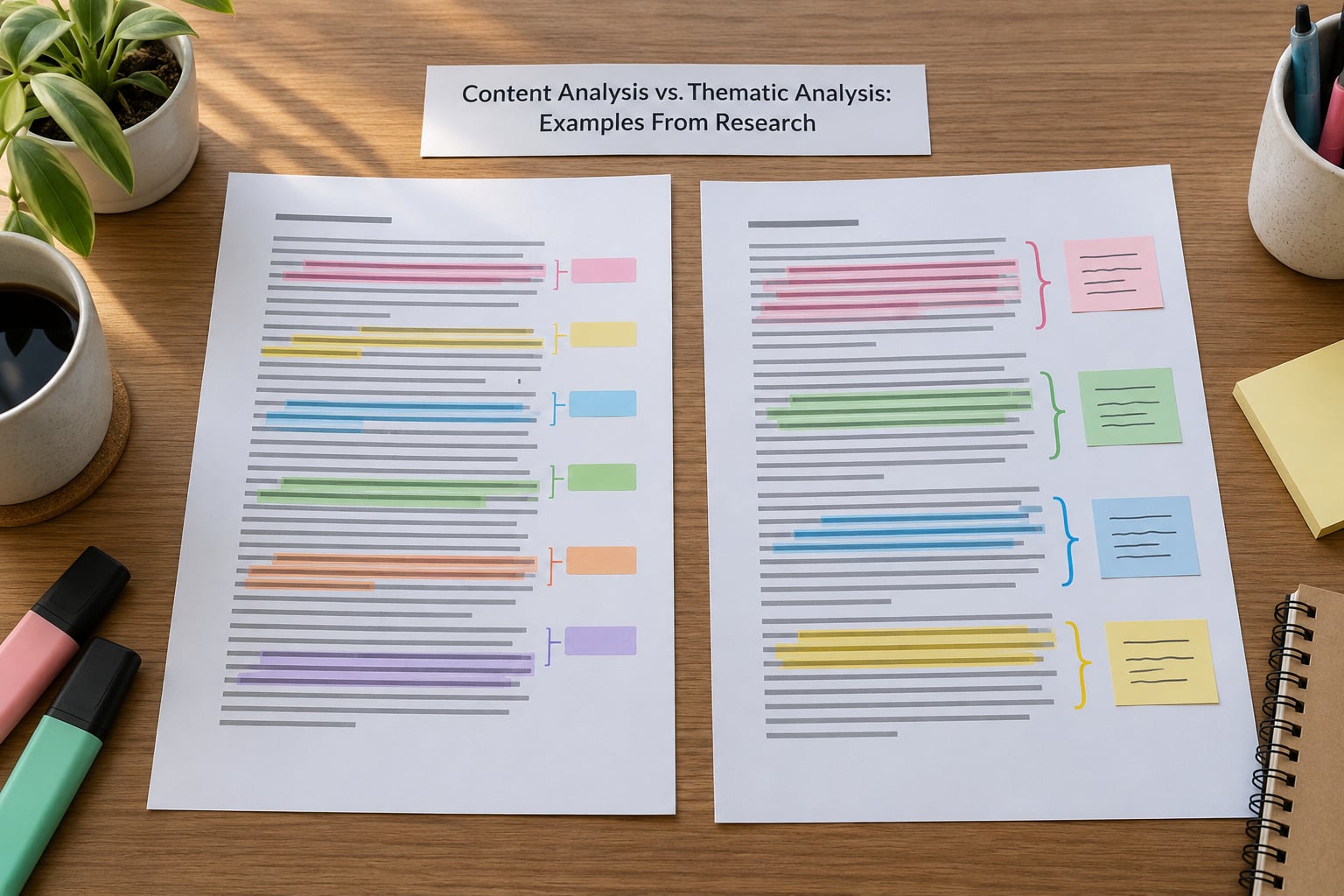
Here is the same two-line interview extract taken through each method, with the outputs shown side by side.
“Nobody told me what to watch for, so I just waited and hoped. My wife did the googling.”
Under content analysis, the unit of analysis is the clause. Using a frame built for discharge communication studies, the first clause is coded to the category “inadequate discharge information”, the second to “patient-led information seeking”, and the third to “informal support substituted for professional input”. A codebook entry would read: includes spoken or written discharge guidance absent or too vague to act on; excludes situations where guidance was given and the participant did not follow it.
Run across 40 interviews, that yields something like: inadequate discharge information 31 of 40, patient-led information seeking 22 of 40, informal substitution 19 of 40. The result can be cross-tabulated against readmission rates and handed to a colleague who never sees your interviews.
Under thematic analysis, the coding starts open. Initial codes might be held back, searching, borrowed authority, and doing the work of a clinician at home. These collate into a theme, tentatively named “discharge as a handover to self-management”, which the analyst then defines as the point at which responsibility transfers without the knowledge or capability needed to carry it. The second line is not an extra data point, it is what tells you how the theme works: the participant had the resources to self-manage, so the failure is located in the handover rather than in the person.
Both analyses are rigorous. The content analysis tells you how common a specific communication failure is and whether it tracks an outcome. The thematic analysis tells you what is actually wrong and why a well-resourced, motivated patient still ends up waiting. If your research question needs the first number, content analysis is right. If it needs the second explanation, thematic analysis is right.
Which Should You Choose?
Work backwards from the research question, not forwards from the data you happen to have.
Choose content analysis when you have predefined categories from theory or prior work, when you need to compare groups or test associations, when your corpus is too large to read closely, or when your field expects a codebook and intercoder reliability. It is the safer choice under examination because its validity claim is procedural and checkable.
Choose thematic analysis when your question is exploratory or interpretive, when you want to understand how participants make sense of an experience, when the existing framework does not yet have a category for what participants are describing, or when your field expects Braun and Clarke. It is the stronger choice for generating theory and for writing an account that practitioners recognise.
Consider both when you want breadth and depth: a deductive content analysis to establish how common each category in your framework is, followed by thematic analysis on the material the categories did not fit. Report them as two linked stages, not as one analysis with two names. This is the most defensible answer to the supervisor conflict described earlier, because it shows the method choice was driven by the research question at each stage.
Whatever you pick, write one paragraph of justification that names the tradition, the reason, and the quality strategy. Something like: thematic analysis following Braun and Clarke’s reflexive approach was selected because the research question concerns how patients interpret discharge communication rather than how often specific advice was given; analysis is inductive within a deductively framed thematic structure, supported by reflexive memos rather than intercoder reliability.
That paragraph does more work at your viva than any software choice will.
Frequently Asked Questions
Can content analysis and thematic analysis be used together?
Yes, and many studies do. A common design is deductive content analysis to measure how often categories from an existing framework appear, followed by thematic analysis on the material those categories failed to explain. Report the two as separate linked stages with their own data, results and quality strategies, not as one analysis under two labels.
Is thematic analysis a type of content analysis?
Not in the way the labels are usually used. Content analysis classifies content into categories to describe a dataset, while thematic analysis identifies patterns of meaning and interprets them. The overlap is real and both involve coding, which is why the terms get confused, but they answer different questions and produce different outputs. Thematic analysis is not simply a renamed content analysis.
Can thematic analysis include code frequencies and statistics?
Technically yes, you can count codes, but that is content analysis output, and Braun and Clarke’s reflexive approach does not ask for it. Counts can mislead when codes were applied iteratively and their meaning shifted during analysis, because the same label may cover different material early and late in coding. If your research question needs frequencies and statistical comparison, use content analysis and say so.
Which method is more suitable for open-ended interview transcripts?
Both work, and the choice depends on your question. Thematic analysis suits open-ended interviews when you want to understand experience and generate theory, typically across 6 to 60 interviews. Content analysis suits them when you have a defensible category system, for example from prior work, and want to measure prevalence or compare groups. The binding constraint is your frame, not the interview format.
Can content analysis and thematic analysis be performed in SPSS, R, or Stata?
Partly. SPSS, R and Stata handle category counts, frequency tables and the statistical tests that follow them, so content analysis on structured or already-coded data fits comfortably. Thematic analysis needs to hold a live code-to-theme hierarchy, memo text and retrieval of extracts, which is what NVivo, ATLAS.ti, MAXQDA, Delve and similar packages are built for. You can code manually and analyse in R, but the thematic writing is still done by you.
Conclusion
Content analysis counts what is there; thematic analysis works out what it means. The same interview transcript can be validly analysed either way, but the outputs, the quality checks and the defending arguments are entirely different.
So write or tighten your research question before you choose. If it asks how often or which categories, you need content analysis. If it asks how, why or in what ways, you need thematic analysis. State the tradition you are following by name, keep the quality strategy that matches it, and write the justification paragraph before your supervisor asks for it in the viva.