
Most students do not write limitations because they think it will cost them marks. The opposite is closer to the truth: a vague, apologetic limitations section is one of the fastest ways to lose an examiner’s trust, while an honest one that bounds your claims shows you understand your own study well enough to defend it.
Learning how to write study limitations without weakening your thesis comes down to one habit: name the boundary, say which direction it pushes the findings, and state what you already did to hold it steady. That is the whole technique. This guide works through it with sentence-level rewrites you can copy, a set of categories so you can check you have named the right things, and guidance on length, placement, and the viva voce questions that follow from what you wrote.
If your discussion chapter is still a pile of half-finished notes, start by pulling out your research questions and your main findings before you touch this guide. The limitations only make sense once you can say in one sentence what the study claims.
Table of Contents
- 1What You Need
- 2Step-by-Step
- 3How to write study limitations without weakening your thesis
- 4Identify the type of limitation
- 5Tie each limitation to the research purpose
- 6Describe the likely effect without exaggerating it
- 7Show what you did to reduce the limitation
- 8Write a future-research recommendation
- 9Use before-and-after examples
- 10Edit for clarity, honesty, and proportion
- 11Common Mistakes
- 12Frequently Asked Questions
- 13How long should the study limitations section be?
- 14Should limitations be written in the discussion or the conclusion?
- 15What is the difference between a limitation and a delimitation?
- 16Does admitting a limitation make my thesis weaker?
- 17How specific should study limitations be?
What You Need
You need your research aims and questions, your method, your sample details, your measures, your analysis decisions, and your results — ideally the actual figures, not your memory of them. Almost every weak limitations section is weak because the writer was working from a vague recollection of the design rather than the design itself.
Gather these before drafting:
- The specific claim your study makes. Write out the one sentence you would be willing to defend in a viva. Every limitation should attach to part of that sentence.
- Your sampling approach — probabilistic, convenience, purposive, snowball — and the recruitment window you actually had.
- Your measures and instruments. For quantitative work, that means the scale, its source, and its reported reliability. For qualitative work, the interview guide and how long the interviews ran.
- Your design. Cross-sectional, longitudinal, experimental, quasi-experimental, case study, ethnography. The design alone generates a predictable list of limitations.
- Your response rate or saturation note. Whichever number your method produces, and the honest version of it rather than the flattering one.
- Any supervisor or handbook requirements on placement, heading style, or length. Check this before you write, not after.
One habit worth borrowing: open the limitations section of five or six recent papers in your own field and note how they handle it. Researchers on r/GradSchool describe this as the fastest way to calibrate what is normal for your discipline, and it takes about an hour.
Step-by-Step
How to write study limitations without weakening your thesis
Write each limitation as a bound on the claim, not a retraction of it. State what was limited, tie it to the specific aim it affects, describe the direction of the likely effect, then state what you did to reduce it — four moves, in that order, in every limitation you write.
The distinction is the whole game. A retraction reads: “Because the sample was small, these results are unreliable and should be interpreted with caution.” A bound reads: “The study recruited 84 participants from a single university, so the effect sizes reported here should be treated as estimates for that population rather than as effects that generalise to all UK undergraduates. The sample size was sufficient to detect the medium-to-large effects reported in Table 4, but effects below d = 0.5 would not have been reliably detected.”
Same fact, same honesty, opposite impression. The first version hands the examiner a reason to reject the chapter. The second shows you know exactly what your design can and cannot support — which is the thing they are testing.
Three rules follow from that. First, never write a limitation you did not actually design around; if you fixed it, it belongs in a methods note, not here. Second, keep the hedge proportionate to the design: suggests, indicates, and is associated with for non-experimental work, because those words carry your claim exactly as far as your data do. Third, one limitation, one paragraph in a dissertation, or one to two sentences in a journal article. Never stack five caveats in a single sentence.
Identify the type of limitation
Study limitations are the boundaries in a study’s design, sampling, measurement, analysis, or setting that restrict how far its findings can be generalised or applied. Every study has them. The common types are sampling, measurement, design, context, analysis, and researcher influence.
Work through your own study and sort what you have found into these six groups. The sorting itself is useful, because most weak sections are weak for a simple reason: the writer listed problems from the whole discipline rather than from their own study.
- Sampling. Who you did and did not reach, and how far they represent the population you claim.
- Measurement. How well the instrument or interview guide captured the construct, including anything self-reported.
- Design. What the design structurally cannot show — cross-sectional data cannot establish order, a single case cannot establish prevalence.
- Setting and context. The site, the country, the time window, the online forum, the single classroom.
- Analysis. The modelling and assumption choices that narrow your answer.
- Researcher influence. Your own decisions in coding, interviewing, or interpretation — most relevant in qualitative work, and expected to be addressed there.
| Type of limitation | What it actually constrains | The mitigation worth stating |
|---|---|---|
| Sampling | External validity — whether results extend beyond the sampled group | Response rate, comparison to the population frame, sensitivity analysis on non-responders |
| Measurement | Construct validity — whether the measure captured the idea | Reliability coefficients, pilot testing, triangulation against a second source |
| Design | Causal and temporal claims | The analytic choice you made that is conservative given the design |
| Setting and context | Generalisability beyond the site or period | Description of the recruitment window and site characteristics |
| Analysis | The precision and scope of the estimate | Robustness checks, alternative specifications, assumption diagnostics |
| Researcher influence | Credibility in qualitative work | Reflexivity statement, member checking, saturation rationale |
Two things are not limitations. A general problem everyone in your field faces — the difficulty of measuring attitudes, the lack of a gold-standard instrument — is context, and it belongs in a sentence of framing, not in your list. And a limitation you chose deliberately is a scope decision: say it as a scope decision. “I did not have enough time” reads as an excuse. “Recruitment was restricted to one site to allow intensive, repeated interviews with a stable participant group” reads as a design decision with a reason attached.
Tie each limitation to the research purpose
Every limitation should connect to a specific objective, research question, or hypothesis. A limitation that touches nothing in your study’s aims is a general complaint about research, not a limitation of your study.
Do this by writing the pair together in one sentence: “Because of [limitation], the evidence for [specific research question] should be read as [what it can support] rather than [what it cannot support].” That structure keeps the limitation attached to something you actually set out to do, and it makes the boundary legible to an examiner scanning your aims list against your discussion.
It also settles the question students argue about most. A narrow question can be answered fully by a study that cannot answer a broad one. If your question was about how first-year students in one UK institution used the library app, a single-site sample does not weaken your thesis at all — it matches your question.
Describe the likely effect without exaggerating it
Say which way the limitation pushes the findings and roughly how far, using language proportionate to the design. Over-hedging is as damaging as over-claiming: a section full of “may”, “possibly”, “could potentially” reads as a writer who has lost confidence in their own data.
Useful directional statements, calibrated to what your design supports:
- “This reduces statistical power for small effects, so null results in this analysis should be read as inconclusive rather than as evidence of no relationship.”
- “Self-reported data are susceptible to social desirability bias, which most likely inflates reports of the socially approved behaviour.”
- “The cross-sectional design prevents any inference about the direction of the association between the two variables.”
- “Member checking with six of the twenty-three participants supported the analyst’s coding, but disagreement was concentrated in two interviews and is discussed rather than resolved.”
Be concrete where you can and vague only where you must. “Fewer than 40% of invited students responded” tells an examiner more than “the response rate was low”. Naming a figure, a site, an instrument, or a window is what separates rigour from evasion.
Show what you did to reduce the limitation
Every limitation should be followed by what you already did about it. This is the part students skip, and it is the part that changes the section from an apology into evidence of rigour.
Common mitigations by design:
- Quantitative: random or stratified sampling where possible, reporting a power analysis or a minimum detectable effect, reliability coefficients, robustness checks with alternative model specifications, sensitivity analysis for missing data.
- Qualitative: saturation as the stopping rule, member checking, reflexive journaling, independent coding by a second analyst, a clear audit trail, thick description of setting.
- Mixed methods: convergence between the strands as a check on a single method’s blind spots.
If the mitigation genuinely does not exist — and it sometimes does not — do not invent one. Write the gap honestly and move it straight to the future-research sentence. Examiners spot invented safeguards quickly, and an honest gap costs far less than a fake fix.
Write a future-research recommendation
Turn each limitation into a constructive next step, one to three directions in total. Ten directions reads as a proposal you never wrote; two reads as a researcher who knows what they would do next.
The form is simple: “Future work could address this by [specific design change] — for example, [a replication with a multi-site sample], or [a longitudinal design that establishes ordering].” Name the actual remedy, tied to the actual limitation.
Keep the tense and the scope right. A recommendation for future research is not an admission that your study should have done it differently. “A longer, multi-site study would test whether the effect holds beyond this institution” respects what you did. “This study should have used a larger sample” invites the question of why it did not.
One limitation you were told to write in rather than fix — a supervisor directing you to list a method you had no choice about — fits the same pattern. Describe it precisely, state its effect, skip the mitigation clause, and route it to future research with a reason.
Use before-and-after examples
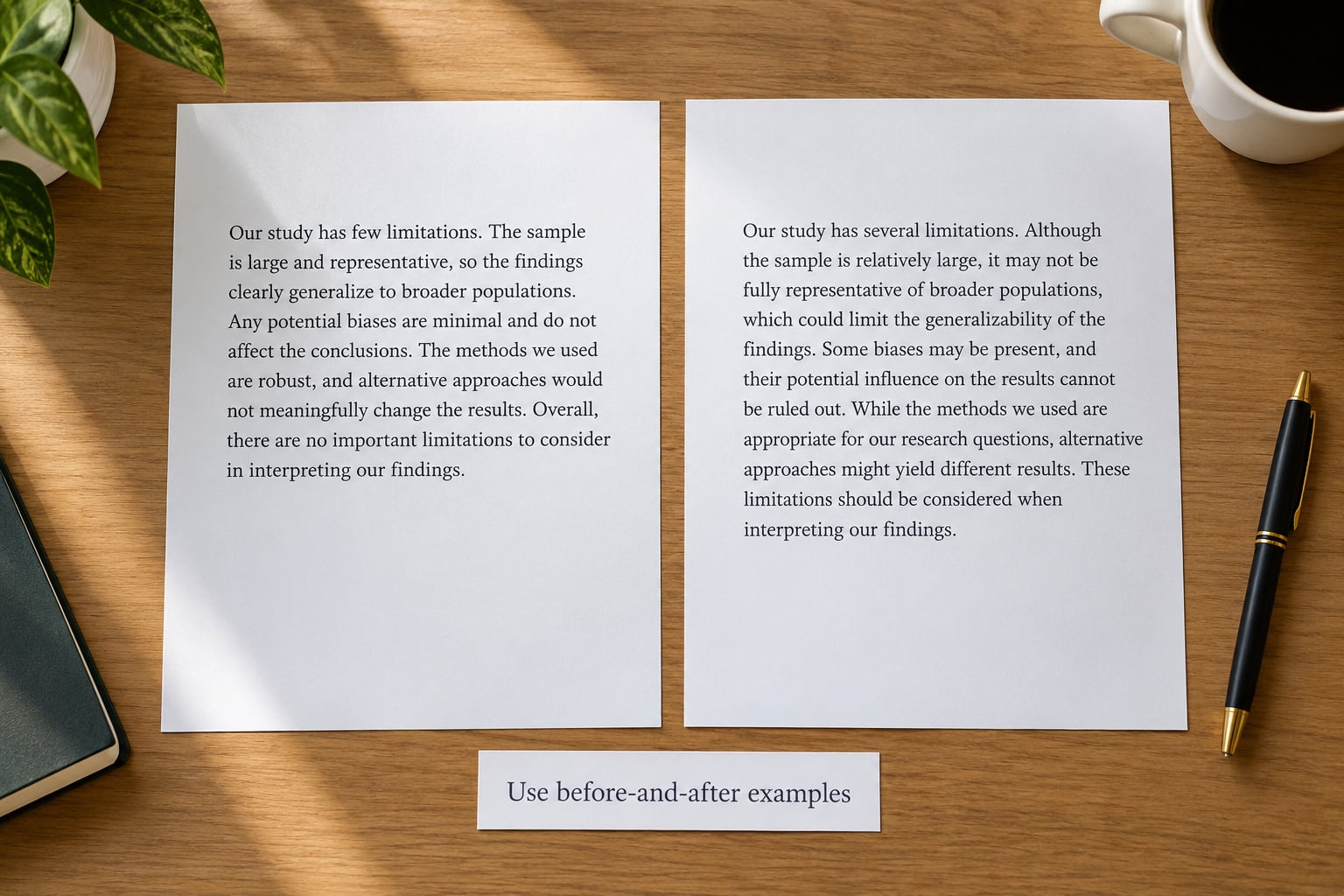
The fastest way to see the difference is to put the two versions next to each other. Read the weak column first and notice how each one volunteers a reason to distrust the study.
| Weak wording | Revised wording | Why the revision is stronger | |
|---|---|---|---|
| “The sample size was relatively small and results should be interpreted with caution.” | “With 84 participants the design was powered to detect effects of d = 0.5 or larger; smaller effects would not have been reliably detected, so null results here are inconclusive.” | Gives the number, names the threshold, and defines what a null means. The reader can now interpret the result themselves. | |
| “Participants may not have answered honestly because of social desirability bias.” | “Attitudes were self-reported, so responses are open to social desirability bias. Correlational checks with a single-item behavioural measure were consistent with, though not independent of, the self-report pattern.” | Concedes the bias, then shows you tested it rather than hoping it was not there. | |
| “Due to time constraints, only two schools were included.” | “Recruitment covered two secondary schools within one district. Findings describe those two sites and are not evidence about other districts, where intake and funding structures differ.” | Recasts an excuse as a defined scope with a stated boundary. The reader knows exactly where the claim stops. | |
| “The qualitative data may be subjective and lack reliability.” | “Coding decisions were made by one analyst, which limits independence. Two independent analysts coded 30% of the transcripts, with 84% agreement, and disagreements were resolved by discussion and are described in Appendix C.” | Replaces an abstract worry with a concrete procedure. Reflexivity is expected in qualitative work; here it is answered. |
Notice what never changes: the facts. The sample was small in both columns. The number of schools was two in both columns. What changes is whether the reader ends up trusting the chapter.
For a worked paragraph you can adapt, a cross-sectional single-site survey typically runs like this: “This study examined whether weekly study-group attendance predicts first-year attainment at one UK university. Three features of the design bound that claim. Recruitment ran through a single departmental mailing list over four weeks, so the 312 respondents represent students who were reachable and willing to participate rather than the full first-year cohort. Attendance was self-recorded, which is likely to over-report attendance. Finally, the cross-sectional design cannot establish whether attendance raises attainment or whether students who expect to do well attend more often. A minimum of 240 responses was set in advance; 312 were received, and the design detects effects of d = 0.23 or greater. Attrition was addressed by comparing responders with the departmental register on three characteristics and by refitting the main model under multiple imputation.”
Edit for clarity, honesty, and proportion
Before you submit, run the section against this checklist. It is designed to catch the sentences that quietly give your thesis away.
- Is it specific? Replace “the study was limited” with the actual sample size, site, instrument, or window.
- Is the effect stated? Every limitation says which direction it pushes and how far.
- Is there a mitigation? Every limitation has what you did, or an explicit statement that there was none.
- Does it match the results? Check that every figure you quote in limitations matches your tables.
- Is the hedging proportionate? “Suggests” and “is associated with” for non-experimental work; “leads to”, “increases”, “causes” only where the design supports them.
- Is it paired? Future research addresses the limitation above it, not a separate list of unrelated ideas.
- Is it proportioned? One limitation, one paragraph in a dissertation; one to two sentences in a journal article. Four to six substantive limitations is normal; fifteen is a confession.
Read it aloud. Sentences that sound apologetic when spoken usually are. “Unfortunately the sample was small” becomes “the sample was 84 participants, recruited at one site” — and it suddenly reads as a fact.
Common Mistakes
Most of these damage a thesis more than the limitation ever would. Each has a direct fix.
Apologising. “Unfortunately,” “sadly,” and “we were unable to” put the examiner in the position of consoling you. Write the fact and drop the emotion.
Vague confessions. “The research has certain limitations” tells a reader nothing they could not assume. Name them, or cut the sentence.
Listing without analysing. Six bullets with no effect stated reads like a list of excuses. Each one needs a direction of impact and a mitigation.
Blaming participants. “Participants did not take the survey seriously” is a conclusion you cannot support. Write instead that self-reported data are open to social desirability bias, and note whether you tested it.
Treating limitations as conclusions. Do not use the section to report results, argue your theory, or restate your findings. Interpretation belongs in the discussion, boundaries belong here.
Over-hedging into meaninglessness. If every sentence says “may” and “could possibly”, the reader cannot tell what you actually found. Hedge at the level your design supports and stop there.
Writing a second methodology chapter. If a limitation could have been fixed with a paragraph about a better instrument, fix the instrument or leave it out. This section is for boundaries you could not remove.
Making it long. A limitations section longer than the discussion it sits in has inverted the chapter. If you cannot keep it proportionate, you are probably including problems you already solved.
Padding it out for the viva. Examiners scan this section as a maturity test, and they will find the filler. Three well-argued limitations beat ten padded ones, and the viva questions will come from the ones you wrote carefully anyway.
Frequently Asked Questions
How long should the study limitations section be?
About one paragraph per substantive limitation in a dissertation, or one to two sentences in a journal article. Four to six limitations is a normal range. Length is the wrong measure anyway — what matters is whether each one names the boundary, its effect, and your mitigation. If a limitation takes three sentences to explain its effect, it needed three sentences.
Should limitations be written in the discussion or the conclusion?
In the discussion, always. Limitations interpret your results, and interpretation belongs in the chapter where results are discussed. The conclusion should be a short, bounded statement of what the study showed and what it can claim, drawing on the limitations without relisting them. Some disciplines use a combined discussion and conclusion chapter, but the ordering inside it stays the same.
What is the difference between a limitation and a delimitation?
A delimitation is a boundary you chose in advance and would defend as a design decision, such as studying one institution because it suited your question. A limitation is a constraint you did not choose, such as a response rate lower than you hoped or a measure that turned out to be imperfect. Delimitations explain scope. Limitations constrain claims. Mixing them up is why students write things like ‘we only studied one site’ as though it were an error.
Does admitting a limitation make my thesis weaker?
No, if you admit it accurately and proportionately. Acknowledging limitations strengthens credibility rather than weakening the thesis, because it shows you can assess your own evidence. What damages a thesis is vague, apologetic phrasing that hands the examiner a reason to reject the chapter. A specific limitation with its effect and mitigation stated makes every other claim in the thesis more believable, not less.
How specific should study limitations be?
Specific enough that a reader could check it. Give the number, the site, the instrument, the response rate, the recruitment window — not ‘the sample was small’ but ‘the sample was 84 participants from one university’. Specificity reads as rigour. Vagueness reads as evasion, and an examiner who cannot tell what a limitation actually is cannot judge whether it matters.
Start with the sentence your thesis is actually claiming, then write three limitations that bound it: what you sampled, how you measured, and what your design could not show. Give each one a number, a direction of effect, and a mitigation, and stop there. That is how to write study limitations without weakening your thesis — the boundaries make the findings credible, and the credibility is the thing examiners are marking.