To write interview questions for a qualitative study, start from your main research question, split it into three to five themes, and draft one or two neutral open-ended questions per theme. Sequence them from broad experiences to focused reflections, add probe prompts under each, then pilot the whole guide before fieldwork.
Most guides get a full afternoon of drafting wrong, then run twenty interviews on top of it. The fix is usually cheap: neutral wording, one idea per question, and a plan for what to say when a participant answers with a single word.
Questions are the instrument in a qualitative study. If they lean, double up, or ask for dates and figures, the data you collect will be biased or thin, and a thematic analysis will have nothing solid to bite into. Everything below is written for students and early-career researchers working with semi-structured interviews, though the same principles hold for fully unstructured ones.
Table of Contents
- 1What You Need
- 2Step-by-Step: How to Write Interview Questions for a Qualitative Study
- 3Step 1: Define the Research Topic and Main Research Question
- 4Step 2: Select the Main Interview Themes
- 5Step 3: Write Open-Ended Questions
- 6Step 4: Add Neutral Follow-Up Questions
- 7Step 5: Create a Logical Interview Flow
- 8Step 6: Pilot and Refine Your Qualitative Interview Questions
- 9Common Mistakes and How to Fix Them
- 10Tips for Conducting a Useful Qualitative Interview
- 11Frequently Asked Questions
- 12What is a semi-structured interview?
- 13How many questions should a qualitative interview have?
- 14What makes a good qualitative interview question?
- 15How do I stop writing leading questions?
- 16What are probe questions in qualitative research?
- 17What is the 30-60-90 question in an interview?
- 18Conclusion
What You Need
Before you draft a single question, six things need to be settled. Skipping any of them is why guides end up padded, repetitive, or pointed at the wrong topic.
- A final research question and a short list of objectives. One main question is enough. Objectives tell you what the interview must actually cover.
- A short participant profile. Age range, role, and how much experience they have with the thing you are studying, because that shapes what they can answer.
- A decision on interview type. Structured, semi-structured, or unstructured. Semi-structured is the usual default for qualitative fieldwork.
- An interview guide skeleton. Sections with headings, not a numbered list yet, so you can see the shape of the session.
- A consent and recording plan. Consent script, recording device or platform, and how you will handle anyone who declines recording.
- A note-taking or transcription method. Decide whether you rely on audio, hand notes, or both. Questions get shorter and more probing when you know you are not writing everything down.
Have your ethics paperwork to hand too, and check your institution’s current guidance, since the details of what counts as adequate consent change from year to year.
Step-by-Step: How to Write Interview Questions for a Qualitative Study
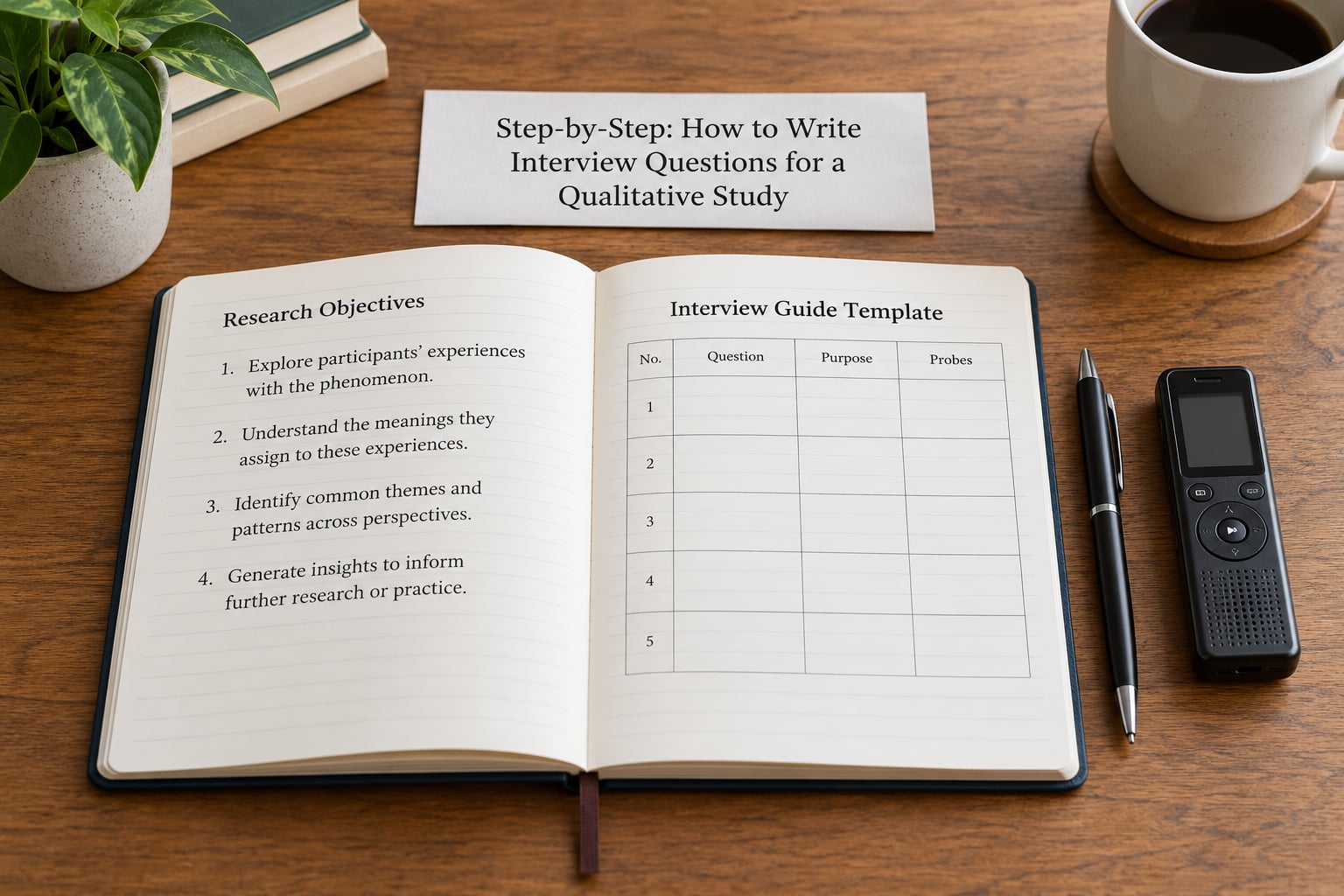
The process below takes a couple of hours for a dissertation chapter and about twenty minutes for a small user research study. The order matters: each step feeds the next, so resist the urge to jump straight to writing questions.
Step 1: Define the Research Topic and Main Research Question
Write your main research question in one sentence and make sure it can only be answered by talking to people. If your question is about frequency or change over time, that is quantitative work and interviews are the wrong tool.
Qualitative questions usually contain words like experience, perception, motivation, meaning, or strategy. A workable main question looks like this: How do newly qualified nurses experience their first year on an acute ward?
Underneath it, add two or three subquestions that narrow the scope, such as how they handled their first clinical error, or which support they reached for and why. These subquestions become your themes in the next step.
A useful test: read the question aloud and ask whether a participant could give you a five-minute answer about it. If not, it is too broad for a single interview.
Step 2: Select the Main Interview Themes
Themes are the topic areas your interview guide covers. Three to five is the working range for most studies, and each theme should trace back to a subquestion or objective.
For the nursing example the themes are: early experiences on the ward, handling mistakes and uncertainty, support and mentorship, and reasons for staying or considering leaving.
Five themes is usually the ceiling for a 60-minute session. Six or more means you will rush every one of them, and rushing produces notes rather than data.
Step 3: Write Open-Ended Questions
An open-ended question asks for a description, an example, a process, an opinion, or a feeling. A closed question asks for agreement or a fact and gives you little to analyse.
Weak: Was your first week stressful?
Better: Can you walk me through your first week on the ward?
Weak: Did you feel supported by your mentor?
Better: How did your mentor support you, or not, during that first month?
Michael Quinn Patton’s framework of six question types is the most useful reference set I know, because it stops you from writing ten variations of the same prompt. Use the table below as a drafting menu and aim to mix types across your themes.
| Question type | What it draws out | Example wording (nursing example) |
|---|---|---|
| Behaviour and experience | Past actions and events | Tell me about a time a colleague challenged your clinical judgement. |
| Opinion and values | Beliefs and priorities | What does a good first year on a ward look like to you? |
| Feeling | Emotional response | How did that feel at the time? |
| Knowledge | What the participant knows | What did you know about the ward routine before your first shift? |
| Sensory | Sensory and spatial detail | Describe the handover on a busy night as best you can. |
| Demographic and background | Role, tenure, context | How long have you worked on acute wards? |
Write behavioural questions about the past rather than the future. Ask what someone did last month, not what they would do next year, because stated intentions rarely match behaviour and you will analyse the gap instead of the experience.
Keep each question to one idea. A question with two parts forces the participant to choose which half to answer, and you will usually get the easier half.
Weak: How did the induction feel and did it give you enough confidence to manage your own patients?
Better: How did the induction feel? and, as a separate item, What gave you confidence to manage your own patients?
Step 4: Add Neutral Follow-Up Questions
Probe questions are the follow-ups you ask when an answer is thin. Write two or three per main question and put them in your guide as prompts in brackets so you can glance at them mid-conversation.
- Can you say more about that?
- What happened next?
- Can you give me an example of that?
- What was happening around you at the time?
- What did you think was going to happen?
Two or three seconds of silence after an answer often pulls out more than a question does. Count to three in your head before jumping in.
Stay neutral when you probe. Never react with surprise or approval, and never say that is interesting in a way that rewards one answer over another.
Avoid why-questions where you can. Why did you do that? sounds like an accusation, and people either justify themselves or give you a one-line answer. Ask what happened, or what made that seem like the right move at the time.
When a participant gives you one word, do not move on. Offer three routes: ask for an example, ask about the moment itself, or offer a quiet beat and see if they continue. About three in ten people go quiet after a one-word answer and start talking properly once you wait.
Step 5: Create a Logical Interview Flow
Order matters as much as wording. The usual structure is introductory and contextual questions, then main topic questions, then closing questions.
Open with something easy that establishes context: their role, how long they have been doing it, and a broad question such as Tell me about a typical week. Broad-to-specific sequencing, often called the funnel technique, keeps participants from feeling cornered early and stops you from priming them before they have described things in their own words.
The inverted funnel does the reverse, starting specific then opening out. It works well with experienced participants who already share your vocabulary, and it works badly with novices, who need the broad story before they can answer anything detailed.
Anchor each new question to something the participant just said. If they mentioned a difficult shift, ask about that shift rather than jumping to the next theme on your list.
Time is the constraint most people underestimate. A 30-minute interview comfortably fits five main questions, 45 minutes fits about eight, and a 60-minute session runs to ten or eleven. Divide by two and you get the real number, because every main question plus its probes eats roughly twice its reading time.
Put your best questions in the middle. People are guarded in the first five minutes and tired by the last, and the core of your data comes from the middle third.
Close with two questions that let them add anything you missed, plus what they would tell someone starting the same job tomorrow. That last question often surfaces material no planned question reached.
Step 6: Pilot and Refine Your Qualitative Interview Questions
Pilot with two or three people who fit your participant profile but are not in your final sample. Twenty minutes each is enough to find most problems.
Cognitive interviewing is the cheapest version of this: ask someone to paraphrase a question back to you in their own words. If their version differs from yours, the wording is the problem, not their comprehension.
What to check in the pilot:
- Did any question confuse them or need reading twice?
- Where did they give you one word?
- Which themes never came up?
- Did you run out of time before the closing questions?
- Did you ask the same thing twice because the guide was unclear?
Then revise: cut anything nobody answered, split double-barreled questions in two, replace jargon, and move a theme that nobody raised into your follow-up interviews rather than the main guide. The guide is a hypothesis about what matters, and the pilot is the first test of it.
A worked example of the whole chain. Research question: how newly qualified nurses experience their first year on an acute ward. Themes: early experiences, mistakes and uncertainty, support, staying or leaving. A ten-question guide drawn from those four themes looks like this.
| # | Question | Type | Probes in brackets |
|---|---|---|---|
| 1 | How long have you worked on acute wards, and what brought you to this ward? | Background | [Career path so far] |
| 2 | Tell me about your first week here. | Experience | [First shift, who helped, what surprised you] |
| 3 | Describe a handover on a busy night as best you can remember. | Sensory | [Who speaks, what the noise is like, where you stand] |
| 4 | Tell me about a time a colleague challenged your judgement. What did you do? | Behaviour | [Your reaction, what happened afterwards] |
| 5 | You mentioned feeling unsure earlier. How did that feel at the time? | Feeling | [Where you were, who was around] |
| 6 | What support did you get, and how did it reach you? | Experience | [Named people, informal support, things not offered] |
| 7 | What does a good first year on a ward look like to you? | Opinion | [What is missing from that picture] |
| 8 | What did you think you would do differently before starting? | Opinion | [Expectation against reality] |
| 9 | When have you considered leaving, and what kept you? | Behaviour | [Timing, triggers, what tipped it] |
| 10 | If you could change one thing about your first month, what would it be? | Opinion | [Anything we missed] |
Every question in that guide is open-ended, sits under a theme, carries probes, and can be coded later. Question 3 gives you a sensory description; question 9 gives you a reason and a trigger. That is what makes the interview usable in thematic analysis rather than merely memorable.
Design for the analysis you will run. If you plan thematic analysis, each question should point at a code you could plausibly name. If you are running grounded theory and want the theory to emerge from the data, keep themes looser and leave room for sessions to go somewhere you did not plan.
Common Mistakes and How to Fix Them
Every one of these mistakes is easy to make and hard to spot in your own draft, because the wording still looks like a research question. Reading each one aloud catches most of them.
| The mistake | Why it damages the data | The fix |
|---|---|---|
| Leading questions | Signals the answer you expect and both parties know it | Strip evaluative words and assume nothing: not Would you agree that handover is unsafe? but How safe does handover feel to you? |
| Double-barreled questions | Forces a choice between two topics, so one gets dropped | Split into two questions and ask both |
| Why-questions | Sound accusatory and invite justification | Replace with What happened? or What made that the sensible option? |
| Overly broad questions | Gives a vague summary instead of an account | Anchor it: add a time period, a place or a specific incident |
| Asking for facts and dates | Produces survey-like data you already could have collected on a form | Ask for the experience around the fact, not the fact alone |
| Repeated questions | Makes the guide feel padded and tires the participant | Merge duplicates and let one question carry the theme |
| Jargon or long wording | Participants paraphrase in their own words, which may not mean what you meant | Use one idea, short sentences, plain vocabulary |
| Too many questions | You end up racing through shallow answers | Half your written questions for the time you have |
One self-check catches most leading questions. Read the question and ask whether a participant could sensibly give the opposite answer and still feel comfortable doing so. If not, it is leaning.
A second check catches double-barreled questions. Count the question marks in your guide. If a single item carries two, split it.
Tips for Conducting a Useful Qualitative Interview
The quality of the conversation decides the quality of the data more than the guide does. A few habits carry most of the weight.
Read the consent and recording request calmly and briefly. Wording that sounds like a legal warning puts people off, and researchers on research forums describe losing participants in the first five minutes over an over-formal briefing. Say what you will record, how long it will be kept, who can hear it, and that they can skip any question or stop at any point.
Give real thinking time. Most people need a few seconds to retrieve an experience, and filling the gap yourself produces your words in their mouth.
Use your probes consistently across participants. Asking one person for an example and letting another talk on unprompted makes later comparison harder than it needs to be.
Keep interpretation out of the conversation. Do not say that sounds like burnout while a participant is still describing their week, because you will get the rest of the answer shaped by your label. Note the interpretation for later, in your field notes.
Write field notes the same day, while you still remember tone and pauses. Transcribe and annotate within a day or two of the session; the recording is data, but the pauses and hedges are only in your notes if you catch them.
Online interviews need small adjustments. Test your recording setup first, keep a backup copy running locally, and expect slightly shorter answers. Ask participants to find a private space, and set a chat window aside for questions they would rather not say on a call.
Finally, write reflexive notes as you go, noting your own reactions and assumptions. They are part of the data in qualitative work and they are what keeps your researcher bias visible instead of hidden.
Frequently Asked Questions
What is a semi-structured interview?
A semi-structured interview uses a written guide with a set order of topics and open-ended questions, but the researcher is free to follow up, rephrase, or skip questions depending on what the participant says. It sits between a fully structured interview, where every question is fixed and read identically to each participant, and an unstructured conversation. Most qualitative researchers use semi-structured interviews because they keep interviews comparable across participants while still letting unexpected but relevant threads be pursued.
How many questions should a qualitative interview have?
About five main questions for a 30-minute interview, eight for 45 minutes, and ten or eleven for 60 minutes. The calculation is simple: divide the time by two, because each question plus its probes takes roughly twice its reading time. Interview guides usually list more questions than you will actually ask, which is fine. Probes and follow-ups live in brackets under the main question rather than as separate numbered items.
What makes a good qualitative interview question?
A good qualitative interview question is open-ended, neutral, and focused on a single idea. It asks for a description, an example, an opinion, or a feeling rather than a yes or no answer. It contains no evaluative words that hint at an expected response, and it can be linked back to one of your research objectives. If a participant could give the opposite answer and still feel comfortable, the question is doing its job.
How do I stop writing leading questions?
Read each question aloud and ask whether it hints at the answer you expect, either through wording like obviously, better, or best, or through a loaded framing such as how difficult was it. Rewrite it so that both positive and negative answers are comfortable to give. The quick test: could a participant answer the opposite way without worrying about how you would react? If not, the question leans and needs another pass.
What are probe questions in qualitative research?
Probes are short follow-up prompts used to get more detail without steering the conversation, such as can you say more about that, what happened next, or can you give me an example. Researchers write two or three per main question and print them in brackets beneath it in the interview guide. They matter most when a participant gives a one-word answer, where a patient probe or a few seconds of silence does more than moving on.
What is the 30-60-90 question in an interview?
The 30-60-90 question belongs to job interviews, not research: it asks a candidate what they will achieve in their first 30 days, 60 days, and 90 days on the job. It appears in search results for this topic because people search interview questions without specifying the context. In a qualitative study the equivalent move is to ask about past behaviour, such as what happened during your first month, rather than about future intentions.
Conclusion
Writing interview questions for a qualitative study comes down to discipline rather than cleverness. One main research question, three to five themes, one neutral open-ended question per theme, probes written underneath, an order that moves from broad to specific, and a pilot before a single real participant sits down.
Start with the smallest version: write your main question, pick three themes, and draft one open-ended question for each. Read them aloud and check whether anyone could answer the other way without feeling awkward. Everything else, the sequencing, the timing, the refinement, follows from that first clean draft.