
How to write a conclusion chapter for a dissertation comes down to one move: you synthesise. You have already reported your findings, so the conclusion chapter is not where you list results again. It is where you answer your research questions, state what the answers mean for the field, admit what your design cannot claim, and close with a statement of significance. Budget two drafts, and expect the second one to be mostly cutting.
Students on r/AskAcademiaUK describe the same stuck point: they have summarised every chapter and their findings, and now nothing is left to write. That summary is the discussion chapter’s job, whether yours is called that or folded into your findings. Once you have separated the two, the conclusion chapter becomes straightforward.
Table of Contents
- 1What You Need Before You Draft
- 2Conclusion chapter vs discussion chapter
- 3How to Write a Conclusion Chapter for a Dissertation: Step by Step
- 4How to Write a Conclusion Chapter Opening
- 5Answer the Research Questions
- 6Summarize the Main Findings Without Repeating Results
- 7Explain the Dissertation’s Contribution
- 8Discuss the Implications
- 9Address Limitations and Recommendations
- 10Write a Strong Final Section
- 11Common Mistakes and How to Fix Them
- 12Proofread and Format the Conclusion
- 13How Long Should the Conclusion Chapter Be?
- 14Frequently Asked Questions
- 15How long should a dissertation conclusion chapter be?
- 16Should the conclusion include new results or recommendations?
- 17Can a dissertation conclusion use phrases such as I found or we identified?
- 18How should I answer multiple research questions in the conclusion?
- 19Should the conclusion repeat the discussion chapter?
- 20What is the difference between implications and recommendations in a conclusion?
- 21Conclusion: Begin With Your Main Finding
What You Need Before You Draft
Gather these before you open a blank document, because the conclusion chapter pulls from all of them and from nowhere else:
- Your research problem and the exact research questions or hypotheses
- Your findings chapter, with the headline result for each question marked
- Your discussion chapter, where you already interpreted each finding against the literature
- Your abstract and introduction, so the promise made at the start can be closed
- Your limitations notes, kept as you wrote, not reconstructed in a panic later
- Your institution’s chapter template, word limits and submission checklist
- A reference list you trust, so any claim you touch on the way back through is findable
That last item matters more than people expect. Half of a conclusion is written by walking backwards from findings to questions to contribution, and every step back lands on a source you need to cite properly.
Conclusion chapter vs discussion chapter
Which comes first, the discussion or the conclusion? The discussion comes first, always. If your department merges them into one chapter, the discussion material still comes first inside it and the conclusion still closes the chapter. Here is the split:
| Dimension | Discussion chapter | Conclusion chapter |
|---|---|---|
| Core job | Interpret each finding against existing literature | Synthesise everything into an answer and a position |
| Organised by | One subsection per finding or research question | One argument that runs across all of them |
| Voice | Exploratory, hedged, weighs alternatives | Decisive, bounded, forward-looking |
| Evidence | Full reporting and comparison with prior studies | Reference to headline results only, no new data |
| Typical length | Longest chapter, often a quarter of the thesis | Short, roughly 5 to 10 percent of the word count |
| Answers | What do these results mean? | What did we find, and so what? |
If your institution uses a merged Discussion and Conclusion chapter, keep the two halves clearly labelled inside it so an examiner can see where interpretation stops and synthesis starts.
How to Write a Conclusion Chapter for a Dissertation: Step by Step
How to Write a Conclusion Chapter Opening
The opening does three jobs in three sentences: what the study set out to do, how it did it, and what it found. Stop there. Do not re-run the abstract, and do not introduce a source or a finding that has not already appeared.
Weak: In this dissertation I have looked at remote working and how it affects staff. This chapter will summarise the research and discuss the findings in detail along with recommendations for organisations.
Strong: This study examined how remote working arrangements affect job satisfaction among UK civil service staff aged 25 to 44, combining a survey of 412 respondents with 18 semi-structured interviews. Higher autonomy predicted higher satisfaction, while isolation from informal networks predicted lower satisfaction, and the two effects held independently.
The second version works because a reader could draw a small sketch of the study from it. That is the test for your own opening.
Answer the Research Questions

Take the research questions in the order you set them in the introduction and answer each one explicitly. Do not skip the ones that were awkward. If a question turned out to be unanswerable with your design, say so and explain why. Examiners read for coverage here more than for elegance.
Where two findings point the same way, connect them and state the pattern once. That connection is the first genuine contribution of the chapter, because it did not exist anywhere else in the dissertation.
Weak: RQ1 was answered. RQ2 was answered. RQ3 was also answered.
Strong: The three research questions converge on one finding: what limited remote employees is not the loss of supervision but the loss of weak ties. Autonomy predicted satisfaction at beta = 0.31, frequency of informal contact predicted it at beta = 0.24, and the interaction between the two was not significant, indicating that neither factor substitutes for the other.
Report the headline statistics only. The full tables stay where they are.
Summarize the Main Findings Without Repeating Results
Summary walks backwards through the chapters in the order you wrote them. Synthesis walks forwards through your argument. When a reader finishes your conclusion chapter, they should be able to state your main finding without rereading the results.
So prioritise ruthlessly. Name the two or three findings the study stands on, compress the rest, and leave anything that only mattered to one subsection out entirely.
Quantitative, weak: Table 4.1 shows that satisfaction was 3.8 for remote workers and 3.4 for office workers. Table 4.2 shows the regression results. Table 4.3 shows the model fit.
Quantitative, strong: Remote workers reported satisfaction only 0.4 points higher on the five-point scale, a difference that disappeared once age and tenure were controlled for. The effect that survived control was autonomy, not location.
Qualitative, strong: Across all 18 interviews, senior staff described remote work as freedom while junior staff described it as exposure. The difference tracked access to decision-making, not home working conditions, which reframes the usual assumption that the home office is the decisive factor.
Explain the Dissertation’s Contribution
Contribution is where students hedge hardest and examiners look hardest. Be specific about what is new, and keep the claim the same size as the evidence. Three types are worth distinguishing.
- Empirical contribution: new data, a new population, a new setting, or a result that contradicts an established expectation.
- Theoretical contribution: a model refined, a boundary condition added, or a mechanism made explicit. Only claim this if your data let you test the mechanism.
- Practical contribution: something a manager, policymaker or practitioner can do differently because of the finding.
A fill-in frame that keeps you honest: This study contributes to [field] by [new evidence, model or application], which matters because [specific problem it eases]. It does not claim to [the bigger thing your design cannot support].
That last clause is what separates a doctoral conclusion from an undergraduate one. Naming what you are not claiming is a strength, not a weakness.
Discuss the Implications
Implications are the meanings your findings carry beyond your sample. Sort them into three buckets and keep each within reach of your design.
- For research: what the field can now build on, and which of your findings others should try to replicate.
- For policy or practice: what changes for the people your participants actually were. A qualitative study of 18 civil servants supports implications for that department, not for every organisation.
- For future research: the gaps your limitations opened, phrased as open questions rather than as homework.
The common failure is scope creep. If your survey covered one university, do not write implications for the entire education sector. Examiners notice when a single convenience sample carries a national recommendation, and it costs you more credibility than it earns.
Address Limitations and Recommendations
Limitations read well when they follow a three-step formula: identify the limitation, explain its effect on the findings, then suggest what would fix it. That third step turns a defensive passage into a research agenda.
Weak: A limitation is the small sample size. Further research with bigger samples is needed.
Strong: Interviews were conducted in a single department during a period of restructuring, so participants may have described their working relationships more defensively than normal. Findings about informal contact therefore describe a workplace under strain, and a replication outside a period of change would test whether the effect holds. Interviewing new joiners separately from established staff would also show whether weak ties buffer or simply take time to form.
That version names the limitation, traces its impact, and hands a future researcher a method. Do the same for cross-sectional data, self-reported measures, single-country samples and short study windows.
Recommendations should grow out of the limitations and the findings, in that order. Recommendations for practice follow the practical implications. Recommendations for future research follow the limitations. If a recommendation has no traceable ancestor in your own study, cut it.
One case deserves its own paragraph: findings that did not support your hypothesis. Null results are findings. State what you expected, what you found, and what it rules out or makes newly plausible. A tested and rejected hypothesis is a stronger contribution than an untested one.
Write a Strong Final Section
Close with a single statement of significance that ties the finding to the field. No new evidence, no quotation, no motivational filler, and no summary of your own chapter.
Weak: In conclusion, this dissertation has discussed remote working and its effects. Future researchers should continue to explore this topic so that better solutions can be found. I hope this study has been useful.
Strong: The value of remote working for individuals turns less on where the work happens than on who they still talk to. Findings from 412 survey respondents and 18 interviews suggest that preserving weak ties, not enforcing presence, is the more reliable route to satisfaction in distributed teams.
Common Mistakes and How to Fix Them
- Repeating the discussion. If a paragraph would sit unchanged in your discussion chapter, cut it. Test each paragraph against one question: does it only appear here?
- Introducing new results. Anything first appearing in the conclusion was not part of your evidenced study. Move it to the findings chapter or leave it out.
- Listing every finding in order. Prioritise to the two or three that carry the argument and compress the rest into a single sentence.
- Overstating the impact. Replace “proves” with “suggests”, and scope every claim to the population and setting you actually sampled.
- Opening with a stock phrase. A paragraph beginning with “In conclusion” wastes your first line. When the chapter is called Conclusion, start with the finding.
- Vague closing statements. “Further research is needed” is not a closing thought. Name the question, the method and the population.
- Passive, impersonal prose throughout. A research voice is allowed. Use “the study found” and “the analysis showed”, not “it was found that”.
Proofread and Format the Conclusion
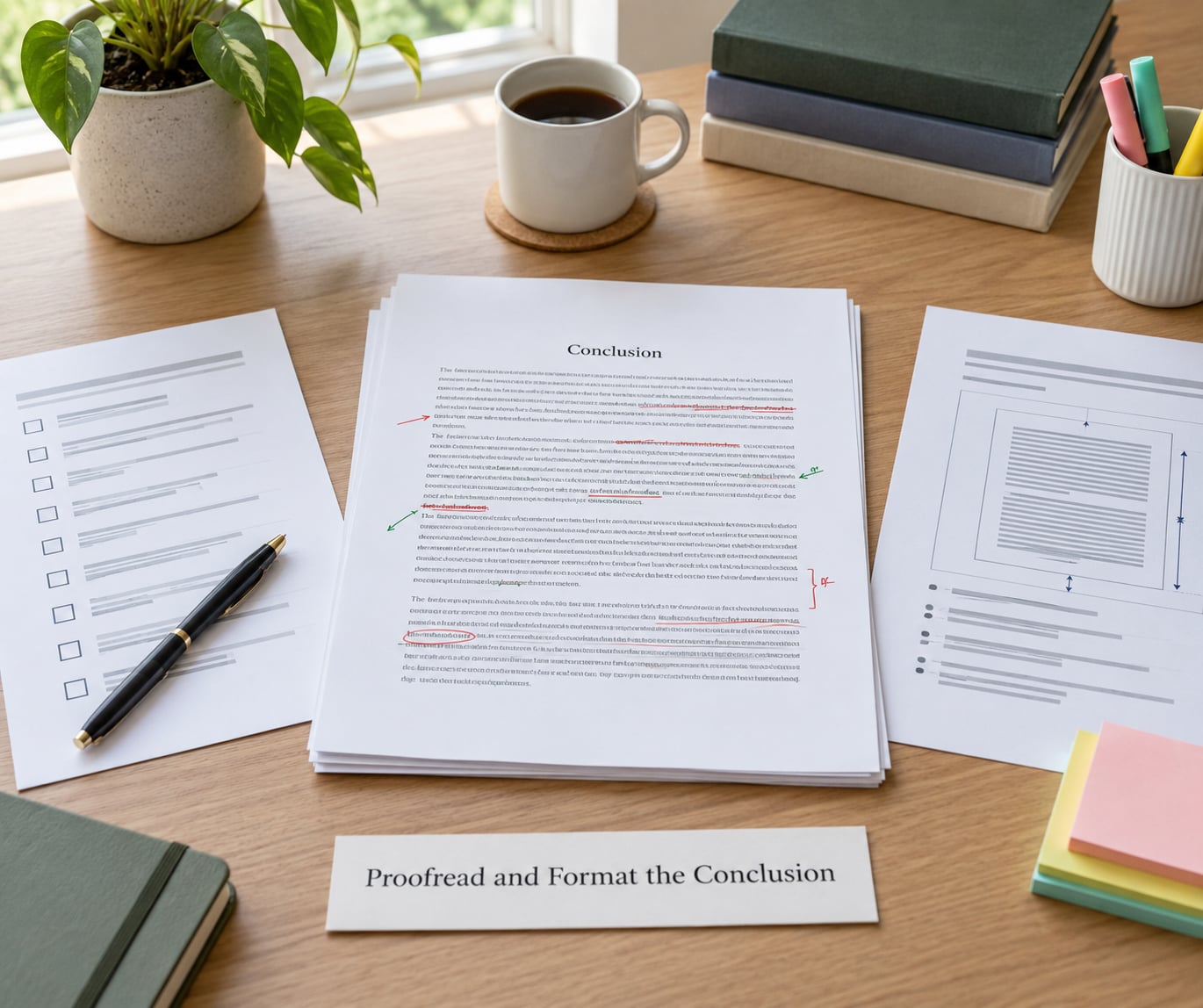
Leave a gap of at least a day between finishing the draft and proofreading it. Read the chapter aloud once, then work through the checklist below.
- Every research question is answered, in order, including the awkward ones
- No finding appears here for the first time
- Each claim is traceable to the discussion chapter, with citations intact
- Terminology matches the introduction; you have not swapped constructs halfway through
- Limitations are tied to specific findings, not listed generically
- Recommendations trace back to limitations or implications
- Implications stay inside your sampled population
- The closing line states significance without new claims
- Chapter title, heading levels and running head match your institution’s template
On APA style: the conclusion chapter is a standard section with a centred bold heading, double-spaced, with the first line of each paragraph indented. References in the conclusion still appear in the reference list, and citations inside parentheses still count toward any in-text citation limits your department sets. Check your template, since several universities cap what may be cited after the discussion.
How Long Should the Conclusion Chapter Be?
Most guidance points to 5 to 10 percent of the total word count, but the practical answer depends on your degree level. Use these as starting points and confirm against your template.
| Degree level | Typical total words | Conclusion chapter | Share |
|---|---|---|---|
| Undergraduate dissertation | 8,000 to 10,000 | 400 to 750 words | 5 to 8 percent |
| Master’s thesis | 15,000 to 20,000 | 750 to 1,200 words | 5 to 8 percent |
| Professional doctorate | 25,000 to 35,000 | 1,000 to 1,800 words | 4 to 6 percent |
| PhD dissertation | 30,000 to 80,000 | 1,500 to 3,000 words | 3 to 5 percent |
More than one institution fixes the format in pages rather than words. One undergraduate programme on r/psychologists_india requires a Chapter 7 titled Conclusion and Recommendations at three to five pages, which is longer than most of the ranges above. Your template wins wherever the two disagree.
Two more word-count questions come up constantly. A 20,000-word submission is within range for a UK master’s thesis and at the low end of a PhD, depending on your discipline’s norms; 30,000 words is comfortable for a doctoral dissertation in the sciences and social sciences. In a 10,000-word undergraduate dissertation, methodology usually takes 1,500 to 2,500 words, and the conclusion sits at the 400 to 750 band above.
Frequently Asked Questions
How long should a dissertation conclusion chapter be?
Aim for 5 to 10 percent of your total word count. That is roughly 400 to 750 words for an 8,000 to 10,000 word undergraduate dissertation, 750 to 1,200 for a 15,000 to 20,000 word master’s thesis, and 1,500 to 3,000 for a doctoral submission. Where your university specifies pages, that figure overrides every range here.
Should the conclusion include new results or recommendations?
No new results. Anything reported for the first time in the conclusion was not part of your evidenced study, and examiners treat it as an error. Recommendations are different: they belong in the conclusion, provided each one traces back to a finding or a stated limitation rather than appearing from nowhere.
Can a dissertation conclusion use phrases such as I found or we identified?
Yes, and most style guides prefer an active research voice to passive constructions like it was found that. Use the study as the subject: the study found, the analysis identified, the interviews showed. Keep hedging where your evidence is thin, and avoid first-person singular in chapters that follow a formal impersonal convention.
How should I answer multiple research questions in the conclusion?
Answer each question in the order you set them in the introduction, and give each one an explicit answer with its headline evidence attached. Where two findings converge, state the shared pattern once instead of repeating it twice. If a question proved unanswerable within your design, say so directly and explain why.
Should the conclusion repeat the discussion chapter?
No. The discussion interprets each finding against the literature; the conclusion synthesises across findings and states what they mean together. Test every paragraph by asking whether it would read identically in the discussion chapter. If it would, it is a duplicate and it should go.
What is the difference between implications and recommendations in a conclusion?
An implication is a meaning your findings carry for research, policy or practice, and it stays inside the population and setting you studied. A recommendation is an action you propose as a result, aimed at a named audience such as practitioners, policymakers or future researchers. Implications follow from findings; recommendations follow from implications and limitations.
Conclusion: Begin With Your Main Finding
Start where the argument starts, not where the chapter does. Identify the single main finding and the contribution it makes, then let everything else hang off that: answers to your research questions in order, implications scoped to your sample, limitations tied to specific findings, recommendations that trace back to them, and a closing line that states significance without adding anything new.
Write the chapter from your discussion, not from your results chapter, and check every paragraph against the duplication test. If it would read the same in two places, one of them does not need it.