If you want to know how to improve survey response rates, the answer is less mysterious than most people expect: shorten the questionnaire, write an invitation that says who you are and how long it takes, send two or three timed reminders, and offer a small guaranteed reward rather than a prize draw. Surveys rarely fail because the topic is uninteresting. They fail because they are long, vague about purpose, and followed by a week of silence.
That is the pattern I keep hearing from researchers who post about fieldwork problems. On communities like Qualtrics Community and r/SurveyExchange, the same issues come up repeatedly: a deadline in three weeks, a list of 300 people, and a 12-question form that has been live for four days with 19 replies. The good news is that most of that gap is fixable with preparation rather than technology.
This guide walks through eight steps, in the order you would actually do them, from defining your response goal to closing the field window properly. Each step includes a simple check that tells you whether it worked. It should take about an hour of setup per project plus the time your respondents spend answering, and there is nothing in here that requires paid software.
Table of Contents
- 1What You Need
- 2How to Improve Survey Response Rates Step by Step
- 3Define the audience and response goal
- 4Recruit participants before the survey field window
- 5Make the invitation clear and trustworthy
- 6Keep the survey short and easy to complete
- 7Choose the best timing and contact method
- 8Send timed reminders to nonrespondents
- 9Use incentives without creating bias
- 10Monitor responses and close the survey properly
- 11Common Mistakes
- 12Frequently Asked Questions
- 13What is considered a good survey response rate?
- 14How do I calculate a survey response rate?
- 15What are effective incentives for survey participation?
- 16How many survey reminders should I send, and when?
- 17How do I improve employee survey response rates?
- 18How many survey responses do I need for valid results?
- 19Conclusion
What You Need
Before you send a single invitation, get six things in place. Skipping any one of them tends to show up later as a response rate that will not move.
- A defined sample and contact list. The exact people you want answers from, with a working email or phone number for each one. A list of “anyone who follows our page” is not a sample.
- A realistic response goal. The number of completed surveys you need, and the date the field window closes. A deadline is what makes the reminder schedule possible.
- A survey platform. Any tool that produces a clean mobile view, exports to a spreadsheet, and lets you track which recipients have or have not responded. Free tiers are fine for student projects.
- A consent and privacy statement. Plain language about who is collecting the data, what it is used for, whether responses are anonymous, and how long the data is kept.
- An incentive budget. Even a modest one. Decide the amount and the eligibility rule before you launch, not after responses are thin.
- A tracking sheet. One row per invited person with columns for sent, reminded, completed, and reward claimed. This is the file that stops duplicate invitations and lets you count your final rate accurately.
If you are running a dissertation, an employee pulse, or a customer satisfaction check, the last two items matter most. A survey you cannot count is a survey you cannot report.
How to Improve Survey Response Rates Step by Step
These eight steps are ordered on purpose. Each one makes the next one easier, and skipping ahead to incentives or reminders before the questionnaire is ready usually wastes both.
Define the audience and response goal
You cannot improve what you have not defined, so write down the number of completed responses you actually need and the population you invited. Those two numbers give you a target response rate instead of a vague hope.
The calculation is simple. Divide completed surveys by the number of invitations delivered, then multiply by 100. If you sent 300 invitations and received 75 completions, your response rate is 25 percent. Note the word delivered: bounces, wrong addresses, and people outside your target group shrink the denominator and should be removed before you calculate.
To work backward from a sample size requirement, take the number of completions you need and divide it by your realistic expected rate. If you need 100 usable responses and you expect 25 percent, you must invite about 400 people. Students on tight deadlines often discover this the hard way when 60 responses turn up instead of 100.
Also set the number of usable responses, not just responses. A completion that is missing the two key questions is not usable data, and for descriptive work such as a satisfaction survey, the rate of usable completions is the number that matters.
How you know it worked: you can state your target completion count, your invited count, and your closing date without doing arithmetic on the spot.
Recruit participants before the survey field window
Advance contact is the cheapest way to lift participation, because it converts a cold list into people who already know the survey is coming. Two to three days of notice costs nothing and makes the first invitation feel expected rather than intrusive.
Keep the pre-notice short. One or two sentences saying what the survey is about, roughly how long it takes, and when it will arrive. If the participants come through a gatekeeper, such as a department manager, an HR contact, or a clinic receptionist, ask that person to forward the note in their own words rather than mailing the list cold.
For academic work, faculty or supervisors who endorse the study tend to lift participation more than any incentive. Researchers posting on research communities report the same thing: a study with visible institutional backing gets replies, an anonymous request from an unknown address gets ignored.
Use the pre-notice to check eligibility too, while the topic is fresh. If someone is not in your target group, find that out now instead of after 200 invitations.
How you know it worked: more than half of your intended sample has seen the survey before the first formal invitation, and the contact list is verified and current.
Make the invitation clear and trustworthy
A good invitation answers five questions in about 120 words: who you are, what the survey is about, why their answer matters, how long it takes, and what you promise about the data.
Here is the structure that works, in order:
- Identification. Your name, your department or organisation, and a real reply address. Generic sender names are the fastest route to the spam folder.
- One sentence of purpose. What the survey is about and what decisions the answers feed into. “You will receive the full summary of results” is more motivating than a research objective nobody outside your course recognises.
- Time estimate. “About four minutes” removes the biggest unknown. A stated estimate consistently outperforms a vague request.
- Data promise. Whether responses are anonymous, who sees them, and what happens next.
- One link. A single short URL, ideally with a readable description. Five tracked links in one message looks like a marketing email.
Personalise what you can cheaply. A first name and one detail tied to the person’s situation, such as their role, their course, or the ticket you just closed, gets noticeably better response than a broadcast. Keep the personalisation to the message, not the subject line trickery, and never imply a deadline that is not real.
How you know it worked: someone outside the project can read the invitation and tell you, in one sentence each, who you are, what the survey covers, how long it takes, and what happens to their answers.
Keep the survey short and easy to complete
Length is the strongest design lever you control. Completion falls steadily as questions pile up, and the drop-off is worst near the end, where respondents have already spent most of their attention budget.
Cutting from 30 questions to 12 does more for your response rate than any incentive you could afford. Go through the questionnaire and mark every question that does not directly serve an analysis you will actually run. Anything that is interesting but not necessary goes into a future survey.
Then fix the mechanics. Use plain language and avoid acronyms, internal department names, and long sentences. Explain the answer options where they are not obvious, group related questions together, and avoid matrix grids, which are hard to read on a phone. Put the most engaging questions early, since respondents who enjoy the first few are more likely to reach the end.
Test on both a desktop and a phone, and ideally on someone who did not write the questions. Two hard rules: never require a login unless access is genuinely restricted, and make the progress visible on anything longer than three minutes with a progress bar, an indicator, or a question counter. Research on longer surveys shows the bar helps; on very short surveys it is just clutter.
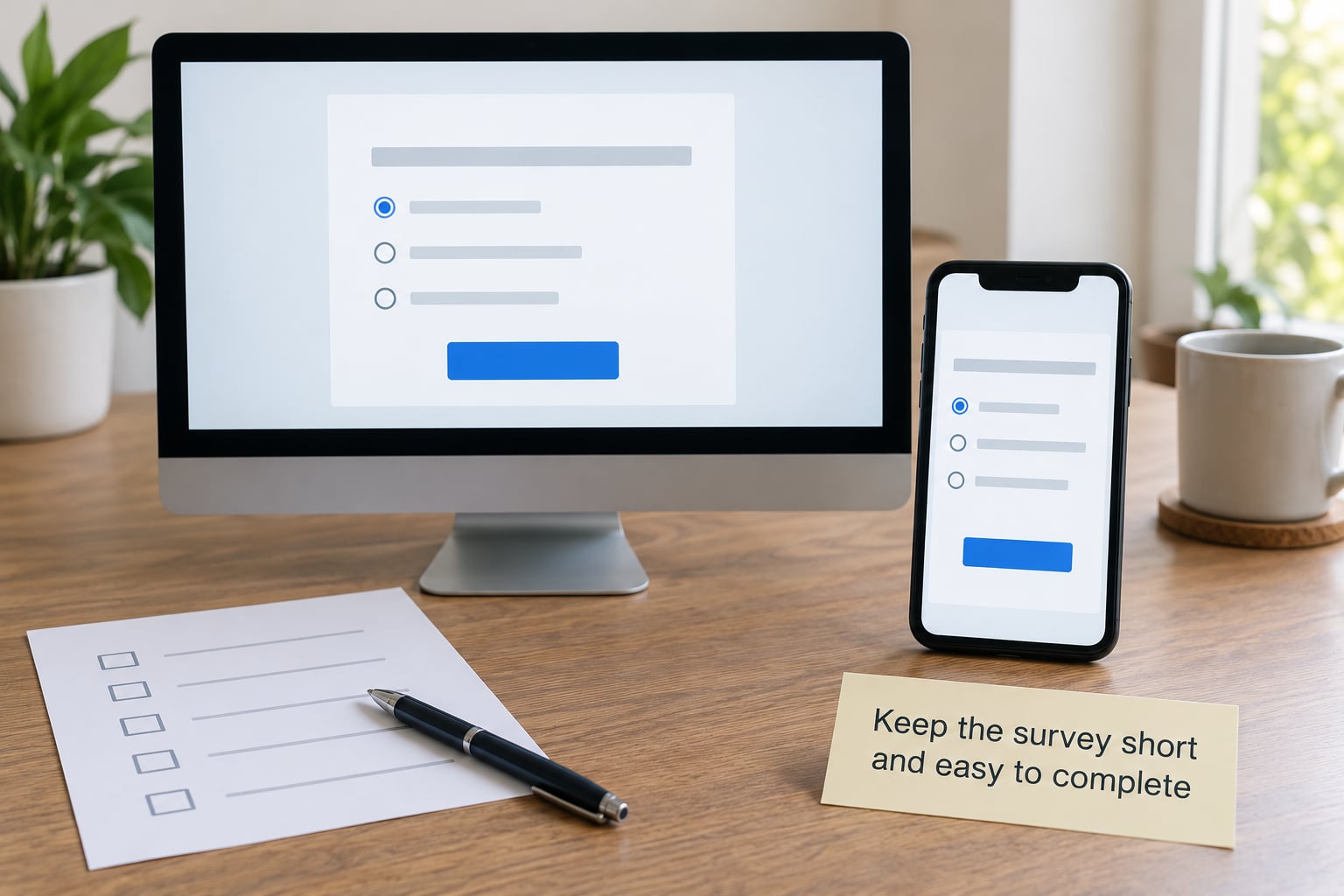
Skip logic and piping earn their place here. If a respondent does not use the product you are asking about, they should skip the follow-up block rather than page through questions that do not apply.
How you know it worked: two people who are not on the project can finish the survey on a phone without asking you a question, and the median completion time matches the estimate in your invitation.
Choose the best timing and contact method
Response rate depends heavily on the channel, because each one carries a different level of expectation and interruption. Pick the channel your audience already reads, not the one that is easiest for you to send.
Commonly reported ranges for completed surveys look like this. Treat them as rough orientation, since your audience and topic will move them.
| Channel | Typical reported range | Works best for |
|---|---|---|
| SMS or text | 40 to 60 percent | Short transactional surveys, post-purchase and post-support checks |
| In-app or on-site | 20 to 30 percent | Feedback asked at the moment the person is already on the product |
| 5 to 30 percent | Wider samples, longer questionnaires, professional audiences | |
| Phone interview | 10 to 20 percent | Hard-to-reach groups, older respondents, sensitive topics |
Email and SMS reward different things. Email tolerates length and explanation, so it carries the invitation plus the survey. SMS has room for roughly one idea and one link, so it works best as a short nudge that points back to a survey you already sent.
Business audiences and consumer audiences also behave differently. Knowing which side you are on tells you where to spend your effort.
| Factor | B2B or professional respondents | B2C or general public |
|---|---|---|
| Best channels | Email, a named contact, a call to a gatekeeper | SMS, social posts, QR codes on receipts and packaging |
| Main obstacle | Time and the gatekeeper, not interest | Survey fatigue and distrust of the sender |
| What persuades | Concise purpose, a real deadline, a named beneficiary | Speed, a phone-first design, a clear reward |
| Typical first send | Personal email from a known contact | Short link with a recognisable brand name |
On timing, avoid Mondays before people clear their weekend inbox and Friday afternoons. Midweek mornings usually work for professional respondents, while consumer surveys often do better in the evening. The reliable test is your own data: send the first wave, watch when completions arrive, and schedule reminders to land during the hours that are already working for you.
How you know it worked: the first wave comes back at a rate you can compare against the channel range above, and most of the responses land within a predictable window rather than scattered at random.
Send timed reminders to nonrespondents
Reminders are usually the single biggest recoverable gain available, and most people send none at all. A reminder sent two or three days after the first invitation can lift completion by around half, and the gain holds across sectors.
Build a short cadence rather than a drip campaign:
- Day 2 or 3: one reminder to nonrespondents, mentioning the closing date and the time estimate again.
- Day 7: a second reminder that changes the angle. Highlight one question people find useful, restate the incentive, or note how many responses you have so far if social proof fits your audience.
- Two or three days before closing: a final note saying the survey closes soon, with the deadline in clear words.
Target your tracking sheet, not your inbox. Remind only the people who have not completed the survey, and skip anyone who started but paused, since a second link can create a duplicate submission that distorts your rate.
Keep the tone level. A reminder that says the survey is your last chance reads as pressure and does more harm than good. Say what is still needed, how long it takes, and when it closes, then stop. Three contacts is the working limit for most projects; more than that pushes people into actively ignoring you.
How you know it worked: at least half of the people who responded did so after a reminder, and the completion rate for the second wave is clearly higher than for the first.
Use incentives without creating bias
A guaranteed small reward reliably outperforms a large prize draw. A draw appeals to a few people and leaves everyone else calculating their odds; a guaranteed reward is a reason to answer now. Monetary rewards are also the most effective type, which is the awkward part for anyone on a small budget.
If money is not available, non-monetary options still work when they are specific and useful: early access to a report, a summary written for non-specialists, a recorded walkthrough of the results, a small donation to a cause the respondent chooses, or entry into a drawing with a guaranteed number of modest prizes. Reciprocity counts. People answer more often when they get something concrete back.
Four rules keep incentives honest:
- Disclose it up front. Say in the invitation what the reward is and who qualifies. Surprise rewards at the end read as bait.
- Never tie it to a particular answer. Reward completion, not a rating, or you have bought yourself a data set that flatters you.
- Do not exclude people who cannot claim it. If the reward is physical, non-respondents from a group without access to that channel need an alternative or an opt-out.
- Draw from everyone who completed. Randomly, after the field window closes, so the draw cannot influence content.
When respondents are on your own team or your own customers, a transparent alternative often beats a reward entirely. Tell them in advance what will change because of their answers, then tell them afterwards what did change. That exchange is the foundation of every future survey you send.
How you know it worked: completion among eligible respondents beats the same survey run without an incentive, and the answers do not show a suspicious spike in the “easy” ratings.
Monitor responses and close the survey properly
Watch the numbers during the field window, not after. Check the daily completions, the completion rate, and the time taken per response. A sudden drop after question four tells you to cut or reorder that block, and you can still fix it while the survey is open.
Audit the data as it lands. Mark duplicates, since the same person using two links creates two records, and separate partial completions from finished ones. Keep a count of invitations that bounced or went to the wrong person and exclude them from the denominator, and record any ineligible completions separately rather than deleting them quietly.
Protect what comes in. Store the export in one location, restrict access, and delete contact details from the analysis file once matching is done, so answers cannot be traced back to individuals if you promised anonymity.
Then close properly. Send a thank-you to respondents, and send a separate message to the people who did not respond if you intend to keep the relationship. Report the final rate honestly, with the denominator you used and the dates of the field window, because a rate without those details cannot be interpreted.
Most importantly, share the results. Sending a short summary to everyone who responded, including what you will act on and what you decided not to, is the most reliable way to lift your next survey. People answer again when they have seen the previous feedback used.
How you know it worked: your reported rate can be reproduced from the tracking sheet, the export matches it, and a summary has been sent to respondents.
Common Mistakes
Almost every stuck response rate traces back to one of these seven errors. Each has a quick correction.
- Sending a survey that is too long. The most common cause of drop-off. Cut to the questions that feed an analysis you will run, and hold the rest for later.
- No reminder at all. One contact is rarely enough. Schedule two or three in advance, not from memory.
- A vague invitation. If it does not say who you are, why it matters, and how long it takes, people have no reason to act now. Rewrite those five sentences.
- Broadcasting to a stale list. Bounces and people outside the target group quietly wreck the denominator. Verify the list and record the exclusions.
- Reminding everyone, including people who finished. A second link for a completed survey produces duplicates and reads as careless. Filter the list first.
- A desktop-only or clunky mobile experience. Test on a phone before launch. If it breaks, fix it before you spend the field window.
- Over-surveying the same people. People who have answered three of your surveys in a month ignore the fourth. Track what you have asked recently, and space requests out or drop the low-value ones.
Two more reminders worth keeping. Test the invitation with a small group first, and if you can afford it, run an A/B test on subject line or send time across two halves of your list. And document everything, because the second survey in the same project should start from what the first one actually taught you rather than from guesswork.
Frequently Asked Questions
What is considered a good survey response rate?
It depends on the channel and the audience, not on the topic. Reported ranges are roughly 40 to 60 percent for SMS, 20 to 30 percent for in-app surveys, 5 to 30 percent for email, and 10 to 20 percent for phone interviews. For academic work, a 30 percent response rate is a reasonable target, and anything above 50 percent from a general population sample is unusually strong. Judge your own result against the rate you planned for in step one, not against a headline number.
How do I calculate a survey response rate?
Divide the number of completed surveys by the number of invitations actually delivered, then multiply by 100. Use delivered invitations as your denominator, meaning you remove bounced emails, undeliverable numbers, and anyone outside your target group first. If you sent 400 invitations, 60 bounced, and you received 85 completions, your response rate is 85 divided by 340, or 25 percent. Report the dates of your field window alongside the figure.
What are effective incentives for survey participation?
A guaranteed small reward works better than a large prize draw, and monetary incentives work best of all. When budget is zero, try a plain-language summary of the results sent to respondents, early access to a report, a recorded walkthrough, or a donation to a cause of their choosing. Whatever you choose, disclose it in the invitation, reward completion rather than a particular answer, and make sure people who cannot claim the reward are not locked out.
How many survey reminders should I send, and when?
Three contacts is the practical limit: one two or three days after the first invitation, one about a week later with a different angle, and a final note two or three days before the field window closes. Target only people who have not completed the survey, and skip anyone who started but paused so you do not create duplicate submissions. Vary the wording instead of repeating the first message, and stop once the window closes.
How do I improve employee survey response rates?
Start with length. Employee surveys that run past ten minutes lose most of the room, so cut to the questions that will drive a decision and keep the rest for a shorter follow-up. Send from a leader the team recognises rather than from an anonymous inbox, tell people in advance what will happen with the results, and share a summary of what changed afterwards. Anonymous to the employer but visible to HR rarely convinces people, so state the confidentiality rules precisely.
How many survey responses do I need for valid results?
It depends on what you plan to do with the data. For estimating a proportion across a population, a few hundred completed responses is often workable, and formal margin of error calculations assume a simple random sample, which online convenience samples rarely are. For a dissertation, the required number is usually set by your supervisor or committee. Plan by dividing the responses you need by your realistic response rate, then invite three to four times that number to leave room for drop-off.
Conclusion
Three actions do most of the work. Shorten the questionnaire to only what you will analyse, rewrite the invitation so it states who you are, why the answers matter, and how long it takes, then schedule two or three reminders before you launch rather than after the silence starts.
Everything else in this guide is refinement. Do those three first, check your rate against the range for your channel, and let the tracking sheet tell you where the remaining gap is. If you want to know how to improve survey response rates beyond the basics, the second survey is where the previous one earns its keep: share what changed, and people answer again.