
A research question is an open, interrogative statement of what a study sets out to find out. A hypothesis is a declarative, testable prediction of the result that question is expected to produce. The question opens the inquiry; the hypothesis commits you to a specific, measurable claim that the data can either support or contradict.
Most students meet this distinction for the first time in a proposal or dissertation methods chapter, usually at 2am, usually with a supervisor’s comment in the margin. Someone says the research question is too broad. Someone else says the hypothesis is really a question in disguise. Both comments mean the same thing: the two elements are doing different jobs and have been written as if they were the same job.
The difference between research questions and hypotheses is mostly about grammar and commitment. A question ends in a question mark and stays neutral. A hypothesis ends in a period and takes a side.
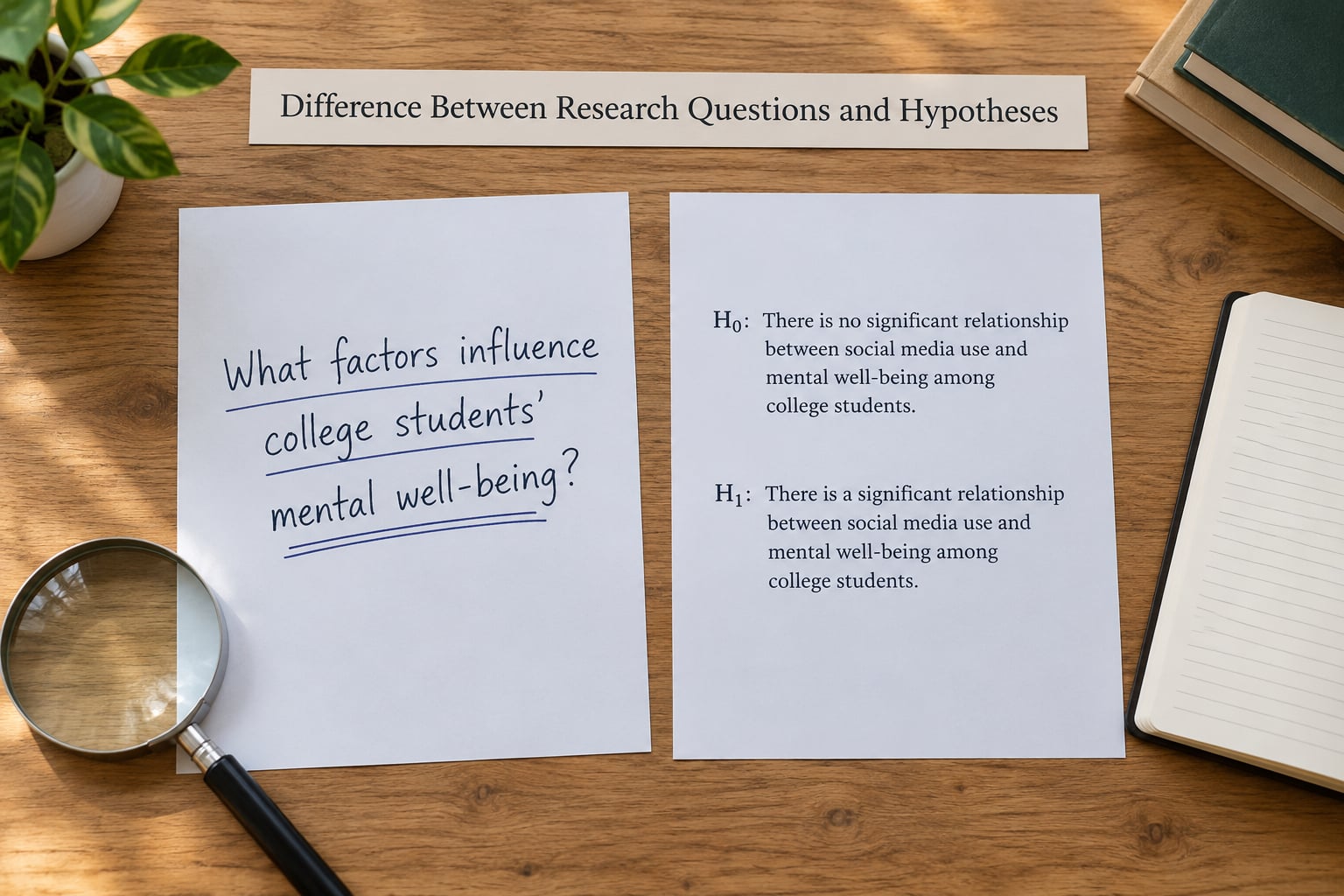
Table of Contents
- 1Difference Between Research Questions and Hypotheses at a Glance
- 2What Is a Research Question?
- 3Four qualities of a usable research question
- 4Common forms a research question takes
- 5What Is a Research Hypothesis?
- 6What a hypothesis must specify to be testable
- 7How Research Questions and Hypotheses Differ
- 8Research questions and hypotheses compared point by point
- 9Key Differences and Examples
- 10How to Write Both in a Research Proposal
- 11Rewriting the two mistakes that cost the most marks
- 12How to Write Both in Chapter 4 Results and Discussion
- 13Which Should You Choose?
- 14Frequently Asked Questions
- 15Can a hypothesis be written as a question?
- 16Which comes first, a research question or a hypothesis?
- 17Do you need a hypothesis for research?
- 18Is a research question testable?
- 19What is the difference between a research question, an objective and a hypothesis?
- 20Should a research question be a question or a statement?
Difference Between Research Questions and Hypotheses at a Glance
Here is the short version before the detail. Your research question defines what you want to learn. Your hypothesis states what you think you will find once you look, in a form your chosen method can actually falsify.
| Dimension | Research question | Hypothesis |
|---|---|---|
| Form | Interrogative sentence ending in a question mark | Declarative statement ending in a period |
| Core purpose | Defines what the study sets out to find out | States the predicted result the study will produce |
| Scope | Broad enough to guide data collection | Narrow enough for one specific test |
| Direction | Neutral, no expected result stated in advance | Directional or non-directional, with a stated expectation |
| Certainty | Open. Many answers could be acceptable | Committed. One pattern of results counts as support |
| Testability | Answerable with the data and time you can collect | Falsifiable. There must be a result that would prove it wrong |
| Study type | Every study type, including qualitative and exploratory work | Mostly quantitative, experimental, quasi-experimental and confirmatory studies |
| Reasoning | Often inductive, moving from observation to explanation | Often deductive, moving from theory to prediction |
| When written | After the research problem, before the literature review | After the question and the review of existing theory |
| Example | How does weekly use of an AI writing assistant affect essay quality among first-year undergraduates? | Students who use an AI writing assistant weekly produce essays with higher rubric scores than students who never use one. |
| Null form | None. Questions do not have a null version | H0: there is no difference in rubric scores between the two groups |
| In a report | Answered in the results section with findings | Supported, rejected, or not supported by the test result |
Read that table twice if you like, because the grammar column is the fastest diagnostic. If your sentence ends in a question mark, it is a research question. If it ends in a period and makes a claim about the world, you are looking at a hypothesis.
What Is a Research Question?
A research question is a sentence that names the specific thing your study intends to find out. It converts a broad topic into a bounded inquiry, and everything downstream (variables, measures, sampling, analysis) gets built to answer it.
Students often arrive with a topic rather than a question. “Social media” is a topic. “How does the number of daily social media checks relate to sleep quality among university undergraduates aged 18 to 22?” is a research question. The second version tells you the population, the variables and the relationship under investigation before you read a single methodology chapter.
Four qualities of a usable research question
Specific. It names a population, a context and a relationship. “Is social media bad?” fails on all three counts.
Measurable. Every concept in it can be operationalized. If a construct like sleep quality has no instrument attached to it, the question cannot be answered and the method will not run.
Answerable. You have access to the participants, the time and the measures. A question about why a national policy worked in 1994 is answerable in principle but almost never in practice.
Relevant. It connects to a conversation already happening in your field. Your literature review exists to justify why this question deserves an answer.
Common forms a research question takes
- Descriptive: What is the current distribution or level? For example, how many hours per week do postgraduate researchers spend on supervisory meetings?
- Comparative: Does one group differ from another on a measured outcome?
- Correlational: How are two variables related, and how strongly?
- Causal: Does manipulating one variable produce a change in another? This form needs an experimental or quasi-experimental design behind it.
The first three work in almost any discipline. Education, business and health services all use the same forms with different variables swapped in. An education study might ask whether class size affects final grades; a business study might ask whether flexible scheduling affects retention; a health services study might ask whether appointment reminder text messages reduce missed clinic visits.
What Is a Research Hypothesis?
A hypothesis is a specific, testable prediction about the relationship between variables, written as a declarative statement. It is grounded in a theoretical framework or in findings from earlier work, and it is falsifiable: there has to be a result that would count as evidence against it.
That last requirement catches a lot of weak hypotheses. “Students find the new module engaging” cannot be disproved by any dataset, because “engaging” was never defined and no outcome was specified. Replace it with something measurable and it becomes testable.
What a hypothesis must specify to be testable
Four things: the independent variable, the dependent variable, the population, and the direction or absence of a relationship. Miss any one and your analysis plan starts guessing.
Formal statistical hypothesis testing then splits your prediction in two. The alternative hypothesis (H1 or Ha) is your actual claim. The null hypothesis (H0) is the default position that any observed relationship is due to sampling variation alone. You either reject H0 or you fail to reject it.
Using the AI writing assistant example, in parallel:
- H0: There is no significant difference in mean essay rubric scores between first-year undergraduates who use an AI writing assistant weekly and those who never use one.
- H1: First-year undergraduates who use an AI writing assistant weekly achieve higher mean essay rubric scores than those who never use one.
Note what H0 does and does not say. It says no effect, not “the opposite effect”. Students who write “there is a negative relationship” as their null have misread it, because failing to reject a no-effect null leaves direction open.
A directional hypothesis like H1 above predicts an increase and pairs naturally with a one-tailed test. A non-directional hypothesis, phrased as “the scores differ” without saying which way, pairs with a two-tailed test. Some disciplines accept only non-directional hypotheses for this reason, so check your department’s conventions before you commit to a direction.
How Research Questions and Hypotheses Differ

The difference comes down to eight things, and they are worth separating one at a time because students usually confuse the same two or three.
Research questions and hypotheses compared point by point
Function. The research question sets the scope of the inquiry. The hypothesis answers it in advance.
Breadth. A question can accommodate several analyses. A hypothesis commits to one. If your question asks how AI use affects essay quality, you could analyse frequency, timing and type of use; each would need its own hypothesis if you want a directional claim.
Wording. Questions are interrogative. Hypotheses are declarative. This is a style rule markers actually apply, and forum users hear about the marks they lose over it repeatedly.
Certainty. A question asks what is true. A hypothesis asserts what you expect to be true and accepts the risk of being wrong.
Direction. A question is neutral by design. A hypothesis carries a direction, or deliberately does not.
Statistical test choice. Your question names the variables. Your hypothesis names the test, because the phrasing tells you whether you need a comparison of means, a correlation, a chi-square or a regression, and whether that test is one-tailed or two-tailed.
Timing. The question comes first and guides the literature review. The hypothesis comes after you know what the existing theory predicts, and just before you fix the analysis plan.
Role in the literature review. The question tells you what evidence to search for. The hypothesis tells you whose predictions you are testing, which is usually why you cite the sources you cite.
One paired example makes the whole thing concrete. Topic: flexible work schedules.
Research question: How does access to flexible scheduling relate to job satisfaction among administrative staff in public sector organisations?
Hypothesis: Staff with access to flexible scheduling report higher job satisfaction than staff without access. The null: there is no significant difference in job satisfaction between staff with and without access to flexible scheduling.
Same study, two elements. The question defines the inquiry; the hypothesis fixes what support would look like before a single survey is sent.
Key Differences and Examples
The clearest way to see the difference between research questions and hypotheses is to pair each question type with the hypothesis it produces.
Descriptive. Question: What proportion of first-year students at one university accessed academic support services in the past year? There is usually no hypothesis here at all. A proportion is reported, not tested. Forcing a null and an alternative onto a simple count is where students invent methodology they do not need.
Comparative. Question: Does average sleep duration differ between students living on campus and students commuting from home? Hypothesis: Students living on campus report longer average sleep duration than commuting students. Null: there is no significant difference in average sleep duration between the two groups. This is a two-group comparison of means, so an independent-samples t-test or its non-parametric equivalent follows directly.
Correlational. Question: Is there a relationship between weekly AI tool use and perceived writing confidence among postgraduate researchers? Hypothesis: weekly AI tool use is positively associated with perceived writing confidence. Null: there is no relationship between the two variables in the population. Here the test is a correlation or a simple regression, and no causal language is warranted.
Causal. Question: Does a structured peer-review workshop improve essay quality among second-year undergraduates? Hypothesis: second-year undergraduates who attend a structured peer-review workshop produce essays with higher rubric scores than those who do not attend. This is the only form where a causal claim is defensible, and only because the design supports one. Random assignment makes it an experiment; intact class groups make it a quasi-experiment, and you must say so.
Not every study needs a causal hypothesis, and insisting on one is a common source of trouble. Descriptive reports, qualitative interview studies, exploratory instrument development and case studies all have legitimate research questions with no hypothesis attached. What they do have instead is a research objective, which is the next thing worth untangling.
How to Write Both in a Research Proposal
The sequence below works for most theses and dissertations. Follow it in order and the hypothesis almost writes itself.
- State the research problem. Two or three paragraphs on what is known, what is not known, and why the gap matters. Everything after this point exists to serve the gap.
- Identify the population and variables. Who or what is being studied, what you will measure on them, and how each concept gets operationalized. Do this before you write the question, because vague constructs are usually the reason a question feels vague.
- Write one focused research question. If you have three, check whether they need three different studies. Four is the practical ceiling for a single mixed-methods project.
- Read enough theory to justify a prediction. Your hypothesis should trace back to something a named author or a body of findings argues, not to what seems plausible.
- Convert the expected relationship into an alternative hypothesis. Same variables, same population, now with a stated direction or a stated absence of direction.
- Add the null hypothesis where a statistical test requires it. Written first in practice, even though it is usually read second.
Once the six steps are done, run this checklist over your draft.
- Does the question name a population, a context and at least one variable?
- Can every construct in the question be measured with something concrete?
- Could you answer the question with your actual data, in your actual timescale?
- Does the hypothesis end in a period rather than a question mark?
- Is there a result that would prove the hypothesis wrong?
- Can you name the source of the prediction, not just your intuition?
- Do your question, hypothesis, measures and analysis plan describe the same study?
Rewriting the two mistakes that cost the most marks
A hypothesis written as a question: “Does weekly AI use improve essay quality?” Rewrite it as a statement of prediction and add the null alongside it.
A research question written as a statement: “This study will determine whether AI use improves essay quality.” Rewrite it as a bounded interrogative sentence with the population named.
A hypothesis with no rationale: any directional hypothesis can be justified by some paper somewhere. The fix is not removing the direction, it is citing the specific finding that produced it.
How to Write Both in Chapter 4 Results and Discussion
Both elements resurface in the results and discussion chapter, and this is where alignment either holds or collapses. Report each hypothesis in the order you stated it, using consistent labels.
Use three outcomes, not two. A hypothesis can be supported, which means the test result is consistent with it at your chosen significance level. It can be rejected, which means the result contradicts it. And it can be not supported, which is what you write when the test does not reach significance and you therefore cannot reject the null.
Supported and rejected are not opposites of each other. Rejecting the null means you found evidence for the effect. Failing to reject the null means you did not find enough evidence, which is not evidence that no effect exists. Writing “the hypothesis was rejected” when you actually failed to reject H0 is the single most common technical error in this chapter.
Keep the discussion honest about the design. A non-significant result in a small underpowered sample is a finding about your sample, not about the population. A significant correlation in a cross-sectional survey is not evidence that one variable causes the other, however confident the phrasing feels.
Bring the research question back too. If a sub-question turned out to be unanswerable with your measures, say so and explain what you would change. Supervisors and examiners read for alignment across question, design, analysis and conclusion more than they read for polish.
Which Should You Choose?
They are not alternatives. You need a research question in every study. You need a hypothesis only when your design can actually test one.
Quantitative survey or experiment: use both. Write the question, then the directional or non-directional hypothesis, then the null. If you are reporting a single-group pre-test, post-test design, the null still applies to the pre-to-post comparison.
Qualitative interview or focus group study: use the research question and skip the null hypothesis entirely. Interview studies are usually exploratory and inductive. Forcing an H0 and H1 into a thematic analysis is a mismatch that examiners notice. Doctoral students on forums report arguing exactly this point with supervisors who were following a template.
Mixed methods: write one overarching research question, then a hypothesis for the quantitative strand only. The qualitative strand is there to explain or build theory, not to test a prediction.
Exploratory or instrument development work: lead with the research question. Many of these studies exist precisely because the theory cannot yet support a directional prediction.
Case study or action research: keep a research question, and let the design carry the inquiry. Both are common in applied settings where a single prediction would tell you very little.
The practical test is simple. Ask what would have to happen in the data for your prediction to be wrong. If you can describe that outcome clearly, write the hypothesis. If you cannot, you are not ready for one yet.
Frequently Asked Questions
Can a hypothesis be written as a question?
No. A hypothesis is a declarative statement, so it ends in a period rather than a question mark. If yours reads Do students who use AI tools write better essays?, rewrite it as a prediction: Students who use AI tools weekly write essays with higher rubric scores. Then add the null hypothesis stating that there is no significant difference. A research question can and should be a question; the hypothesis is the only one of the two that must be a statement.
Which comes first, a research question or a hypothesis?
The research question comes first, and it comes after the statement of the research problem. The question defines what you intend to find out, the literature review tells you what theory already predicts, and the hypothesis follows from that. Note that the order of development and the order of presentation in your template are different things: many institutions print the hypothesis in Chapter 1 while the practical reasoning develops it much later.
Do you need a hypothesis for research?
It depends on your design. Quantitative, experimental and quasi-experimental studies usually need both an alternative and a null hypothesis, because a statistical test decides between them. Qualitative interview studies, exploratory work, descriptive studies and case studies usually need only a research question. Adding a hypothesis to those designs tends to produce a prediction your method cannot test, which is a worse problem than having none.
Is a research question testable?
A research question becomes testable once every construct in it can be measured with something concrete and you have access to the data. How does sleep quality relate to exam performance? is not yet testable, because sleep quality has no instrument attached. Add a validated scale, name the population and specify the comparison, and the same question becomes answerable. The test turns on operationalisation, not on the wording alone.
What is the difference between a research question, an objective and a hypothesis?
A research question asks what you want to find out. A research objective restates that question as a task you will complete, usually as a verb phrase, such as to measure the relationship between sleep duration and exam scores. A hypothesis goes further and predicts what you expect to find. The question and the objective are close cousins and often overlap; the hypothesis is the only one of the three that can be supported or rejected by evidence.
Should a research question be a question or a statement?
A question. Using an interrogative sentence tells a marker immediately that you have not already decided the answer, which is what an inquiry is for. Statements such as this study will demonstrate that X are usually written as objectives instead. Phrase it as a question and the corresponding objective can sit right underneath it, keeping the two elements visibly aligned.
Start with your research question this week, before you touch a hypothesis. Get it narrow enough that you can name the population, the variables and how each one gets measured, then read enough theory to justify a prediction. Write the alternative hypothesis in one sentence, add the null beneath it, and check that all four pieces describe the same study. If your design is qualitative or exploratory, stop at the question. That is not a weaker piece of work; it is the correct one for the design you chose.