
A pilot test is a trial run of your questionnaire with a handful of people, done before you collect real data. You hand the draft to 5 to 10 participants who resemble your target respondents, watch where they hesitate, and fix the wording, response options, and skip logic while changing them is still cheap. Skip it and you learn about the broken question three days after 400 people have answered it.
Most students treat pilot testing as a box their supervisor wants ticked. It is more useful than that. It is the only moment in your project when a stranger’s confusion is feedback rather than a problem, and learning how to pilot test a questionnaire well is mostly a matter of deciding in advance what you are looking for, then writing the observations down instead of relying on memory.
The whole cycle takes a few days of part-time work for a student project: one afternoon to prepare, two or three sessions of 20 minutes each to watch people answer, and an hour to revise. Here is the process, the things to prepare, and the mistakes that quietly waste the effort.
Table of Contents
- 1What You Need to Pilot Test a Questionnaire
- 2How to Pilot Test a Questionnaire: Step-by-Step
- 31. Define What the Pilot Test Should Check
- 42. Choose a Small but Relevant Pilot Group
- 53. Prepare the Questionnaire and Feedback Form
- 64. Ask Participants to Think Aloud
- 75. Review Every Question and Response Option
- 86. Analyse Pilot Feedback and Completion Data
- 97. Revise and Retest: How to Pilot Test a Questionnaire After Changes
- 10Common Mistakes When Pilot Testing a Questionnaire
- 11Frequently Asked Questions
- 12How many people do I need for a pilot test?
- 13Can I use pilot data in my main analysis?
- 14Can I pilot test with convenience participants instead of my target population?
- 15How long should a pilot test take to complete?
- 16Can I skip pilot testing if my supervisor does not require it?
- 17How do I document a pilot test in my methodology chapter?
- 18Conclusion: Start With One Small, Structured Pilot
What You Need to Pilot Test a Questionnaire
Preparation is what separates a pilot that finds problems from one that just confirms what you hoped. You need seven things ready before the first person clicks send.
A one-sentence research purpose. If you cannot say in one sentence what the questionnaire is trying to measure, it is not ready to pilot test. The purpose is what you check every question against in step five, and a vague purpose lets a badly worded question slip through.
A complete draft. Every question, every response option, every screen, all skip logic wired in. Piloting a partial draft means the parts you left out are the parts you learn nothing about.
A description of your target participant. Age range, subject or role, and anything else that shapes how they read a question. You need it to recruit the right pilot group rather than whoever is nearest.
Three or four pilot-test questions. Write down what you specifically expect to check: is the terminology familiar, do the response options cover the range of answers, does the branch logic send people to the right screen, does the completion time match what you promised participants. A pilot without a checklist turns into a chat about whether people liked it.
A short feedback form. Five questions at the end, or a separate page: which question was hardest to answer, which option was missing, how long did it take, what did you think X meant, and what would you change. Two open boxes beat a satisfaction rating, and this is the format dissertation researchers tend to use because it is fast to read and easy to code.
A recording sheet. A table with one row per pilot participant and columns for question number, observed confusion, timing, and proposed change. Pencil marks on paper work just as well. What matters is that you capture observations while they are happening rather than reconstructing them at the end.
An analysis plan. Decide now how you will summarise the results: a tally of how many participants raised each issue, a list of items to change, and a list of items to leave alone. Deciding afterwards makes it tempting to keep the items you are proud of.
How to Pilot Test a Questionnaire: Step-by-Step
The process in seven steps: decide which risks the pilot must check, recruit 5 to 10 people who match your target respondents, prepare the instrument and the feedback form, ask them to think aloud while answering, review every question and response option, analyse the feedback alongside the completion data, then revise and run a short second pilot if the changes were substantial.
1. Define What the Pilot Test Should Check
Start with a written list of risks, not a general intention to see how it goes. For most questionnaires that list covers unclear instructions, ambiguous or double-barreled wording, response options that do not cover the range of answers people actually have, a rating scale whose endpoints mean nothing, completion time that runs past what participants agreed to, and questions that quietly do not measure the concept you named in your purpose statement.
Write each risk as a yes-or-no check so the answer is obvious once you have the data. “Can a first-year student define every technical term without help?” beats “is the survey clear”.
2. Choose a Small but Relevant Pilot Group
Roughly 5 to 10 participants is enough for a straightforward questionnaire; think 10 to 30 when the survey is long, uses unfamiliar technical language, or has complicated branching. Academic guidance on cognitive interviews commonly settles on about 10 interviews, which matches that range.
Choose people who resemble your real respondents on the dimensions that affect reading: subject background, age, and familiarity with the topic. Two colleagues who have never seen your field will not notice that you use an insider abbreviation in question seven.
One honest limitation to write down for your methodology chapter: a pilot group is almost always a convenience sample. Its feedback tells you what is broken, not what the wider population thinks. Never report pilot responses as evidence about your target group, and never generalise from them.
3. Prepare the Questionnaire and Feedback Form
Test the instrument in the format it will actually be delivered in. If your main study runs on a phone, have pilot participants open it on a phone. A questionnaire that works on a laptop can lose half an option below the fold on a small screen, and you will never find out from a desktop test.
Turn off anything the real survey would not show: no email collection if you are not collecting emails, no auto-filled identity fields, no notifications. Collecting names during a pilot discourages blunt criticism, which is exactly what you are paying the participants for.
Keep the feedback form separate from the questionnaire where you can, so the answers to your survey questions stay clean. If you must append it, put the feedback items at the very end behind a clear divider.
If the questionnaire is translated, this is where back-translation comes in. Have a second bilingual speaker render the instrument back into the original language and compare the two versions item by item; any item that changes meaning is a candidate for rewriting. Then pilot the translated version with native speakers of that language, because a back-translation catches wording drift but not cultural mismatch.
4. Ask Participants to Think Aloud
Think-aloud interviewing is the most valuable single thing you can do in a pilot. You ask the participant to say out loud what they are reading and what they are deciding, then stay quiet while they do it.
Keep the script to three prompts: “what are you reading right now”, “what does this question mean to you”, and “what would you pick and why”. Do not explain terms, do not suggest answers, and do not rescue a participant who is stuck. A participant who needs rescuing is exactly the finding you came for.
Record where they pause, where they scroll back up, where they reread the instructions, and where they ask you what something means. Most hesitation is ordinary thinking, so separate the two: rereading a long option is normal, while asking “which of these do I pick if I have no opinion” points at a missing option such as “no opinion” or “not applicable”.
You do not need to moderate every session. Running two or three in person and letting the rest complete the survey unmoderated still gives you both qualitative depth and real timing data.
5. Review Every Question and Response Option
Sit down with the draft and go through it item by item, not just the items people complained about. Check each question against your research purpose, then run through the mechanics: wording, order, scale design, skip logic, required fields, and whether the response options are balanced.
Watch for double-barreled questions that ask two things at once, since respondents will answer only one and your analysis will not know which. Check that scale endpoints are labelled with words, not just numbers, and that the scale length matches the response options. Confirm that each skip pattern sends respondents to the right screen and that nobody can reach a dead end.
Read every option out loud looking for overlap. When two options could both be true for the same person, the split is meaningless and you will see it in the pilot data as a pile of write-ins that say the same thing.
6. Analyse Pilot Feedback and Completion Data
Put the feedback into a simple table: question number, what participants reported, how many reported it, proposed change, and your decision. The count column is what turns a handful of impressions into evidence, because one confused participant is anecdote and three is a pattern.
Compare the comments against the response data, since they check each other. A high share of “Other” write-ins that repeat the same phrase means that answer belongs as a real option. Items where everyone chose the same answer may be working or may be leading, so check the wording before celebrating. Median and minimum completion time tells you whether your estimate to participants was honest.
Sort your list into essential revisions, optional improvements, and changes deliberately declined. Write down the reason for anything you keep unchanged, because that line is exactly what a methods examiner wants to see.
7. Revise and Retest: How to Pilot Test a Questionnaire After Changes
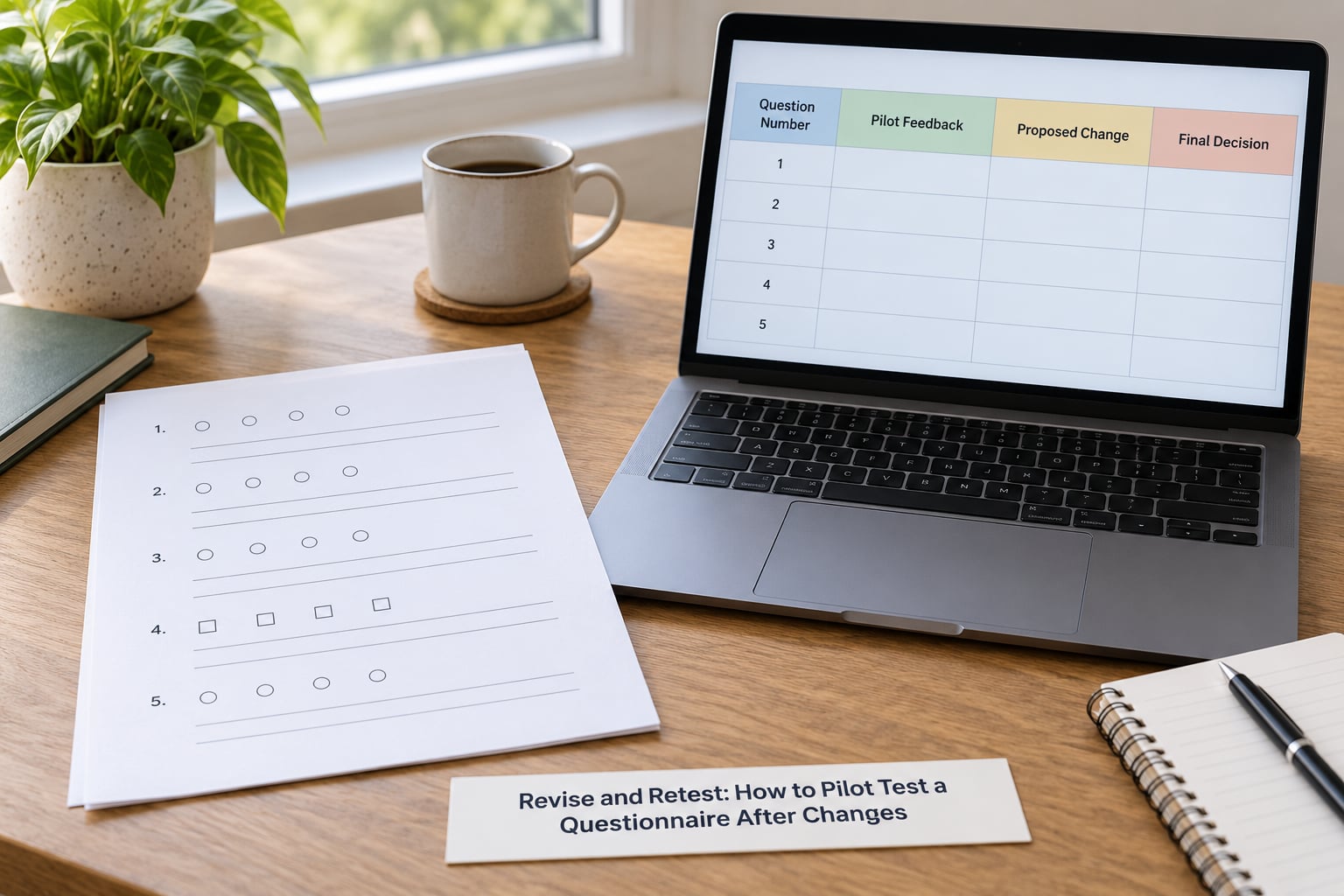
Edit the flagged items and preserve the meaning of the instrument. Rewording a question to fix an unclear instruction is fine; replacing the whole construct because one participant disliked it is not, and it changes what your study measures. If a question cannot be fixed without losing the concept, drop it and report the drop in your write-up.
Then check whether your fixes created new problems. Reordered questions change the context of later items, new response options change how people read the ones above them, and shortened instructions sometimes remove a cue that later questions depend on.
Run a short second pilot, three to five people, whenever the changes were substantial: several rewrites, a new scale, added branching, or a translated version. If the edits were cosmetic, a desk check against the checklist is enough. The second round is also the moment you learn whether your revision log is complete, since a participant who still hesitates at the same item usually means the first fix missed the actual problem.
Common Mistakes When Pilot Testing a Questionnaire
Most wasted pilot sessions come down to the same handful of errors. Each has a straightforward fix.
- Testing with too many people. Ten participants surface nearly every wording problem; the twentieth adds cost and confidence, not information. Stop once new participants stop raising new issues.
- Skipping cognitive interviews. A completion-only pilot gives you timing and drop-off, but not the reason behind them. Watch at least two or three people think aloud.
- Changing everything at once. If you rewrite ten questions after one pilot, you cannot tell which fix worked. Change what you must, then retest.
- Leading the participant. Saying “so you agree the current system is slow, right?” destroys the only data you came for. Stay neutral and let disagreement stand.
- Not writing anything down. Recall after three sessions is unreliable, and vague notes produce vague revisions. Fill the recording sheet during the session.
- Treating pilot results as findings. A convenience group of five or ten people says nothing about your population. Pilot data is for fixing the instrument, and it stays out of the main analysis.
- Ignoring ethics and practicality. Pilot participants still deserve informed consent, voluntary participation, and anonymity. Tell them the session is a test of the questionnaire, not an interrogation, and offer a way to withdraw.
- Testing only on a desktop. If most of your respondents will answer on a phone, the pilot has to include phones.
A pilot catches some problems more reliably than others. Here are the ones worth watching for, what each one looks like in practice, and the fix.
| Issue | What it looks like in the pilot | Fix |
|---|---|---|
| Double-barreled question | Participants answer only the second half | Split into two questions |
| Missing response option | The same phrase appears in nearly every write-in | Add that option as a named choice |
| Unlabelled scale | “1 to 10” with no description of either end | Label both endpoints in words |
| Overlapping options | Two answers feel equally true | Rewrite so options are mutually exclusive |
| Broken skip logic | Wrong screen, or a dead end after one answer | Re-test every branch after any change |
| Jargon or insider terms | Participant asks what a word means | Use plain language or define the term inline |
| Leading wording | Identical answers regardless of attitude | Neutral phrasing, balanced option order |
| Question outside the construct | Participant cannot connect it to the topic | Remove it or add a bridging instruction |
| Survey longer than promised | Median time well above your estimate | Cut items or move a block to a second wave |
| Mobile rendering problems | Options cut off or buttons unusable on a phone | Retest on a small screen |
| Translation drift | An item reads oddly in the second language | Back-translate and re-pilot with native speakers |
One more trap worth naming: the pilot that finds nothing. If ten participants raise zero issues and every completion time matches your estimate, either the questionnaire is very simple, or the participants were not diverse enough to surface a difference. Treat an uneventful pilot as a prompt to check your recruitment rather than as proof of quality.
Frequently Asked Questions
How many people do I need for a pilot test?
For a straightforward questionnaire, 5 to 10 participants will surface almost every wording and option problem. Use 10 to 30 when the survey is long, uses unfamiliar technical language, or has complex branching. There is no formula here because a pilot is diagnostic rather than statistical: its job is to find breakages, and ten confused respondents tell you more than ten satisfied ones.
Can I use pilot data in my main analysis?
Usually not. Pilot participants are a convenience sample recruited to find problems, not a probability sample drawn to estimate population values, and their responses are conditioned on a version of the instrument you later changed. Keep the pilot data separate, use it only for revision decisions, and describe the pilot as a methodological step in your write-up.
Can I pilot test with convenience participants instead of my target population?
Convenience participants are fine for mechanical checks such as skip logic, timing, and page layout. For wording, technical terms, and response options, use people who match your target respondents on the characteristics that affect how they read the question. Whatever the mix, state it plainly in your methods section so nobody mistakes the pilot group for your sample.
How long should a pilot test take to complete?
As a participant, 10 to 15 minutes is a reasonable target for a student questionnaire, and telling people that estimate up front keeps drop-out low. As a researcher, expect two to three sessions of 20 minutes each plus preparation and revision time. If your own estimate of completion time is wrong by a wide margin, that gap is itself a pilot finding worth fixing.
Can I skip pilot testing if my supervisor does not require it?
You can, but you take on the risk yourself. Once a fielded survey is live you cannot recall broken skip logic or missing response options without discarding responses, and ambiguous wording discovered after 400 answers usually means collecting the data again. A pilot costs a few days; replacing a full round of data collection costs weeks.
How do I document a pilot test in my methodology chapter?
Report four things: how many participants and how they were recruited, what version of the instrument they saw, what you asked them to do (including any think-aloud sessions), and what changed as a result. Add the reasons you declined certain suggested changes. Examiners read this section as evidence of process control, so a short honest account is worth more than a long vague one.
Conclusion: Start With One Small, Structured Pilot
Start by writing down the three or four risks your questionnaire carries, then pilot test a questionnaire properly with 5 to 10 people who resemble your real respondents. Watch two or three of them think aloud, fill in the recording sheet as you go, and let the completion data tell you whether your time estimate was honest.
Sort what you find into must-fix, nice-to-have, and deliberately kept, revise the wording and the response options, and run a short second round if the changes were big. Write the whole thing down as you go, because the record you keep is what lets you explain the instrument you finally launch.