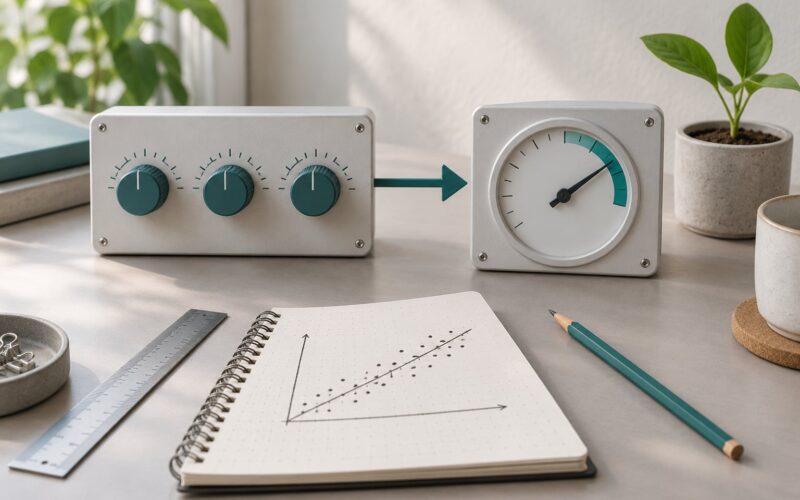
Validity and reliability answer two separate questions about a measurement. Validity asks whether the instrument actually captures the concept it claims to measure, and reliability asks whether it produces the same result every time you use it. Understanding the difference between validity and reliability in research matters because a measure can be perfectly consistent and still be measuring the wrong thing.
Short version: reliability is about consistency, validity is about accuracy, and reliability is necessary but never sufficient for validity. Everything below unpacks what each one looks like in practice, how you check it, and what to write in your methods chapter.
Table of Contents
- 1Difference Between Validity and Reliability at a Glance
- 2Validity: Does the Measure Capture What It Claims?
- 3Content validity
- 4Construct validity
- 5Criterion-related validity
- 6Face validity and external validity
- 7Reliability: Does the Measure Produce Consistent Results?
- 8Internal consistency (Cronbach’s alpha)
- 9Test-retest reliability
- 10Inter-rater reliability
- 11Split-half and parallel forms
- 12How Validity and Reliability Differ in Research
- 13Systematic error versus random error
- 14Can a Research Measure Be Reliable but Not Valid?
- 15Examples of Validity and Reliability in Research
- 16A twenty-item Likert scale
- 17An interview coding procedure
- 18An examination item
- 19A screening score predicting a later outcome
- 20How to Assess Validity and Reliability
- 21How to Report Validity and Reliability in a Research Paper
- 22Which Should You Choose?
- 23Frequently Asked Questions
- 24Are validity and reliability the same thing?
- 25Can a measure be valid but not reliable?
- 26What are examples of validity?
- 27What is an acceptable Cronbach’s alpha?
- 28What is the difference between credibility and reliability?
- 29Conclusion
Difference Between Validity and Reliability at a Glance
Five one-liners worth memorising before anything else:
- Validity is the degree to which a measure represents the construct it is meant to represent.
- Reliability is the degree to which a measure gives consistent results across repeated trials, items or raters.
- A valid measure must be reliable. A reliable measure does not have to be valid.
- Reliability is estimated with a statistic such as Cronbach’s alpha or a correlation. Validity is argued from accumulated evidence.
- No sample size or significance test can repair a measure that is measuring the wrong construct.
| Aspect | Validity | Reliability |
|---|---|---|
| Core question | Does it measure what it claims to measure? | Does it give the same answer each time? |
| Measurement focus | Accuracy and truthfulness of the score | Consistency, stability and precision of the score |
| Judged by | Expert judgement plus evidence from theory and data | Data: repeated trials, item agreement, rater agreement |
| Common methods | Content review, factor analysis, convergent and discriminant evidence, criterion comparison | Test-retest correlation, Cronbach’s alpha, split-halves, parallel forms, inter-rater kappa |
| Typical statistic | Factor loadings, correlations with a criterion, variance explained | Cronbach’s alpha, r, kappa, Spearman-Brown corrected value |
| Main failure point | Systematic error, biased toward the wrong construct | Random error from noise, ambiguity or unstable conditions |
| Research example | A job satisfaction scale that mostly reports pay satisfaction | Ten items that a respondent answers inconsistently at random |
| Fixable by | Redefining the construct, rewriting items, changing the measure | Rewording, adding items, training raters, standardising conditions |
Validity: Does the Measure Capture What It Claims?
Validity is the degree to which a measure accurately represents the construct it is intended to assess. It is not a property you possess once and keep forever; it is a claim that has to be defended with evidence for the population, the setting and the purpose you have in mind.
A scale can be beautifully consistent and still be invalid, because consistency says nothing about the target. The classic case is a pay satisfaction questionnaire that behaves like a reliable instrument but is filed under the heading of job satisfaction. A participant who answers consistently across twenty items is not, by that fact alone, reporting what you say they are reporting.
Content validity
Content validity asks whether the items cover the full domain of the construct. It is judged by people who know the field, usually through an expert review panel and a mapping of each item to a domain in a content validity index. It is the cheapest evidence to gather and the easiest to skip.
Construct validity
Construct validity asks whether the measure behaves as theory says the construct should behave. It has two working parts. Convergent validity means the score correlates with other measures of the same or a closely related construct. Discriminant validity means it does not correlate so strongly with a different construct that the two become indistinguishable.
Convergent and discriminant evidence usually comes from a correlation matrix, an exploratory or confirmatory factor analysis, or a multitrait-multimethod design where each construct is measured by more than one method.
Criterion-related validity
Criterion-related validity measures the score against an outside benchmark. Predictive validity looks at how well the score forecasts a later outcome, such as whether a screening score at intake predicts dropout a year later. Concurrent validity compares the score with an established measure taken at the same time.
Face validity and external validity
Face validity is whether the items look on the surface like they measure the construct. It carries no statistical weight but it matters practically, because respondents who find items confusing give you noisy data and poor completion rates. External validity is a separate question about generalisation: whether your findings hold for other people, settings and time periods.
External validity is about the sample, not the instrument, which is why it gets confused with validity in student writing. A perfectly valid measure applied to 40 volunteers from one department has weak external validity.
Reliability: Does the Measure Produce Consistent Results?
Reliability is the consistency of a measure under the same conditions. It answers a narrower and more statistical question than validity: given the same construct, the same population and the same procedure, how much of the score is signal rather than noise?
Under classical test theory, the observed score equals the true score plus measurement error. Reliability is essentially the proportion of the observed score that is true score, and a very large random error term shrinks that proportion towards zero. Systematic error barely appears in this equation at all, which is the technical reason a measure can be reliable and still wrong.
Internal consistency (Cronbach’s alpha)
Internal consistency asks whether the items in a scale behave as though they are tapping one thing. Cronbach’s alpha is the standard estimate. It is the right tool for Likert scales and multi-item questionnaires, and it is the wrong tool for single-item measures, for measures where the items are deliberately heterogeneous, and for anything described as a validity test.
Test-retest reliability
You administer the instrument twice to the same participants, with a sensible gap in between, and correlate the two sets of scores. A high correlation means the measure is stable over time. The gap has to be long enough that participants forget the wording but short enough that the construct has not genuinely changed; two weeks is common for attitudes, a few days for performance measures.
Inter-rater reliability
When people, not items, produce the score, you check agreement between raters. Percentage agreement is easy to inflate by accident, so most researchers report Cohen’s kappa, which corrects for agreement you would get by chance alone. Use it for fixed categories such as a coding frame, and use an intraclass correlation when the rater produces a continuous rating.
Split-half and parallel forms
Split-half reliability splits the items into two matched halves and correlates them, then applies the Spearman-Brown correction to estimate what the full set would achieve. Parallel forms reliability uses two equivalent versions of the same instrument, which is the cleanest option for anything with a strong practice or memory effect.
| Method | What it estimates | Rough benchmark | Watch out for |
|---|---|---|---|
| Cronbach’s alpha | Internal consistency of items | .70 or above, .80 and above is comfortable | Below .90 often means items are near-duplicates; short scales report lower values honestly |
| Test-retest | Stability over time | r of .60 or above | Learning, mood and genuine change all depress the coefficient |
| Split-half | Item consistency without alpha’s length bias | .70 or above after Spearman-Brown | How you split the items changes the number, so state your method |
| Parallel forms | Equivalence of two versions | r of .70 or above | Building a genuine parallel form is real work, not a translation job |
| Inter-rater (kappa) | Agreement beyond chance | .60 substantial, .80 or above strong | Only appropriate for categorical judgements; report the coding frame too |
These benchmarks are starting points, not laws. Alpha depends heavily on how many items you have, so a four-item scale reporting .65 is not automatically broken, and an alpha of .95 on ten almost identical items is a redundancy warning rather than a triumph.
How Validity and Reliability Differ in Research
The difference between validity and reliability in research is a difference in what is being claimed. Reliability makes a claim about the measurement process: given the same procedure, results should not jump around. Validity makes a claim about the relationship between the score and a construct outside the instrument, and it is judged against theory and evidence rather than against a single number.
This has a practical consequence for how you spend your effort. Reliability problems are usually fixable at the item level. Ambiguous wording, too many double-barrelled questions, a rushed administration or an untrained coder all add random noise, and the fix is a clearer item, more items, a script or a training session. Validity problems are not fixable that way, because the instrument is responding exactly as designed to the wrong target.
Two habits cause most of the trouble I see in student drafts. The first is writing a single alpha as though it settled the matter. Alpha only addresses internal consistency, so it says nothing about whether the scale captures the intended construct or whether it means something different in your population. The second is claiming validity from the literature alone. A scale validated with 300 hospital patients in one country is a hypothesis about your sample, not a fact about it, and revalidation or at least a stated justification belongs in your methods.
Systematic error versus random error
Random error shrinks reliability and averages out as sample size grows. Systematic error does the opposite: it stays put, no matter how many people you measure, and it is what invalidity usually looks like in practice. A thermometer consistently reading 2 degrees high is reliable and wrong in the same direction every time, which is why adding respondents never rescues it.
Can a Research Measure Be Reliable but Not Valid?
Yes, and it happens more often than students expect. Imagine a bathroom scale that reads 3 kg too heavy for everyone who steps on it. Run it twice on the same person and you get the same wrong number both times: excellent reliability, no validity at all. In research terms, that is a scale where every item is worded so loosely that all respondents select roughly the same answer, or where a self-report measure is confidently picking up a different construct than the one in your title.
Go the other way and the answer is no. A measure cannot be valid without being reliable, because validity requires a stable relationship between the score and the construct. A thermometer whose reading changes every time you look at it tells you nothing about temperature, however accurate it might be on a lucky reading.
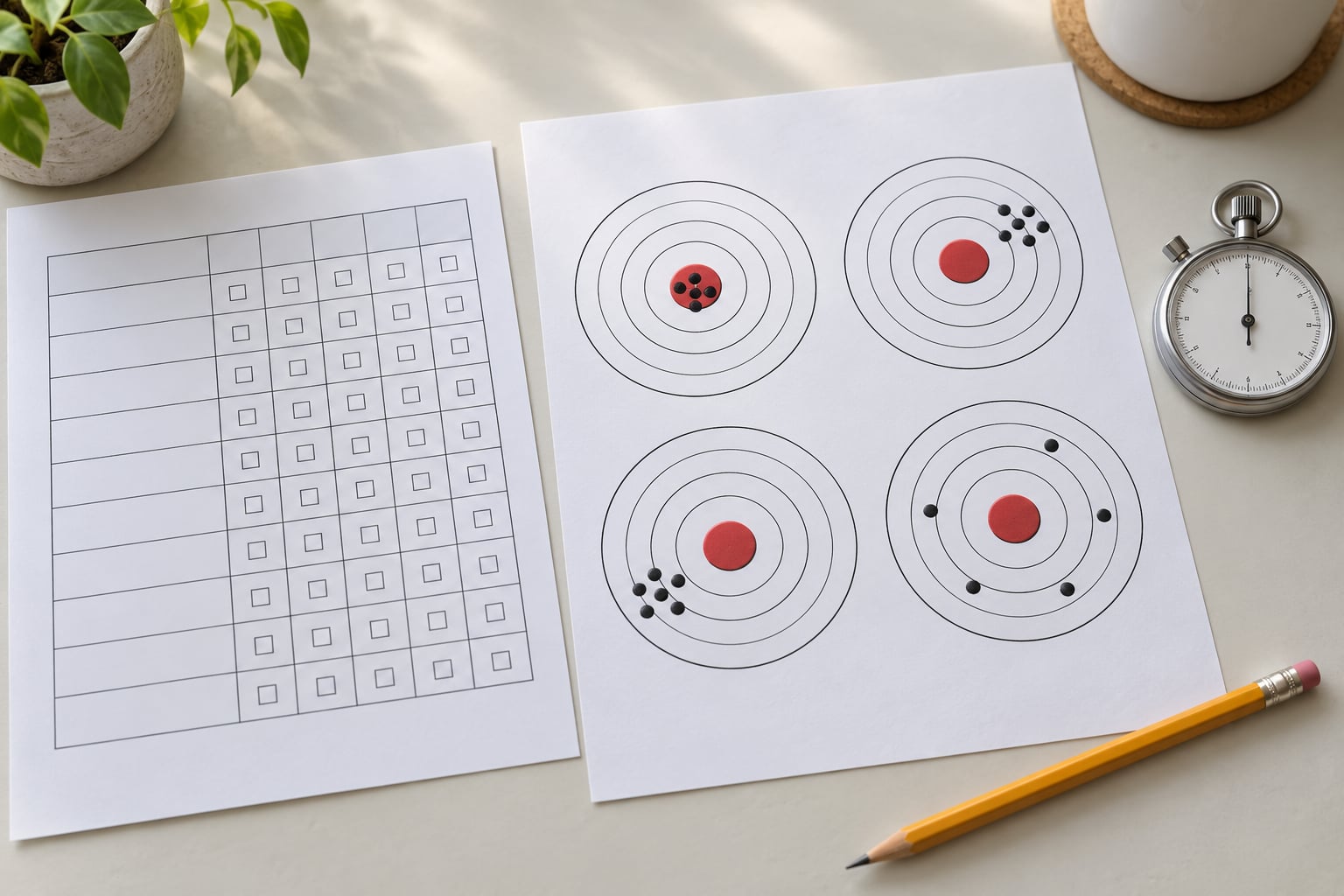
| Scenario | Reliable? | Valid? | What it looks like |
|---|---|---|---|
| Consistent and accurate | Yes | Yes | Shots cluster in the bullseye |
| Consistent but biased | Yes | No | Shots cluster off-centre, always in the same direction |
| Accurate on average, erratic | No | Partial | Shots scatter around the bullseye; error shrinks with a larger sample |
| Scattered and off-target | No | No | Shots land anywhere but the target |
Researchers working in psychometrics often reframe a low test-retest coefficient as a validity question rather than a reliability one: if the construct itself is unstable over that interval, the scale is measuring something that does not hold still. That is a fair reading, and it is worth a paragraph in a discussion section rather than a quiet omission.
Examples of Validity and Reliability in Research
A twenty-item Likert scale
Reliability is the alpha across the twenty items, plus a test-retest correlation two weeks later. Validity is the harder half: do the items hang together as one factor, does the total score correlate with a related measure such as a validated wellbeing scale, and does it stay distinct from a measure of a neighbouring construct such as burnout? An alpha of .86 with two competing factors is a reliable instrument pointed at two constructs.
An interview coding procedure
Two researchers independently code the same twenty transcripts using a codebook. Inter-rater kappa of .71 says the procedure is reproducible. The validity question is whether the codes represent what participants actually meant, which you argue through the codebook’s derivation from your theory, a pilot round, and evidence such as negative cases that the codebook captures. A high kappa with an incomplete codebook is precise and wrong.
An examination item
Reliability is item difficulty and discrimination statistics from a first sitting, plus the proportion of candidates choosing each distractor. Validity is whether the item assesses the learning outcome it claims to. A distractor that nobody selects, or an item that passes students who did not attend the topic, is a reliable scoring decision that does not measure the intended outcome.
A screening score predicting a later outcome
If the instrument is meant to predict dropout within a year, criterion-related validity is the correlation with actual dropout. Reliability still has to be established first, because a noisy predictor can produce a real correlation by accident in a large sample. Check the coefficient’s stability across folds of the data rather than quoting a single impressive number.
How to Assess Validity and Reliability
A workable assessment sequence, in the order I would run it:
- Write the construct definition first. If you cannot state what the measure is supposed to capture in one or two sentences, the items cannot be evaluated against it later.
- Pilot with 20 to 30 people from the target population and watch for items that are misread, skipped or answered with total indifference.
- Run an expert review for content validity, asking a small panel to rate each item’s relevance and clarity and to flag anything that belongs to a different construct.
- Check item-total correlations. An item correlating below about .30 with the total scale is usually not doing the job you paid it for.
- Compute Cronbach’s alpha and read the alpha-if-deleted column, which points at the items dragging the coefficient down.
- Run a factor analysis if you have more than about ten items, check the KMO and Bartlett’s test of sphericity first, and confirm the scree plot matches the structure you assumed.
- Gather convergent and discriminant evidence by correlating the total with a measure of a similar construct and a measure of a different one.
- Test against a criterion where one exists, either concurrent or predictive, and report the coefficient with its confidence interval.
- Repeat the measure on a subset for test-retest, and have a second person code a subset if human judgement is part of the process.
A few cautions while you do this. Report the number of items and the version of the instrument, because alpha is not comparable across different item sets. Never treat a coefficient as proof on its own, and avoid reporting a statistic you did not have the data or design to earn.
How to Report Validity and Reliability in a Research Paper
Keep evidence and claims separate. State what you did in the methods, state the numbers in the results, and reserve the interpretation for the discussion. Naming the instrument, its version and the number of items is what makes your numbers checkable.
Reliability template: “Reliability of the [instrument name] (version [x], [n] items) was assessed in this study. Internal consistency was [acceptable, α = .XX], and test-retest stability across a two-week interval was [r = .XX, n = XX]. [Add inter-rater κ = .XX where two coders were used.]”
Validity template: “Content validity was established through review by [n] experts in [field], who assessed item relevance and clarity. Construct validity was examined through factor analysis, which yielded [n] factors accounting for [XX]% of variance, and through convergent and discriminant evidence: the total score correlated [r = .XX] with [name of related measure] and [r = .XX] with [name of neighbouring construct]. Criterion-related validity was assessed against [criterion] and yielded [r = .XX].”
If you use an established instrument, cite the original validation study and say whether you revalidated it for your population. Many journals now ask for that explicitly, and it is the honest position when your sample differs in language, setting or clinical profile from the original one.
For qualitative work, the same two ideas reappear under the trustworthiness criteria of Lincoln and Guba. Credibility stands in the place of validity, dependability in the place of reliability, with transferability covering generalisation and confirmability covering the researcher’s own bias. Say which of these you addressed and how: member checking, an audit trail, a reflexive journal and a thick description of context are the equivalents of a reliability coefficient, and reviewers accept them as such. For secondary or official data with no instrument of your own, state the source, its collection method and its published quality checks, and explain the limits you inherit rather than claiming a reliability you never computed.
Which Should You Choose?
Choose reliability when the score has to be comparable over time or across people: clinical monitoring, pre-post designs, quality auditing, anything where a difference between two readings is the finding. Choose validity when the argument is about a construct, a relationship or a theory, because that is where interpretation happens. When you are building a new instrument or collecting survey data, you need both, and you need reliability evidence before the validity argument can be read properly.
The practical test I use: if the number changes between two administrations, no amount of validity evidence will save the conclusion. If the number never changes but the construct is wrong, no amount of reliability will save it either. Most real studies need the pair, and the order you work in is reliability first, validity second.
Frequently Asked Questions
Are validity and reliability the same thing?
No. They describe different properties of a measurement. Validity is about accuracy: whether the score represents the construct you claim it measures. Reliability is about consistency: whether the same procedure produces the same result repeatedly. An instrument can be highly reliable and completely invalid, such as a scale that reads a few kilograms heavy for every person who steps on it. Validity requires reliability, but reliability alone does not establish validity.
Can a measure be valid but not reliable?
No. Validity requires a stable relationship between the score and the construct, so an unreliable measure cannot support a validity claim. A stopwatch that gives a different reading every time it is used tells you nothing dependable about elapsed time, however accurate an individual reading might look. The reverse is entirely possible: a measure can be consistently wrong in the same direction every single time, which is reliable and invalid at once. That is why reliability is necessary but not sufficient for validity.
What are examples of validity?
Content validity, where expert judges confirm the items cover the whole domain. Construct validity, where factor analysis and convergent and discriminant correlations show the score behaves as theory predicts. Criterion-related validity, either concurrent against an established measure taken at the same time or predictive against a later outcome. Face validity, where the items look appropriate to respondents. External validity covers whether findings generalise beyond your sample, though it describes the sample rather than the instrument.
What is an acceptable Cronbach’s alpha?
For most multi-item scales, .70 or above is the usual floor and .80 or above is comfortable, but the number means little without context. Alpha rises with item count, so four-item scales often report values in the .60s honestly, while an alpha above .90 frequently means the items are near-duplicates. Alpha measures internal consistency only. It says nothing about whether the scale captures the intended construct, so treat a high value as one piece of reliability evidence rather than a verdict on the instrument.
What is the difference between credibility and reliability?
Credibility and reliability are the qualitative research counterparts of validity and reliability. Credibility asks whether the findings represent the participants’ actual experience, and is supported by member checking, triangulation, negative cases and prolonged engagement. Reliability becomes dependability, supported by an audit trail, a consistent codebook and reflexivity. Transferability takes the place of generalisation and confirmability addresses researcher bias. The logic matches the quantitative one even though the terms and methods differ.
Conclusion
Validity asks whether your measure captures the concept it claims, and reliability asks whether it does so consistently. Reliability comes first because a valid claim needs a stable signal, but a passing alpha is never the end of the argument.
Start by writing one sentence defining your construct, then choose the evidence that definition demands: a pilot and expert review for content, correlations for construct, a benchmark for criterion, and a coefficient for reliability. Whatever the standards your field applies in 2026, the first step is the same. Define the construct before you touch the items.