
A leading question is a questionnaire item worded so that it points toward one answer, nudging respondents toward a response that reflects the researcher’s assumption rather than their own view. You avoid them by writing each item in plain, neutral language, balancing the answer options around the middle, matching every question to your research objective, and testing the draft with a small group before it reaches real respondents. The whole review takes an afternoon once you know what to look for.
The awkward part is that leading questions are invisible to the person who wrote them. The wording feels natural because it reflects what you already believe about your service, your team or your subject. That is why a written routine beats intuition every time.
Table of Contents
- 1How to Avoid Leading Questions in a Questionnaire
- 2What You Need
- 3Step-by-Step
- 4Step 1: Start With the Research Objective
- 5Step 2: Identify Assumption-Heavy Wording
- 6Step 3: Replace Leading Questions With Neutral Ones
- 7Step 4: Fix Double-Barreled and Ambiguous Questions
- 8Step 5: Design Balanced Response Options
- 9Step 6: Check the Order and Context
- 10Step 7: Pilot-Test the Questionnaire
- 11Common Mistakes
- 12Frequently Asked Questions
- 13What are leading questions in a questionnaire?
- 14Why should leading questions be avoided?
- 15How do you fix a leading question?
- 16What is the difference between a leading question and a loaded question?
- 17What type of questions should be avoided on a questionnaire?
- 18What is the opposite of a leading question?
- 19Conclusion
How to Avoid Leading Questions in a Questionnaire
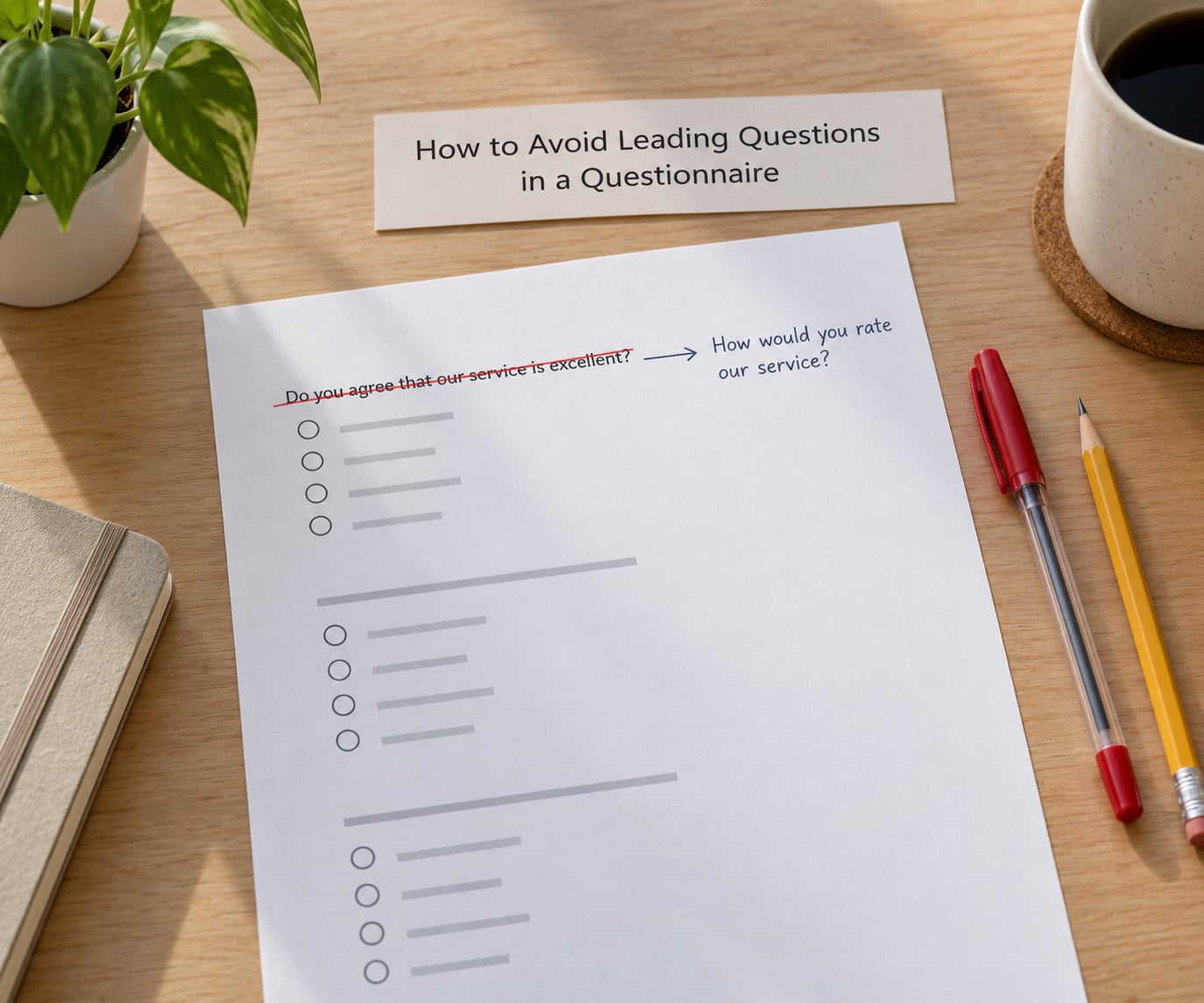
Leading questions distort data through response bias at the moment of collection. The wording cues the respondent, they answer in the direction implied, and that systematic shift lands in your dataset looking like a genuine opinion. It shows up as measurement error, and it usually pushes in one direction, which means your scores drift rather than scatter.
Here is the difference in plain sight. “How helpful was our fast and friendly service team?” presupposes that the service is fast and friendly, and a respondent who disagrees has to fight the wording to say so. “How helpful was our service team?” asks the same thing without asserting a conclusion the respondent has not agreed to.
Three things make an item leading: it contains an assumed belief, it embeds a value judgement, or it builds in a presupposition that has to be accepted before the question can be answered. Strip any of those out and the item gets measurably closer to neutral.
What You Need
You need the draft questionnaire, one sentence stating the research objective, a list of the variables you actually intend to measure, a short description of who will respond, and a handful of people willing to pilot it. That last one matters more than most people expect, because reading your own questions carefully is much harder than watching someone else answer them.
Keep the objective in writing. Wording drifts toward whatever conclusion you half expect, and a written objective is the thing that pulls it back.
Step-by-Step

Step 1: Start With the Research Objective
Write down what each question has to measure before you word it. If your objective is to estimate how satisfied customers are with delivery speed, the item asks about delivery speed and nothing else.
Now compare that to the draft item: “How well does our delivery process meet your expectations?” Expectations are a different construct from satisfaction, and “meet your expectations” lets respondents rate their expectations rather than their experience. The question is not leading exactly, but it is not measuring the objective either.
How do you know it worked? Read your objective and your question side by side. If the question would still make sense in a study with a different topic, it has drifted.
Step 2: Identify Assumption-Heavy Wording
Scan for absolute words first: always, never, all, every, none, constantly. They assume a pattern of experience that some respondents have and others do not. “How often do you feel our training is always available when you need it?” buries two problems in one clause: the absolute “always”, and an assertion that you provide training at all.
Next scan for value-laden adjectives: excellent, outstanding, best-in-class, frustrating, disappointing, effortless. These invite agreement or disagreement with the adjective rather than an answer to the question.
Then look for presupposition. Any phrasing that treats something as established, such as “when you contact our support team” or “how much you value our quick service”, asks the respondent to accept a premise in the first clause. A quick test practitioners use: read the question with the answer options removed. If the statement is not true of everyone who will see it, the premise needs to go.
Step 3: Replace Leading Questions With Neutral Ones
Rewriting is mostly deletion. Remove the loaded adjective, remove the absolute, remove the implied cause.
Leading: “How satisfied are you with our excellent, always-helpful support team?”
Neutral: “How satisfied are you with our support team?”
Leading: “How often do you feel we go above and beyond to resolve your issue?”
Neutral: “How satisfied were you with the way your issue was resolved?”
Leading: “What made our pricing so confusing?”
Neutral: “What, if anything, was difficult about our pricing?”
One warning worth taking seriously: a neutral rewrite can break comparability. If your instrument tracked a multi-item concept across three annual waves and you strip a descriptor from one item in wave four, that item is no longer measuring the same thing as the earlier ones. Neutralise the bias and keep the construct intact, or you have traded one problem for another.
Step 4: Fix Double-Barreled and Ambiguous Questions
A double-barreled question asks two things at once, so no single answer can satisfy it and the data cannot tell you which half mattered. “How fast and how friendly was the delivery driver?” needs to become two items: “How satisfied were you with the delivery speed?” and “How satisfied were you with the driver’s manner?”
Ambiguity is the same problem in softer form. Vague quantifiers like regularly, often and frequently mean different things to different respondents, and each one lands in a different answer bucket. Replace “How often do you use this feature?” with a numbered frequency scale such as daily, weekly, monthly, less often, never.
Watch for double negatives too. “Would you not agree that the report was easy to follow?” is technically answerable, but it invites misreading. Say “How easy was the report to follow?”
Step 5: Design Balanced Response Options
A perfectly worded question is ruined by lopsided options. Three rules cover most of it.
Keep the scale balanced. On a five-point scale, put two negative points on one side, one neutral in the middle, two positive on the other. A seven-point scale with five positive labels pushes scores upward on its own.
Make options mutually exclusive and non-overlapping. “0 to 20”, “20 to 30”, “30 to 40” leaves every boundary value belonging to two answers at once. Use 0 to 19, 20 to 29, 30 to 39, or label them clearly with inclusive bounds.
Do not make the attractive answer the longest or most complete one. If “excellent” carries a description and “poor” is a bare word, you have designed a scale that rewards a particular answer. Add an explicit middle option when you genuinely expect one; leave it out when you do not, but decide on purpose rather than by habit.
For sensitive items such as income, health or illegal behaviour, include a prefer-not-to-answer option. Forcing a response produces fabricated data, not honest data.
Step 6: Check the Order and Context
Wording contaminates everything after it. A leading question that flatters the organisation makes the next item more likely to agree, and the effect carries through the rest of the survey even when every later question is written cleanly.
Run broad to specific: general views first, then detail, then the harder or more sensitive items last. Put instructions and any worked examples in neutral language, since examples are read as exemplars and respondents anchor on them. Where you have a set of related items, consider randomising their order so no single item always primes the rest.
Step 7: Pilot-Test the Questionnaire
Testing is the step that catches what reading cannot. Ask five to eight people from your target group to complete the instrument while thinking aloud, and ask four questions of each: what does this question mean to you, how did you choose your answer, what did you think it was asking, and was anything confusing or missing.
Write down every hesitation. A pause before an answer is often the first sign of an ambiguous item. Then ask a colleague who did not write the survey to mark every sentence they would read twice. If you have budget, run a soft launch to a small sample and check whether the response pattern on each item matches what the wording predicts. Items where nearly everyone picks the same option, or where the most popular option is far more popular than the concept warrants, deserve another look.
Common Mistakes
Treating a proofread as a bias review. Proofreading catches typos. It does not catch presupposition. Run a separate pass against the list of absolute and value-laden words.
Using persuasive wording in the instructions. An introduction that explains why the study matters, or thanks respondents for being positive, shifts answers as effectively as a leading item. Keep it to what the respondent needs to know.
Asking two things in one item. Split the question rather than adding an “and also” clause.
Using vague timeframes. “In the past few months” produces recall differences as much as opinion differences. Name a window and use the same one across items.
Assuming knowledge the respondent may not have. If a term is internal jargon, define it in one line or replace it. “How would you rate our CR-200 onboarding module?” tells a first-week hire nothing about what you want from them.
Letting the answer options drift. Review options separately from the question text. They lead independently of the stem.
Over-correcting into vagueness. Removing every descriptive word can leave an item too thin to interpret. Keep enough detail to identify what is being rated.
Frequently Asked Questions
What are leading questions in a questionnaire?
A leading question is a survey item that suggests or assumes a preferred answer, so respondents tend to reply in the direction the wording points rather than reporting their own view. Typical signs are absolute words such as always or never, value-laden adjectives, and phrases that treat something as already established. An example is asking how helpful your excellent service team was, which assumes the team is excellent before anyone answers.
Why should leading questions be avoided?
Leading questions introduce response bias at the point of collection, so the recorded data stops representing the population you sampled. In practice they inflate satisfaction and engagement scores, suppress criticism, and contaminate every item that follows them through order effects. The damage is systematic rather than random, so it does not wash out with a large sample. Your confidence grows with the sample size while the bias stays exactly where it was.
How do you fix a leading question?
Find the assumption, then remove it. Cut absolute words, value-laden adjectives, and any clause that presupposes an experience or belief. Ask what the question needs to measure, write a plain version in plain language, and check that every answer option remains balanced around the middle. Then pilot-test the rewritten item with a few people from your target group and listen for hesitation.
What is the difference between a leading question and a loaded question?
A leading question pushes respondents toward an answer through its wording, often with evaluative adjectives or an assumed premise. A loaded question assumes something about the respondent rather than the topic, such as presupposing that they are a heavy user, an expert or a dissatisfied customer. Both distort results, but the fix differs: leading items need neutral wording, loaded items usually need a screener or branching so the question only reaches the people it fits.
What type of questions should be avoided on a questionnaire?
The main ones to avoid are leading, loaded, double-barreled, double-negative, absolute and vague questions. Leading items steer the answer, loaded items assume facts about the respondent, double-barreled items ask two things at once, double negatives invite misreading, absolute items use always or never, and vague items rely on quantifiers such as regularly or often. None of these is unusable, but each needs rewriting before it goes into the field.
What is the opposite of a leading question?
The opposite is a neutral question: one that names the topic, states any timeframe plainly, and offers balanced response options, so a respondent can answer for their own experience without fighting the wording. Neutral does not mean vague, and it does not mean dull. A specific, plainly worded item that lets a disagreeing respondent disagree without difficulty is the goal.
Conclusion
Start with the objective, then work through the draft in this order: write what each item must measure, scan for absolute and value-laden words, strip the presupposition, split anything asking two things, balance the response options, check the order, and pilot-test with five to eight real respondents. If you only do two things today, read your questions aloud with the answer options covered and read each item with the words “always” deleted. The awkward ones surface quickly.