To avoid plagiarism when writing a results chapter, quote anything word-for-word, rewrite everything else in a structure you built yourself, and add your own analysis of what the numbers mean for your research questions. Citation alone is not enough. It tells the reader where a finding came from, but a results chapter still has to demonstrate that you understood the material well enough to interpret it. Budget an extra two or three hours per chapter for this, mostly spent checking sources and reading flagged passages. Doing it as you draft costs a fraction of what re-writing a flagged chapter costs.
Results chapters attract more accidental plagiarism than other sections because the writing is formulaic. Phrases like “a significant difference was observed between the two groups” recur in thousands of papers, and standardised survey items, scale wording and instrument descriptions often have to be repeated verbatim. Examiners know this, which is why they read results sections closely for signs of genuine work.
Table of Contents
- 1What You Need
- 2Step-by-Step: How to Avoid Plagiarism When Writing a Results Chapter
- 3Plan the Chapter Around Your Research Questions
- 4Record Every Source and Data Source
- 5Report Numbers and Findings in Your Own Analytical Context
- 6Use a Citation for Ideas, Methods, and Prior Research
- 7How to Avoid Plagiarism in the Results Chapter When Paraphrasing Statistics
- 8Quote Only When the Exact Words Matter
- 9Check Tables, Figures, Notes, and Captions
- 10Run a Final Plagiarism and Citation Audit
- 11Common Mistakes
- 12Frequently Asked Questions
- 13How much percentage of plagiarism is acceptable in a thesis?
- 14Is 25% plagiarism okay?
- 15Is it still plagiarism if you reword it?
- 16Can paraphrasing be considered plagiarism?
- 17Is it plagiarizing if you use ChatGPT?
- 18Turnitin says I plagiarized my assignment, but I didn’t. What should I do?
- 19Start With a Source Ledger, Not a Paraphrasing Pass
What You Need
Five things, and none of them expensive.
- Your locked analysis outputs. Final SPSS, Stata or R output, exported tables, the syntax file, and a data dictionary listing every variable and its coding.
- A source ledger. A single running list — a spreadsheet works fine — of every article, report, dataset and prior paper that contributes anything to the chapter, with the specific page, table or paragraph used.
- Your required citation guide. APA 7th, Harvard or Vancouver, whichever your department mandates. Mixing styles inside one chapter is flagged even when the sources are correct.
- Your institution’s integrity policy and examiner regulations. Thresholds, AI-use rules and self-plagiarism treatment all differ between universities and sometimes between departments.
- One second reader and access to a plagiarism checker. The reader catches what the software cannot; the software catches what your eyes skip.
If your institution does not provide checker access, ask your supervisor or the library, because many hold institutional subscriptions students cannot reach directly.
Step-by-Step: How to Avoid Plagiarism When Writing a Results Chapter
Plan the Chapter Around Your Research Questions
Build the outline from your research questions first, then slot in tables and tests under each one. A results chapter organised by question tells the reader what you tested, what came back and how strong the evidence is — which is exactly the original argument examiners are looking for.
An outline copied from another dissertation’s results chapter is already borrowed structure, even if every sentence underneath is yours. Write your headings in plain language that matches your questions, and resist the temptation to reuse an elegant phrasing you found in a journal article you liked.
Record Every Source and Data Source
Add a row to your ledger the moment you open a source, not when you cite it. Columns worth having: author and year, what you took from it (a figure, a method, an interpretation, a whole dataset), the exact page or table number, and whether you will quote it or rewrite it.
Software output counts as a source too. When you describe what a test did, you may need to cite the software documentation, and derived datasets need their origin stated. For statistical tests with a canonical reference, a citation shows you know the method’s literature rather than reinventing it.
Report Numbers and Findings in Your Own Analytical Context
Your own findings need no citation. Reporting your own t-test output as “a significant difference was observed” is not plagiarism, because no one else produced that result. You may still cite the scale or instrument you used, because that wording belongs to someone else.
The line to watch is the moment you describe another study’s finding. Then a number always travels with a citation, and the wording around it should be yours. If you find yourself copying a sentence from a paper and changing only the tense, you have created mosaic plagiarism rather than paraphrased it.
Use a Citation for Ideas, Methods, and Prior Research
Cite whenever the intellectual content came from elsewhere: a borrowed method, an adopted scale, a classification scheme, an established theoretical construct, or a prior result you are comparing against. Citation covers the idea; it does not license the phrasing, so the sentence around the citation still needs to be rewritten in your own structure.
Most institutions treat a correct citation paired with unattributed close wording as a citation failure rather than as cleared plagiarism, and many count each missing source separately. When in doubt about whether something needs attributing, attribute it — an unnecessary citation costs nothing, an absent one can cost the whole chapter.
How to Avoid Plagiarism in the Results Chapter When Paraphrasing Statistics
Statistics are where paraphrasing quietly breaks. Numbers cannot change, and the sentences around them are often near-identical across studies, so detection software matches long numeric strings even when your prose is original.
Rewriting a numeric finding usually means three moves. Change the structure — lead with the design or the sample rather than with the test. Change the emphasis — report the effect size first and the significance test second, or describe the pattern before naming the statistic. Then add a clause that only you could write, such as a note on what the number means against your own research question. That last clause is what turns a restatement into analysis, and it is the one part a similarity checker cannot supply.
Two worked versions of the same borrowed finding show the difference. The first, and common, version reads: “This study showed a significant difference between the two groups (p < .05), which is consistent with the findings of Smith (2026).” It adds nothing, and it sits close to the source wording.
The second version reads: “Group scores in this sample diverged more than the pooled benchmark, with the between-group difference reaching significance at p < .05. Smith (2026) reports the same pattern under a comparable design, which strengthens the case that the effect is not specific to our sample.” The number is unchanged, the citation is present, and the interpretation belongs to you.
One caution specific to this site: never copy tables of output straight from software documentation or a tutorial and present them as your analysis. Report your own output, and describe it in your own words.
Quote Only When the Exact Words Matter
Use quotation marks when altering the words would lose precision — a participant’s phrasing that carries the meaning, a definition you must not distort, or a conclusion stated so precisely that rewriting would blur it. Quote sparingly; a results chapter full of quoted material looks like evidence it cannot interpret.
For every quotation, give the page or paragraph reference rather than only the author and year, and never stitch together fragments from different parts of a source into one continuous quotation without an ellipsis. Participant responses in a results chapter deserve quotation more often than published prose does, because their wording is data.
Reproduce instrument and survey items verbatim when reporting responses to them, since altered wording changes the meaning of the answers. Mark them as reproduced rather than adapted, and cite the original instrument.
Check Tables, Figures, Notes, and Captions
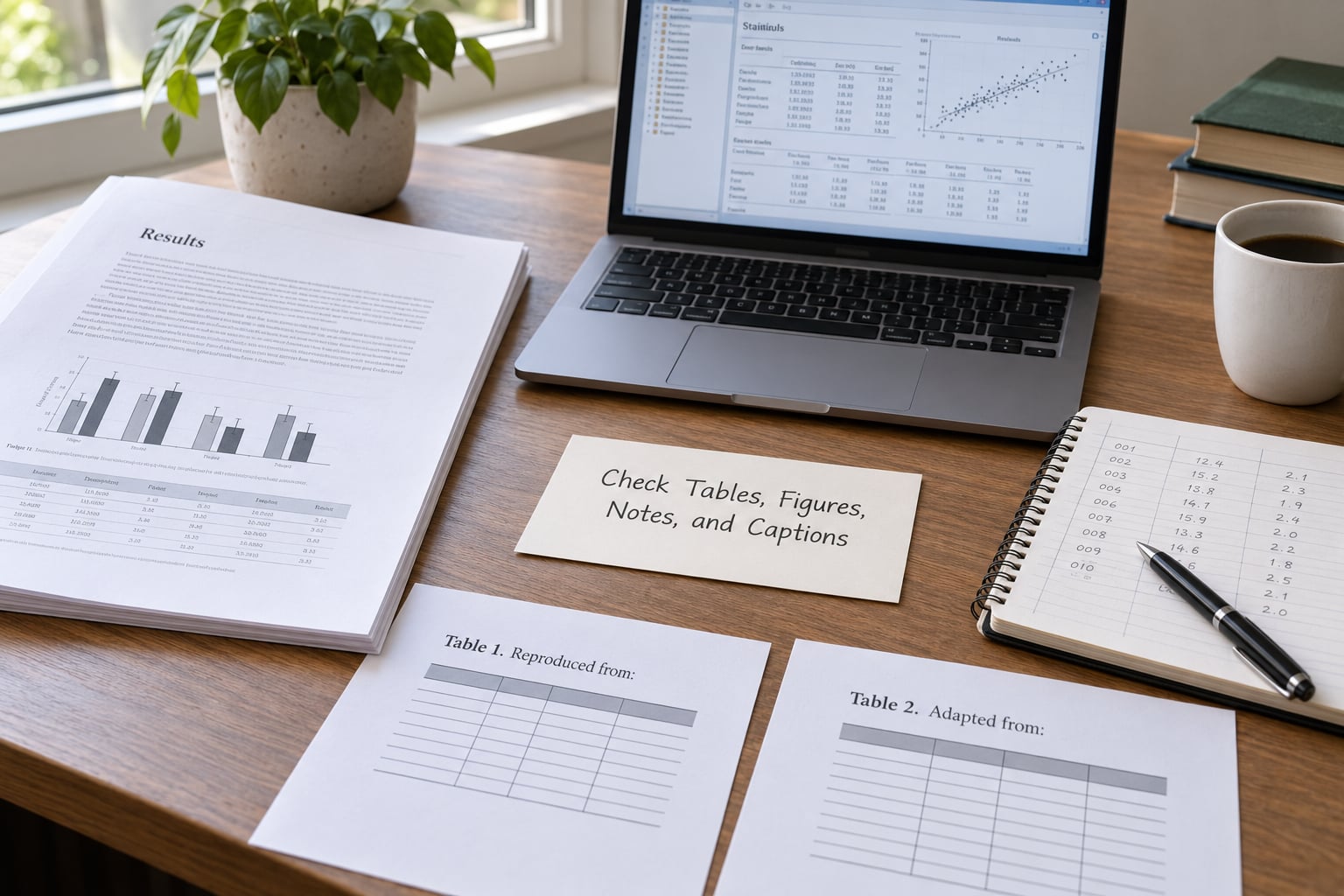
Tables and figures are the most-missed plagiarism vector. Citing a table you have reproduced does not automatically make the reuse acceptable — many institutions distinguish copying from adapting, and adaptation carries its own disclosure requirement.
Three rules cover most cases. Reproduced material keeps the original layout and content and is labelled “reproduced from”. Adapted material, where you reformat, reorder or extend a published table, is labelled “adapted from”. Anything you generate yourself is labelled “author’s own”, which is the default for your own output and should be stated so readers can tell the difference at a glance.
Apply the same discipline to captions, table notes, footnotes and variable definitions. A caption lifted with its table is still lifted text.
Run a Final Plagiarism and Citation Audit
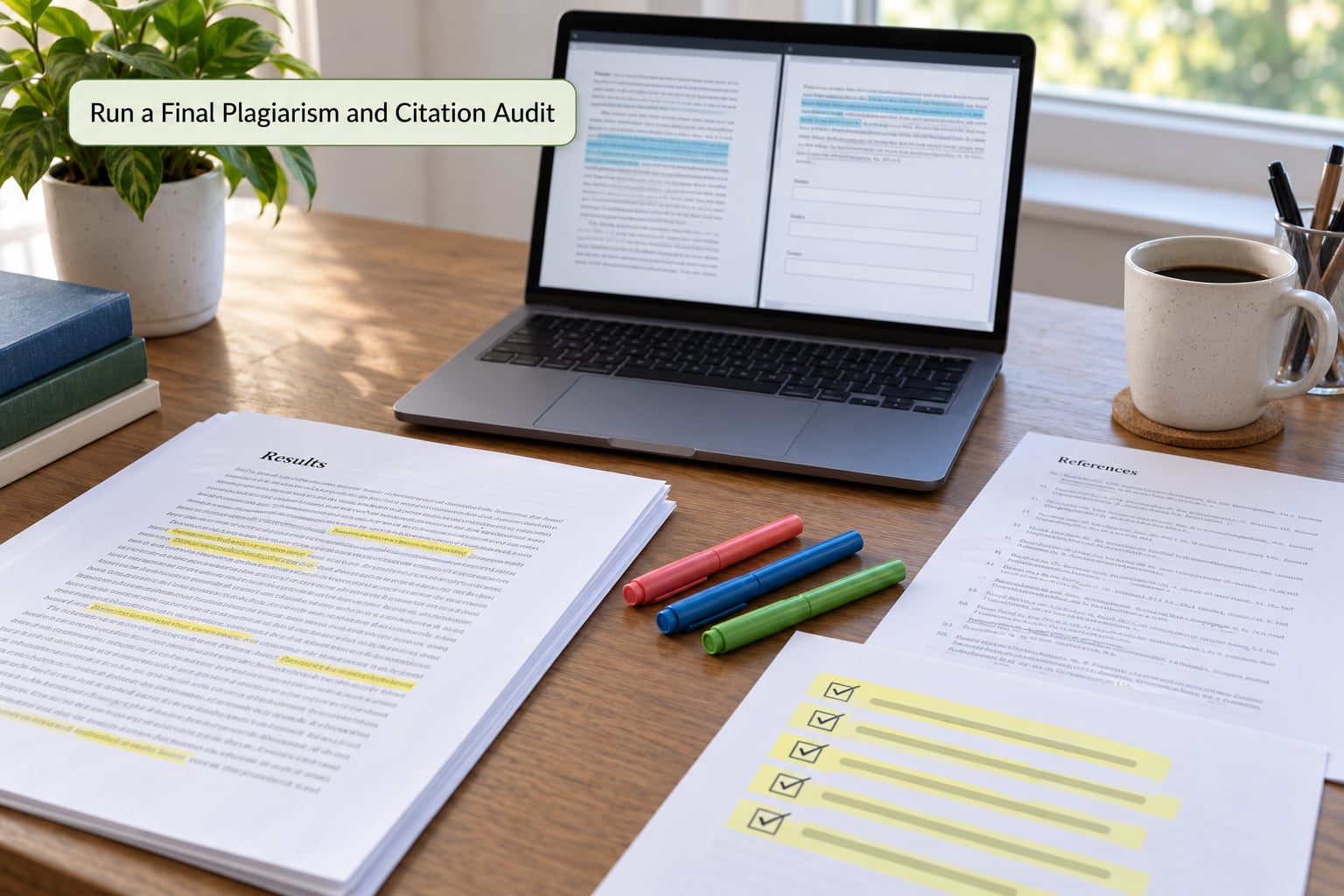
Submit a draft to a similarity checker before your supervisor sees it. Students who do this treat it as a routine habit, and it is a better one than discovering a flag after the deadline has passed.
Work through the report in a fixed order. Read every highlighted passage and decide, sentence by sentence, whether it is quoted and cited, paraphrased and cited, or your own. Anything in the third category is fine even at high similarity, which is why quotations and standard instrument wording often dominate a report’s top matches. Then check that every citation in the text appears in the reference list, and that the reference list holds no entries you never cited.
If the report flags something you did not plagiarise — a formulaic methods sentence, a block of references, a standard instrument description — do not rewrite around it. Attach the marked draft with the source identified and request review through your institution’s appeal process, which usually means contacting the module leader or running a formal appeal with supporting evidence within a stated window.
Expect flagged passages to be the ones where your discipline fixes the wording. Instruments, validated scales and standard test names are supposed to match their sources exactly, and examiners recognise that.
Common Mistakes
These account for nearly every flagged results chapter I have seen, and each has a straightforward correction.
| Mistake | What it looks like in a results chapter | The correction |
|---|---|---|
| Missing citation on a borrowed number | A statistic from a published study reported without attribution | Attach the citation to the number and rewrite the surrounding sentence |
| Copy-and-tweak phrasing | A sentence lifted intact with one or two words swapped | Close the source, then rebuild the sentence from your notes in your own structure |
| Inappropriate paraphrasing | Synonym substitution and tense shifts that leave the sentence skeleton intact | Change sentence structure and add a clause tied to your own data |
| Borrowed tables and figures | A published table pasted in with a citation but no adaptation note | Label it reproduced or adapted, and cite the source in the caption and note |
| Uncredited software or dataset | A dataset used without stating where it came from | Name the dataset, its provider and any access conditions |
| Self-plagiarism | Reusing text from your own published paper or earlier coursework as if new | Cite your own prior work and disclose the substantial overlap |
| Interpretation written in the wrong chapter | Extended discussion of why results matter sitting inside the results section | Move the reasoning to the discussion chapter and leave reporting in results |
| Passing off paraphrased AI output as your own | Smooth generic prose covering findings you never wrote | Read your institution’s AI policy, and rewrite from your analysis rather than from the tool’s text |
Three habits fix most of these before a checker ever sees the file. Keep the source ledger open beside your draft. Read every paragraph aloud — borrowed phrasing often trips differently when spoken than it looks on screen. And build an original argument, then challenge the sources you disagree with, rather than assembling your chapter from summaries of what others found. That last habit does more for originality than any rephrasing technique.
Frequently Asked Questions
How much percentage of plagiarism is acceptable in a thesis?
No universal figure exists. Most universities publish their own thresholds, and they commonly differ by programme, by submission type and by examiner. Some treat a modest similarity score as unremarkable because references, quotations and standard instrument wording inflate it, while others mark anything above a low ceiling for review. Check your own institution’s policy and your module handbook, then ask your supervisor what they expect rather than guessing at a number.
Is 25% plagiarism okay?
A 25% similarity score is a measurement, not a verdict, and the same number can mean very different things in different chapters. Read the report: quotations with quotation marks, a reference list and repeated instrument wording all raise the figure without being misconduct. What matters is whether every unmarked passage is properly attributed. Find your institution’s stated threshold, and if the report is dominated by material you quoted or cited correctly, you may have nothing to fix at all.
Is it still plagiarism if you reword it?
It can be. Changing words while keeping the original sentence structure leaves the phrasing recognisable, and similarity tools match those sequences reliably. Swapping synonyms is the most common version and the easiest for an examiner to spot. Genuine paraphrasing changes the structure of the sentence, reorders the information and adds a point that belongs to your own analysis. If the reader could reconstruct the original sentence from yours, you have not paraphrased it.
Can paraphrasing be considered plagiarism?
Yes, when the paraphrase stays too close to the original, when it omits a citation, or when it conveys an idea rather than a result. Reported findings and borrowed methods need attribution even when reworded in your own words. Paraphrasing also fails when it distorts the statistics: rounding a figure, dropping a condition or converting a correlation into causation changes the finding. Keep the numbers exactly as published and let your interpretation be the part that is genuinely yours.
Is it plagiarizing if you use ChatGPT?
It depends entirely on your institution’s policy, and the policies are still settling. Most universities now allow some AI assistance while prohibiting submission of generated text as your own, and several require you to declare any use in the methodology or an acknowledgement. Because tools draw on published text, paraphrasing the output does not make it yours, and detection of AI writing is unreliable enough that relying on it to hide use is a poor strategy. Read your department’s written rule before you use a tool at all.
Turnitin says I plagiarized my assignment, but I didn’t. What should I do?
Do not rewrite the passage. Read the matched source first and decide whether it is quoted and cited, paraphrased and cited, or genuinely your own. If it is properly attributed and the match comes from a quotation, a formulaic methods sentence or repeated instrument wording, submit the marked draft with the source identified and request review through your institution’s appeal process. Most module leaders will check a match that is well under the threshold, and supplying the source in advance usually resolves it quickly.
Start With a Source Ledger, Not a Paraphrasing Pass
If you do one thing differently this year, open a spreadsheet before you draft and log every source as you use it. Everything else in this guide is a technique applied on top of that record. Without it, you are relying on memory to attribute material you read three months ago, and memory is where accidental plagiarism starts. Keep the ledger, draft from your own notes, and run a similarity check before your supervisor reads the chapter.