To proofread your own dissertation, work through the draft in separate, single-purpose passes rather than reading it end to end once: structure first, then citations and tables, then formatting, and language last. Budget roughly one hour per 1,000 words across all passes, spread over at least three weeks, because a full draft proofread in a single sitting is where most errors survive.
The hard part is not effort. You already know this document better than anyone alive, and that familiarity is exactly what hides the mistakes. The fix is procedural rather than motivational: change the order you read in, the format you read in, and the pass you are hunting for, and errors that were invisible become obvious.
Table of Contents
- 1What You Need
- 2How to Proofread Your Own Dissertation Step by Step
- 3Start with a Complete, Distraction-Free Draft
- 4Check the Brief and the Big Picture
- 5Proofread One Level at a Time
- 6How to Proofread Your Own Dissertation for Language Errors
- 7Check Citations, References, Tables, and Figures
- 8Review Formatting and Submit the Final File
- 9Common Mistakes
- 10Frequently Asked Questions
- 11How long should it take to proofread a dissertation?
- 12Should I proofread my dissertation before or after my supervisor reviews it?
- 13Is it acceptable to use Grammarly or another grammar checker?
- 14Does proofreading a dissertation mean changing every sentence?
- 15How should I check references and citations efficiently?
- 16When should I hire a professional dissertation editor?
- 17Conclusion: Begin with a Structured First Pass
What You Need
Gather these before you open the file for correction. A proofreading session with missing pieces turns into guesswork, and you end up re-opening the same chapter three times.
- A structurally complete draft. Every chapter, section, table, figure and reference present, even if some sections are thin. Proofreading is the last stage, not a way to find gaps in an unfinished argument.
- Your university or supervisor guidelines. The handbook page covering margins, fonts, line spacing, headings, page numbering, referencing style, word limits and file format. Print it or keep it on a second screen.
- Your reference manager files and any saved search strings. If you use Zotero, Mendeley or EndNote, export or open the library so every entry can be checked against your in-text citations.
- A change-tracking document. A plain table or list where each pass records what you changed and any decision you made about style. This becomes your style sheet and error log for later chapters and any future writing.
- Two tools, not one. A spell checker for the mechanical sweep, and a grammar tool such as Grammarly or a general AI assistant used only as a flagging layer. Neither replaces your reading.
- A realistic schedule. Three weeks for a 10,000 to 15,000 word dissertation, four to six weeks for a longer thesis, with a final 24 hours reserved for the submission check only.
How to Proofread Your Own Dissertation Step by Step
Run the passes in the order below. Each one answers a different question, and mixing them is why single-sitting proofreads stall: you spot a comma splice in chapter two, stop to fix it, lose your thread on the argument, and never get back to the reference list.
Start with a Complete, Distraction-Free Draft
Close every messaging app, silence email, and put the phone in another room. Then take two backups before you touch anything: one timestamped in your cloud folder and one on a USB stick. When a find-and-replace goes wrong at 11pm, that backup is the difference between a lost evening and a lost weekend.
Change the physical conditions of reading too. Print the chapter and read it on paper, or open it on a tablet or a different computer, or change the font to something you would never choose for writing, such as a wide serif at a larger size. Familiarity is carried partly by layout, so disturbing the layout disturbs the reading.
If you have just written for six months, wait at least ten days before starting. Two to three weeks is better. Proofreading while still attached to the writing process reliably produces fatigue rather than accuracy, and you will import fresh errors into sentences you barely looked at.
Check the Brief and the Big Picture
Put your dissertation next to the assignment brief or research proposal and check compliance line by line. Word count limits, required chapters, methodology sections, ethics statements, and the research questions themselves. If the brief names three objectives, confirm that each one is addressed and that the conclusion explicitly answers them.
Then build a reverse outline: one line per section stating what that section actually argues, not what you planned it would argue. This is the fastest way to expose padding, duplicated arguments, and a chapter that drifts off the question. Read only headings and first sentences if you want a faster version.
Check the balance while you are there. A 4,000-word literature review next to a 900-word discussion chapter is a structural problem a spell checker will never report. Ask yourself whether the evidence supports the claim in each section, and whether any conclusion reaches further than the results chapter allows.
Proofread One Level at a Time
Work from the top down: headings first, then paragraphs, then sentences, then individual words. Fixing a comma before you have checked whether the paragraph belongs in that section wastes the edit, because the sentence may be deleted an hour later.
At the heading level, check that the hierarchy is consistent, that numbering runs without gaps, and that every heading title-cases or sentence-cases the same way. A reverse outline doubles as this check because it forces you to read every heading in sequence.
At the paragraph level, check one thing per paragraph: does the first sentence say what the paragraph does? At sentence level, look for the errors listed in the next section. At word level, run the mechanical sweep, which is the one pass a tool can do reliably.
How to Proofread Your Own Dissertation for Language Errors
Run one pass per error class instead of one pass for all of them. Each class takes a different kind of attention, and hunting one at a time is what lets you see it consistently across 40,000 words.
- Subject and verb agreement. Long subjects between the verb and its verb trigger most of these, especially in methods sections: “The number of participants who were recruited was small.”
- Faulty predication. A link verb that makes no claim about the subject: “The problem was the sample size.” What was the problem? The size. Rewrite it as “The problem was that the sample size was small.”
- Misplaced modifiers. A phrase that attaches to the wrong noun, often at the start of a sentence: “Having read the appendix, the marker was impressed.”
- Tense shifts. Literature review in past or present tense, methods in past, findings in present, discussion in present. Pick one and hold it.
- Comma splices. Two independent clauses joined by a comma alone. Use a semicolon, a full stop, or a conjunction.
- Homophones and confusables. its and it’s, affect and effect, their and there, then and than, complement and compliment, and the discipline-specific pairs that catch people out, such as principal and principle, or stationary and stationery in a methods appendix.
- Articles. Common trouble for non-native English speakers: “the improvement in satisfaction” rather than “improvement of satisfaction.” Search for repeated “the of” patterns as a quick diagnostic.
Read every sentence aloud. Your ear catches a missing word, a doubled word, and an unresolvable clause before your eye does, and it is the single most reported technique among doctoral writers. Slow down on anything longer than 25 words; that is where commas usually hide.
Track every change in your change-tracking document. As the passes accumulate, the same error will reappear across chapters, and once you have spotted it three times you can search for it globally instead of finding it by hand.
Check Citations, References, Tables, and Figures
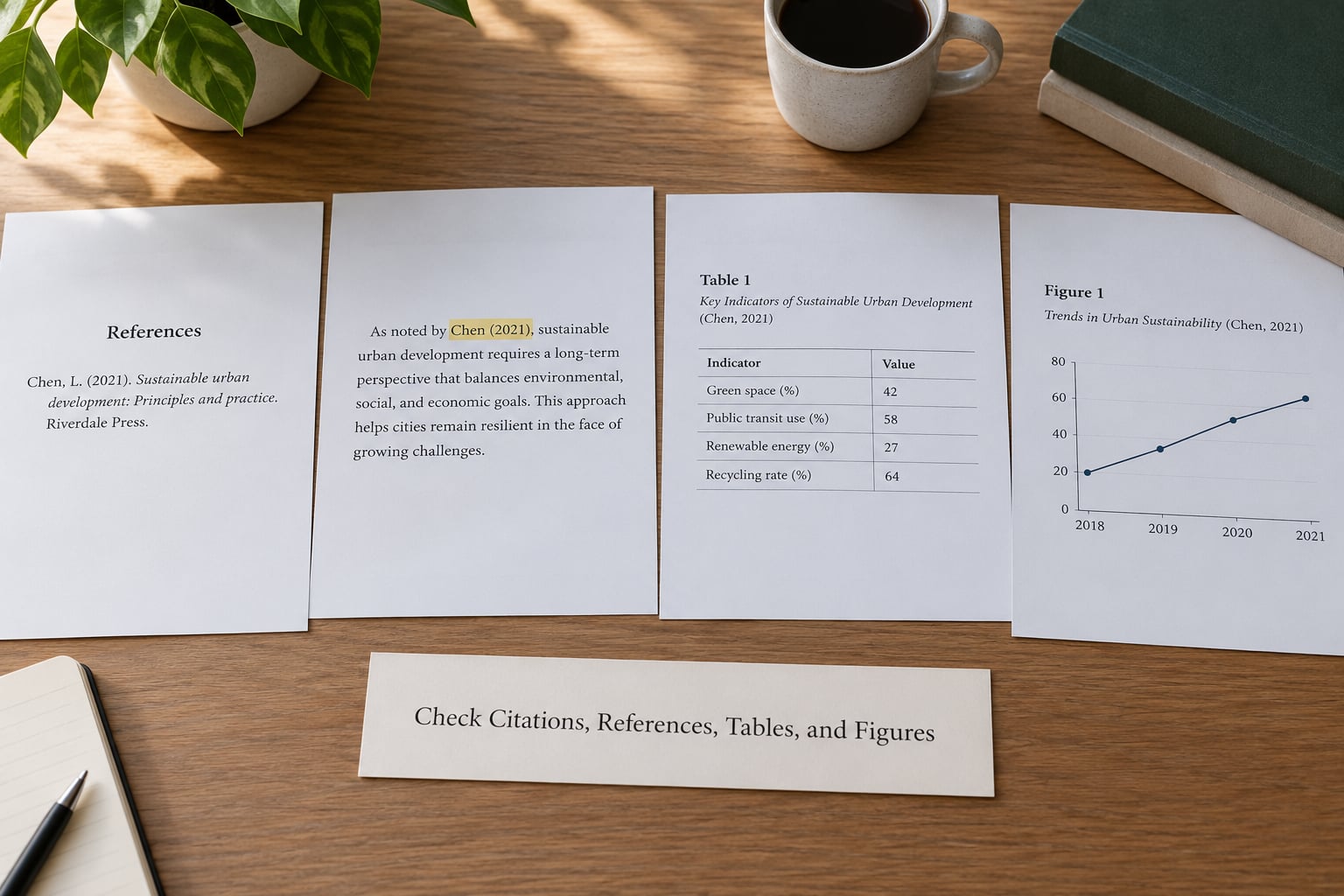
Matching citations to references is mechanical and takes about an hour for a 15,000 word dissertation. Work through it systematically rather than by eye.
Export your reference list from your reference manager as plain text, then read it against your in-text citations in order. Every citation needs a matching entry, every entry needs at least one in-text citation, and the author names and years must match exactly. Look for entries that survived from an earlier draft and sources you cited in chapter two and never revisited.
Then check style compliance inside the entries: how many authors trigger “et al.”, whether that abbreviation takes a full stop, page numbers abbreviated as p. or pp., capitalisation of titles, and italics applied in the body text as well as the list. Pick the required style, APA, Harvard, MLA or Chicago, and apply it without mixing conventions across chapters.
For tables and figures, confirm that each one is referred to in the text before it appears and again after it, that numbers run consecutively in order of first mention, and that every caption is complete with a label and a title. Check that notes beneath tables are numbered and defined, and that no table is orphaned from its discussion. If your results include statistical output, verify that p-values, test statistics, degrees of freedom and confidence intervals are formatted identically everywhere, and that every figure number quoted in the text exists in a table and carries the same value. An inconsistency between a table and the sentence describing it is one of the most common failures examiners notice.
A reverse check works well here: read only the tables and figures first, then write down what each one appears to claim, then compare that with the surrounding text.
Review Formatting and Submit the Final File
Run the formatting pass last, once the content has stopped moving. Check margins, font family and size, line spacing, paragraph spacing, heading styles, page numbering including front matter, running head, page breaks between chapters, appendix labels, and the table of contents page references.
Verify the document word count against your limit, and remember that many institutions count differently from your word processor, sometimes excluding tables, figures, and references. Use your institution’s stated method rather than guessing.
Submit a clean copy. Accept or reject every tracked change deliberately, delete all comments, remove hidden document properties and personal details from the file, name it exactly as required, export it in the required format, and open the exported file once more to confirm nothing shifted during conversion. Only after that, send the file and keep the timestamped backup.
If your supervisor’s feedback arrived late, treat it as a new pass rather than a new draft. Re-read the sections they flagged, correct, and then return to your style sheet so any new wording matches the conventions you already applied.
Common Mistakes
- Proofreading in one sitting. Fix by scheduling one pass per day or per two chapters, with a hard stop.
- Correcting while still writing. Comments on section three interrupt section four. Fix by finishing the draft first, however rough it feels.
- Reading only on screen. Your eyes skip the same lines every time. Fix by printing one chapter and reading it on paper.
- Ignoring repeated terms and inconsistent headings. Fix by keeping a style sheet and searching the document for every variant of a recurring term.
- Ignoring the required style guide. Fix by printing the handbook page and checking the manuscript against it line by line rather than from memory.
- Trusting spell check. It will not catch a missing citation, a wrong year, or a term you spelled consistently the wrong way. Fix by using it only as a final sweep.
- Changing academic meaning. Proofreading corrects language, not claims. If a sentence needs rewording to make sense, that is an editing pass for your supervisor, not a silent fix.
- Submitting with comments or tracked changes open. Fix by running the submission checklist last, on the exported file.
Frequently Asked Questions
How long should it take to proofread a dissertation?
Budget roughly one hour per 1,000 words across all passes, not per reading. A 10,000 word dissertation takes about 10 hours of focused work; a 40,000 word thesis closer to 40. Spread that across three to six weeks so no single session runs longer than 90 minutes, and add the week or two of waiting after you finish writing.
Should I proofread my dissertation before or after my supervisor reviews it?
Do a light structural pass first, then send the draft to your supervisor with spelling and reference errors already cleaned up. That way their comments focus on argument rather than commas. After their feedback arrives, run the full multi-pass routine on the revised draft, since new material introduces new errors.
Is it acceptable to use Grammarly or another grammar checker?
Yes as a flagging layer, never as an editor. Tools are good at agreement, spacing, repeated words, and inconsistent terminology, and they miss broken citations, wrong values in tables, and unclear arguments. Never paste unpublished or confidential research into a cloud tool, and check your university’s AI policy before using one at all.
Does proofreading a dissertation mean changing every sentence?
No. A good pass changes a minority of sentences, usually a few percent. If most of your sentences are being rewritten, you are editing rather than proofreading, which is a bigger job and one to raise with your supervisor. Preserve your disciplinary voice and only intervene where meaning is unclear or the grammar misleads.
How should I check references and citations efficiently?
Export your reference list as plain text and match it against your in-text citations in order, confirming that each citation has an entry and each entry has a citation, with matching author names and years. Then check style details such as the et al. threshold, italics, and capitalisation. Budget about an hour for 15,000 words.
When should I hire a professional dissertation editor?
Hire one when the deadline is tight, when the format is unusual or prescribed in detail, or when a clean final pass on your own work has not caught the errors you know remain. Ask for proofreading and formatting only, not rewriting, and confirm in writing that the service will not change your argument or generate content.
Conclusion: Begin with a Structured First Pass
Start where most people do not: put the full draft in front of you, keep two backups, print one chapter, and read it against the assignment brief before correcting a single word. From there, run the passes in order, one error class at a time, and write down every change in your style sheet so the same mistake stops coming back three chapters later. Reserve the last day for formatting and the final file check, and you will proofread your own dissertation with far more reliability than another careful read-through could ever give you.