To respond to supervisor comments on a draft, you read every comment without editing, sort the feedback into categories, record your decision on each one in a point-by-point response table, revise the draft in priority order, and send back a tracked-changes copy with a short written note. The written record matters as much as the revisions themselves.
A supervisor’s comments usually arrive as a mix of priorities: two conceptual problems that affect the argument, forty line edits, and a handful of vague instructions like “needs more critical analysis.” Treating the pile as one undifferentiated list is where most students lose a week. The method below turns it into a fixed number of decisions you can track to zero.
The workflow takes anywhere from a few hours on a short report to two or three weeks on a full dissertation chapter. The difficulty is low if you keep a table; it climbs fast if you try to hold every comment in your head. If you already know the general theory of academic writing, our guides on research methods and statistical reporting will cover the discipline-specific side of your revisions.
Table of Contents
- 1What You Need
- 2Step-by-Step: How to Respond to Supervisor Comments on a Draft
- 3Step 1: Read the Feedback Once Without Revising
- 4Step 2: Sort Comments Into Categories
- 5Step 3: Create an Action and Decision Table
- 6Step 4: Ask Questions When Feedback Is Unclear
- 7Step 5: Revise the Draft in Priority Order
- 8Step 6: Draft a Professional Response
- 9Step 7: Proofread, Check, and Request the Next Step
- 10Common Mistakes
- 11Frequently Asked Questions
- 12Should I respond to every comment my supervisor makes?
- 13How do I tell my supervisor I disagree with their feedback?
- 14How do I ask my supervisor to clarify vague feedback?
- 15How do I send a revised draft back to my supervisor?
- 16Does the dissertation supervisor mark the dissertation?
- 17Conclusion
What You Need
Set up these five things before you touch the draft. Without them you will lose track of comments within a day, because you cannot check whether a change you thought you made actually landed.
- The annotated draft. Your supervisor’s comments in the margin, in comment threads, or written on a separate sheet. Keep it exactly as returned, including tracked changes.
- The clean submitted version. The file you sent, not the one with your working notes. Line and page numbers must match what your supervisor read, or your references will point to the wrong place.
- The brief, proposal or agreed scope. The document that defines what the project was meant to do. It settles a surprising number of arguments about whether a comment belongs in scope.
- A response table. A new document, one row per comment. The next section shows the columns.
- Formatting and citation requirements. The style guide, word limits, referencing rules and any file-naming conventions your programme enforces.
Add the submission deadline and your supervisor’s stated turnaround for the next round. If you do not know the deadline, that is a clarification request in itself, and it belongs in your first email rather than in a panicked message two weeks later.
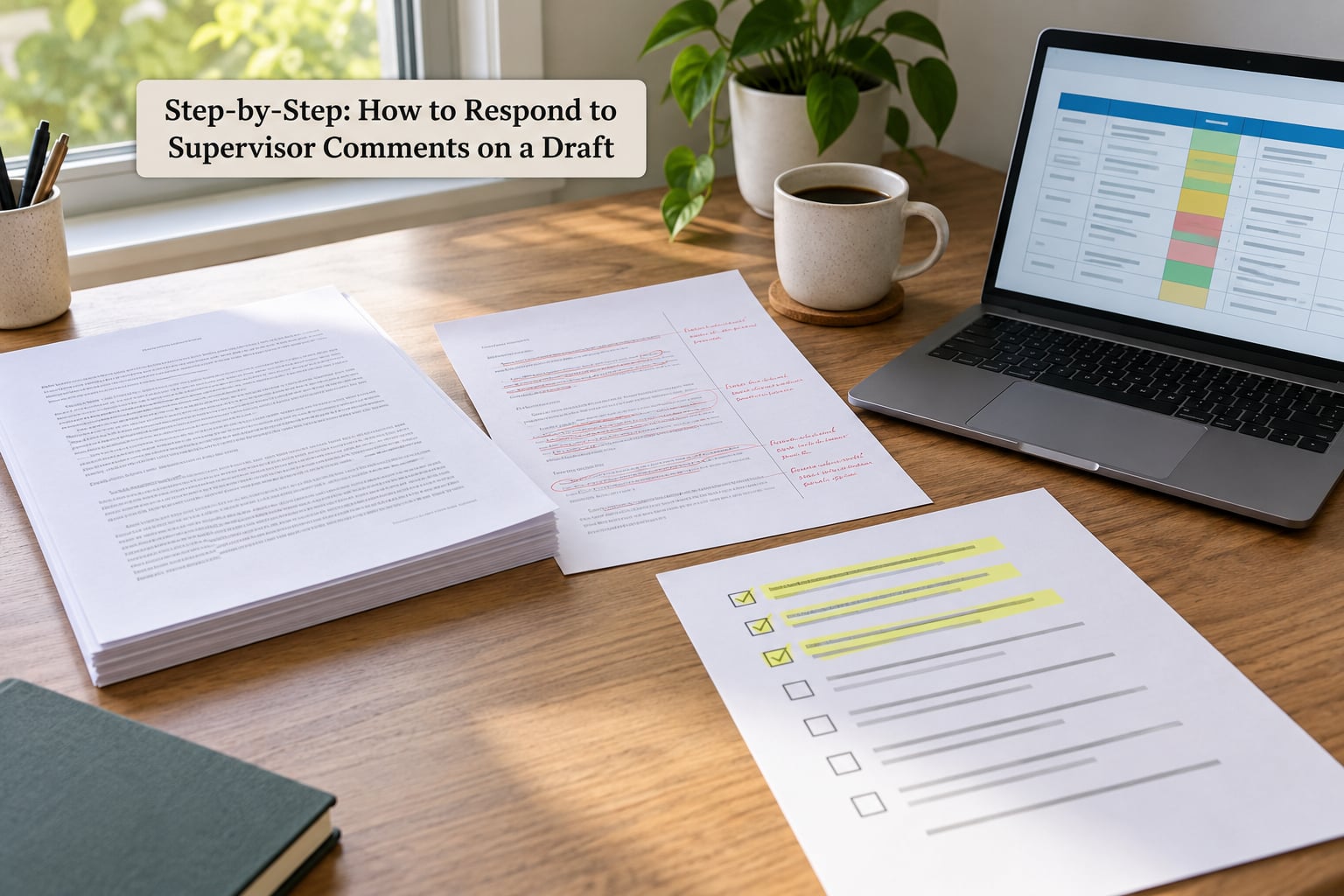
Step-by-Step: How to Respond to Supervisor Comments on a Draft
Step 1: Read the Feedback Once Without Revising
Read the whole set of comments straight through, then close it. Do not start editing as you read, because you will fix whatever you happen to be looking at and lose the pattern in the rest.
As you read, mark only two things: the three or four comments that change what the draft argues, and anything you do not understand. A page of returned draft with forty comments often contains two real structural problems buried under thirty-eight comma fixes.
You have worked on this text for months. Fresh critique lands as a verdict on your ability far more often than as a verdict on the writing, which is why a deliberate pause helps. Leave it for a day, walk, then come back to the triage. The delay is not wasted time.
Step 2: Sort Comments Into Categories
Sort every comment into a category before deciding what to do. The four that matter most are conceptual, structural, methodological and editorial, and they differ in how much work they cost you.
| Type | What it looks like | Cost to fix |
|---|---|---|
| Conceptual | The argument, the framing, the research question, the claim you are making | High: rewriting happens |
| Structural | Section order, headings, missing sections, what moves where | Medium to high |
| Methodological | Measures, sampling, analysis choices, missing robustness checks | Medium, sometimes new analysis |
| Evidence and citation | Unsourced claims, a source that does not support the sentence, missing references | Low to medium |
| Editorial | Wording, register, grammar, formatting, referencing style | Low, but numerous |
Two other labels are worth applying. Content comments change what the draft says; style comments change how it reads. Broad comments name a direction (“the discussion is too thin”); detailed comments tell you the exact fix (“cite the replication study from the same research group here”). Broad ones are the ones worth asking about.
Supervised projects often mix supervisors who work in different styles, and the content and style feedback rarely arrives from the same person. Whatever the split, sort before you sort by priority — you cannot prioritise reliably until you know what kind of change each comment is asking for.
Step 3: Create an Action and Decision Table
This is the artefact that does the real work, and no other guide on this topic hands you the format. One row per comment, with these columns:
- Comment location. Chapter, section, page or line number.
- Feedback type. Conceptual, structural, methodological, evidence or editorial.
- Decision. Accept, adapt or decline.
- Planned action. What you will actually change.
- Evidence needed. Sources, data or analysis to find before you can write it.
- Priority. 1 for must-do before resubmission, 2 for if time allows, 3 for optional.
- Status. Not started, in progress, done, or question sent.
Three worked rows show how the same comment type leads to three different decisions.
| Location | Comment | Decision | Action and where it lands |
|---|---|---|---|
| p. 14, Section 3.2 | Too descriptive, add analysis | Adapt | Kept the descriptive paragraph, added a paragraph after it evaluating the pattern against the two contrasting cases in Table 4. p. 15. |
| p. 22, Section 4.1 | Include a second dependent variable | Decline | Added a short justification of why the current measure was chosen and noted the alternative for future work. p. 22. |
| p. 8, Table 2 | Check this sample size against the power analysis | Accept | Ran the power analysis in Stata, added the required n as a footnote. p. 9. |
Declining is a legitimate outcome, but only with a stated reason and, where it matters, a change that shows you considered the point. A decline with no trace in the document reads as not having read the feedback.
If your supervisor’s phrasing is abstract, decode it into a concrete action before you touch the draft. This table covers the ones that come up most.
| What you hear | What it usually asks for |
|---|---|
| Needs more critical analysis | Evaluate, not just report: compare approaches, weigh evidence, state limits |
| Argument not developed | Add the missing link between your claim and your evidence, not more background |
| Too descriptive | Apply the “so what?” test: follow each description with what it implies |
| Reads like a literature review | Drive the section with your own claim rather than the sources |
| Tighten this section | Cut repetition and hedging, roughly a tenth of the words, not the substance |
| Show me the data | Add the table, figure or model output that supports the claim |
| Revisit the framing | Move the research question or key claim, then check every chapter still answers it |
| This doesn’t belong here | Move the material, or cut it and point to where it now lives |
| Unsure about this | Bring two options and a recommendation to the next meeting |
| Consider adding more literature | Add a specific scholarly debate, not more citations for decoration |
Step 4: Ask Questions When Feedback Is Unclear
Ask when a comment is broad, when two instructions conflict, when the change would cost more than the deadline allows, or when you genuinely think the advice would weaken the work. Do not ask because you resent a comment — that reads as resistance and buys you nothing.
Batch your questions into one message. Supervisors read email in batches, and five single-line questions cost five replies, while one tidy message with a numbered list costs one.
Thanks for the detailed comments on Chapter 3 — most of the structural points are clear and I’ve started work on them. Three I want to check before I spend a week on them:
1. On p. 12 you suggest moving the participant demographics to Section 3.1. If they open the case studies, would it work as a short table in 3.1 instead, so the narrative still runs straight?
2. The note on the qualitative coding asks for a second coder. My deadline for resubmission is [date]. Would a second coder on 20% of the transcripts meet the intent, or do you want the full set?
3. On p. 20, adding the robustness check means re-running the models on the cleaned data. I have the scripts ready — do you want that in this round or flagged for the next?
Thanks either way. I can send the revised chapter by [date].
That wording does three useful things: it shows you read the comments, it asks about scope rather than pushing back on the judgement, and it names dates. Students report on forums that this framing gets answers, while long messages defending a position get ignored.
Mark every unanswered question as “question sent” in your table so it stays visible. Silence on a question is a decision you will have to make yourself later.
Step 5: Revise the Draft in Priority Order
Work through the table by priority, not by document order. Conceptual and structural changes move text around, so any sentence-level editing you do first gets redone or lost.
Turn on tracked changes before you edit anything. In Word, Review then Track Changes; in Google Docs, Tools then Editing mode then Mode, or the pencil icon in the top-right corner of a document opened from Drive. Both let you reply inside the comment thread, which keeps the conversation attached to the text it refers to.
Do not accept or reject changes as you go. Leaving them pending lets your supervisor read additions and deletions as edits rather than as a fresh draft they have to compare against the old version mentally.
After each priority-1 row is done, mark it in the table and add a short change summary in your response document: what changed, where, and why. Three lines per comment is plenty. Long explanations invite disagreement about wording that was never the point.
Step 6: Draft a Professional Response
Write the response while you revise, not at the end. One paragraph per comment, in the supervisor’s order so they can check off as they go: acknowledge the comment, state the decision, describe the change, point to where it lives, and justify any departure. This is the step most people skip in how to respond to supervisor comments on a draft, and it is the one the supervisor reads first.
When you disagree, lead with the reason, not with the refusal. The pattern that works: name what the comment asks for, say why the change would cause a specific problem, offer what you did instead, and leave the decision open.
Comment 7, p. 18 — Supervisor: “This section needs to engage more with the competing explanation in the literature.”
Thank you for this; I have read more widely on the competing account and added two paragraphs to Section 4.3 (pp. 19-20) that set out the alternative and where my data can and cannot speak to it. I kept the current framing rather than restructuring the chapter because the restructuring would have meant re-running the analysis, which does not fit the [date] deadline. I am happy to revisit it in the next round if you still think the restructure is the right call.
Evidence is what makes disagreement land. A reasoned, citation-backed counter-argument gets taken seriously; bare opposition gets treated as resistance to feedback. Students on r/PhD and r/AskAcademia say the same thing repeatedly: the work is yours, but the conversation is easier when the disagreement arrives with evidence attached.
If the supervisor and co-supervisor disagree, document both positions in the table, implement the more defensible one, flag the conflict in your response note, and raise it at the next meeting rather than in email. Picking sides silently looks like you ignored half the supervisory team.
Step 7: Proofread, Check, and Request the Next Step
Before you send anything back, run a fixed final check. It takes twenty minutes and catches most of what undermines a resubmission.
- Every comment in the table has a status of done, declined with reason, or question sent.
- Tracked changes are still on display, and the version you send is the tracked-changes copy.
- Line and page numbers still align, or your references are section names rather than numbers.
- References, tables, figures and appendices are consistent with the style guide.
- Comment threads are resolved where you have finished them, so the supervisor does not re-read work you already closed.
- You also export a clean copy with changes accepted for your own records.
- The cover note states what you changed, what remains open, and when you can deliver the next round.
Resolve or reply to each comment thread rather than deleting it. An open thread invites re-reading, and a closed one shows the work is handled. In Word, right-click the thread and choose Resolve; in Google Docs, open the thread and click Resolve at the top of it.
The covering note is short, and it should list the three biggest changes rather than narrate the whole revision.
Subject: Chapter 3 revised — supervisor comments addressed
Dear [Name],
I’ve been through all 34 comments. Attached are three files: the chapter with tracked changes, a clean copy for reading, and my point-by-point response.
The main revisions are: the case study order you flagged on p. 12 is now the one you suggested; I added the robustness check you asked for and reported the result in Section 4.3; and I tightened the discussion section from about 6,000 to 5,300 words.
Three items are still open and marked in the response table — the second-coder question, the framing of Section 5, and whether the demographics table should stay. I’ve put a suggested approach for each so we can decide quickly.
I can send the next draft by [date]. Would a short meeting before then help?
Best regards,
[Name]
Attach the response table rather than writing the replies into the document. One document, one job: the draft shows what changed, the table shows why.
Common Mistakes
These are the errors that cost students the most time. Each has a straightforward fix.
- Replying emotionally. A frustrated message costs you a week of momentum and puts your supervisor on the defensive. Write it, save it as a private note, then delete it and answer the substance instead.
- Rewriting everything. Wholesale changes destroy your argument and your supervisor’s ability to trace what you did. Change what the comment addresses.
- Accepting every suggestion without recording it. Blind compliance removes your judgement from the document and often leaves it weaker. Accept, adapt or decline — but record which, and why.
- Ignoring comments that contradict earlier feedback. Flag the conflict in your response with both dates. Supervisor comments do drift, and pretending they did not happen helps nobody.
- Revising without tracked changes. An untracked resubmission forces your supervisor to compare two documents by hand. Turn it on before the first edit.
- Sending the draft without the response. Feedback that goes unacknowledged tends to be repeated in the next round.
- Fixing commas while an argument problem is still open. Sentence-level edits get discarded when the structure moves. Priority order is not bureaucracy.
- Asking questions one email at a time. Batch them, number them, and give a date.
- Letting a broad comment stand undecoded. “Needs more critical analysis” survives three rounds of polishing unchanged. Translate it into an action or ask what it means.
- Accepting all comment threads as resolved when they are not. Unresolved threads get re-reviewed, which is exactly what you were trying to avoid.
A few habits help more than the rest. Send your supervisor a one-line summary of what changed at the top of each chapter file. Tell them explicitly which sections you did not touch, since supervisors repeatedly re-read unchanged chapters. Scope your request when you send the next draft — say whether you want feedback on the argument or on the whole thing, because the return you get depends on it. And keep the response table from every round; before a viva or an examiner’s meeting, that record is the fastest way to show how the work developed.
Frequently Asked Questions
Should I respond to every comment my supervisor makes?
Yes, but not to every comment in equal detail. Acknowledge each one in your response table with a status: changed, changed with adaptation, declined with a reason, or question sent. Group the small editorial fixes into a single line rather than writing a paragraph per comma. What matters is that nothing is silently ignored, since anything without a recorded decision tends to come back in the next round.
How do I tell my supervisor I disagree with their feedback?
Lead with the reason, not the refusal. Say what the comment asks for, explain the specific problem with making that change, describe what you did instead, and leave the decision open. Attach evidence: a citation, a deadline, an analysis constraint. A reasoned counter-argument is respected; bare disagreement reads as resistance to supervision.
How do I ask my supervisor to clarify vague feedback?
Batch your questions into one numbered message and ask for options rather than open-ended help. For example, offer a table instead of a narrative for the demographics section, or ask whether a partial robustness check meets the intent. Include a proposed answer with each question, and name the date you need the reply by. Most supervisors answer this faster than they answer a bare request for clarification.
How do I send a revised draft back to my supervisor?
Send three things: the draft with tracked changes still visible, a clean copy with changes accepted, and your point-by-point response table. Add a short covering note naming the three biggest changes, the items still open, and the date you can deliver the next round. Resolving the comment threads you have finished saves your supervisor re-reading settled work.
Does the dissertation supervisor mark the dissertation?
Usually not. Most programmes use independent examiners and sometimes a viva panel, though exact arrangements vary by institution. That does not make supervisor feedback optional. Your supervisor shapes the draft long before anyone assesses it, and unresolved disagreements tend to resurface as examiner questions. Check your own programme’s regulations for the exact process.
Conclusion
The first action is simple: read the whole set of comments once, then build the response table and list every comment by priority. That single artefact is what makes the rest tractable, and it turns how to respond to supervisor comments on a draft from a pile of anxiety into a list of decisions you can finish.
Work the priority-1 rows first, ask your batched questions early so answers arrive while you revise, and record an accept, adapt or decline for every comment. Then send the tracked-changes draft, the clean copy, the completed table and a short covering note, so your supervisor can see exactly what changed and why. Keep the table from every round; it becomes your revision history when the examiners ask how the work developed.