Most programs give you 20 to 30 minutes to present and then 30 to 45 minutes of questions, so learning how to prepare for a thesis defense presentation means compressing months of work into one clear argument and defending every choice in it. The candidates who do well are not the ones with the prettiest slides; they are the ones who can explain their study without looking at a screen, know the answer to any question about their design, and stay calm when a committee member pushes back. This guide walks through that process step by step, and the whole thing takes two to four weeks of steady preparation.
Table of Contents
- 1What You Need
- 2Step-by-Step: How to Prepare for a Thesis Defense Presentation
- 3Step 1: Review the thesis and confirm the requirements
- 4Step 2: Build a clear presentation storyline
- 5Step 3: Create concise, readable slides
- 6Step 4: Prepare explanations for every key result
- 7Step 5: Anticipate defense questions
- 8Step 6: Rehearse and time the thesis defense presentation
- 9Step 7: Prepare the delivery and defense-day checklist
- 10Common Mistakes
- 11Frequently Asked Questions
- 12How long should a thesis defense presentation be?
- 13How many slides should I prepare for a thesis defense?
- 14What questions are usually asked during a thesis defense?
- 15How should I present statistical results in my defense?
- 16What if I do not know the answer to a committee question?
- 17How many times should I rehearse my thesis presentation?
- 18Conclusion
What You Need

Gather five things before you open any slide software. Without them you are guessing, and guessing is what produces a defense that runs long and a question session that stalls.
- The thesis itself. Your own final copy, printed or on screen, plus the draft you sent to the committee. Read the submitted version, not the version in your head.
- The department’s rules. Time limit, whether slides must be sent ahead, who chairs the committee, whether the defense is public, and what counts as a pass. These live in the graduate handbook or the program administrator’s office, and nobody will volunteer them.
- Your evidence. Every table, figure, instrument, code file and dataset you used, in one folder you can open in ten seconds.
- A timer. A phone is fine. You need it at rehearsal, not only on the day.
- A question notebook. One page per category, written by hand if that helps you remember. People remember handwriting under stress better than a typed list.
Add a backup drive with the deck as a PDF and as the original file. Projectors fail, fonts substitute, and typeset figures sometimes render as empty boxes on someone else’s laptop.
Step-by-Step: How to Prepare for a Thesis Defense Presentation
Step 1: Review the thesis and confirm the requirements
Before you rehearse anything, write a single page that says what your thesis actually argues. Fill in the research problem, your objective, the gap in the literature you addressed, your method, the two or three findings that matter most, your main limitation, and your contribution. If that page takes more than one sitting, you have not finished analyzing your own work yet, and no amount of slide work will fix it.
Then check the requirements against the page. Confirm the exact speaking time, whether the question session is inside or outside that time, the number of committee members, and whether anyone outside your department sits on the panel. A doctoral dissertation defense is longer and more technical than a bachelor’s thesis defense, and a viva voce in many international programs is stricter about methodology than an American-style defense. Do not assume yours matches someone else’s.
Step 2: Build a clear presentation storyline
Your talk is a story with a problem, an approach, an answer and a consequence. Do not retell the thesis chapter by chapter; committees have read it, and a chapter summary is the fastest way to lose their attention. Instead, spend your background time on the gap your work fills and your results time on what you found.
A workable spine looks like this: a short framing, one slide on why the problem matters, one on what was missing in the literature, one stating your research question, two on method, three or four on results, two on discussion and limitations, one on contributions and next steps. That is roughly twelve slides for a 20-minute talk, and the numbers shift with your allotted time.
Step 3: Create concise, readable slides
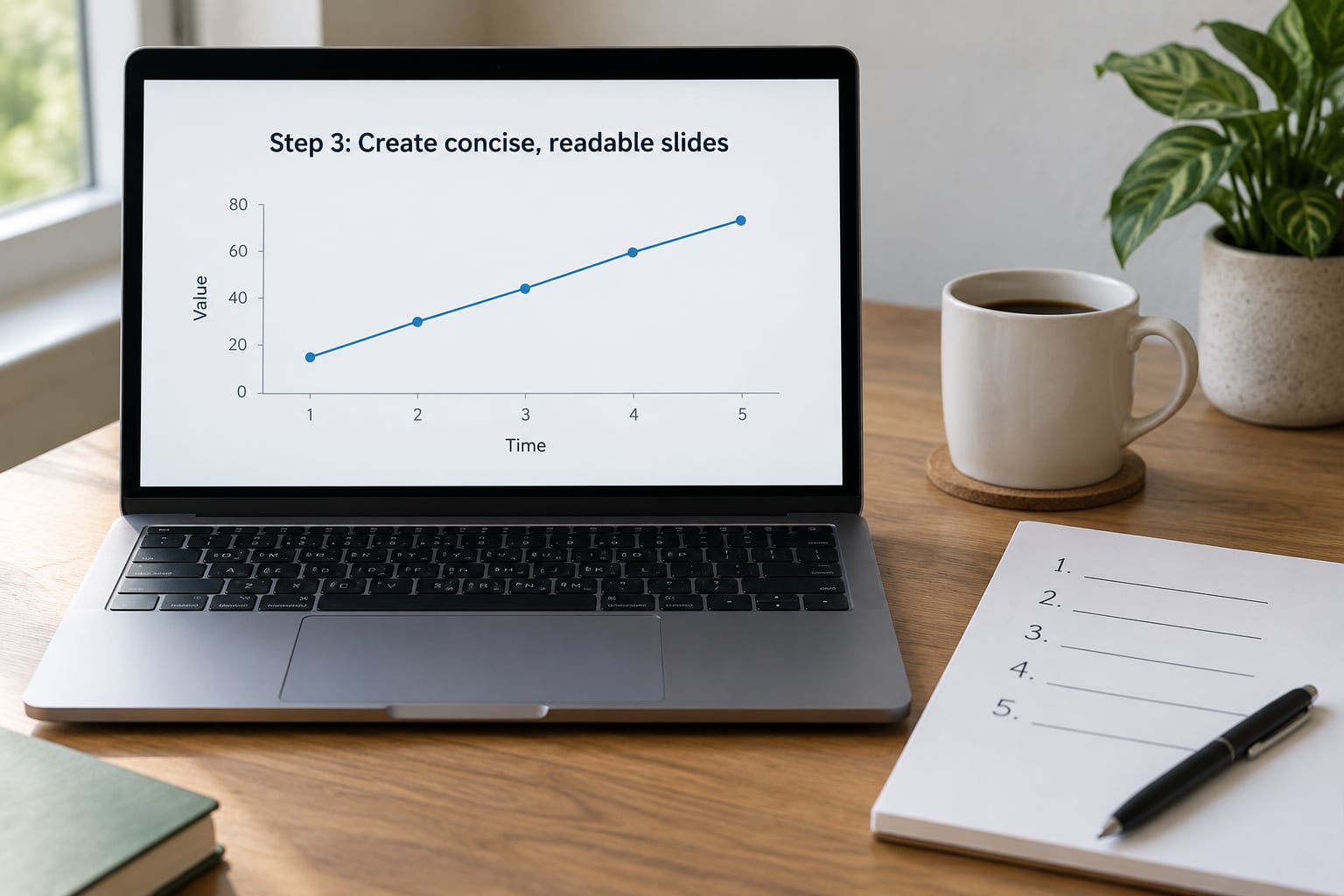
One idea per slide, and put the idea in the slide title. “Results” is a wasted line; “Response time dropped 23 percent after the interface change” is a finding the committee can hold onto while you talk. If someone reading only your slide titles could follow your argument, the structure works.
Keep text minimal and readable from the back of the room. Use charts over tables of raw numbers, label every axis in words, and choose colors that survive a grayscale projector. Most defenses are recorded on a camera with poor audio and an unclear image, so contrast matters more than polish.
Include enough methodological detail to survive scrutiny: sample, measures, and the key analytic choice. Save everything else for appendix slides, which the committee will not see unless they ask. An appendix is a navigation tool, not a dumping ground.
Step 4: Prepare explanations for every key result
For each table and figure, be able to say what was measured, on whom, what the number means in practice, and what it does not mean. Separate evidence from interpretation out loud. “Retention was 68 percent in the treatment arm” is evidence; “the training worked” is interpretation, and the committee will test which one you mean.
If your thesis is quantitative or statistics-heavy, expect pointed questions on assumptions, power, effect size and stability. Have a short answer ready for each of these:
- Which assumptions did you check, and what happens to the estimates if one fails?
- How did you determine your sample size, and what effect size were you powered to detect?
- Why an effect size rather than a significance threshold, and what is the confidence interval?
- How many tests did you run, and did you account for multiple comparisons?
- What sensitivity or alternative analyses did you run, and did the pattern hold?
Prepare the specific numbers rather than the general concept. “I ran a sensitivity analysis excluding outliers and the effect stayed in the same direction” is a real answer. “I checked the model another way” is not.
Step 5: Anticipate defense questions
Write your own questions first, then have someone who has not read your thesis ask you ten more. Organize the list into categories, and for each one note what the examiner is really testing and the move your answer needs to make.
| Question category | What the examiner is testing | Your answer move |
|---|---|---|
| Motivation and gap | Whether the problem matters and you know the literature | Name two or three specific studies, then state exactly what each failed to answer |
| Research question | Whether the question is answerable with your data | Restate the question in one sentence, then confirm your design can answer it |
| Design and sampling | Choice of design, sample size, recruitment, non-response | State the trade-off you accepted and give the number that shows you thought about it |
| Measures and validity | Whether your instrument measures the concept you claim | Explain the operational definition and cite a reliability figure you can defend |
| Analysis choices | Why this test and not another, and assumptions checked | Name the assumption, how you tested it, and what the alternative analysis showed |
| Results interpretation | Whether you over-read small effects or causal claims | Report the effect size and interval, not just the threshold, and keep claims bounded |
| Limitations | Self-awareness and scholarly honesty | Name the limitation first, then explain what you would do with more time or money |
| Contribution and future work | Fit with the field and awareness of what comes next | Say what a practitioner changes tomorrow, and what a follow-up study would test |
Aim for 25 to 30 questions. Fewer than fifteen leaves obvious gaps; more than thirty is a list you will not learn.
Step 6: Rehearse and time the thesis defense presentation
Rehearse in this order: with slides and a script for the first run, then from a one-page outline with no slides, then with a question drill. The second rehearsal is the one that matters, because it proves you know the material rather than the deck. Most candidates discover for the first time that they cannot explain their own study without reading it.
Use a four-week runway. Four weeks out, write the storyline and draft the question bank. Three weeks out, build the deck and get advisor feedback. Two weeks out, run a full timed rehearsal and cut thirty percent. One week out, do a mock defense and rehearse the question session in a standing position.
A mock defense is worth the effort if you run it properly. Ask your advisor or a peer from another department to play the panel, give them your question list plus instructions to invent ten extra questions, and record the session. Write down every question that made you hesitate; those are the ones to rebuild. Two mock sessions are usually enough, and three is plenty.
When you practice delivery, keep three habits: pause after a finding before speaking, look at the room rather than the screen, and speak a little slower than feels natural. Nerves speed people up, and a slow answer reads as confidence.
Step 7: Prepare the delivery and defense-day checklist
Send the deck to the committee 24 to 48 hours ahead if your program allows it, and include a one-page summary: question, method, three findings, contribution. It frames the conversation in your favor without being presumptuous.
On the day, arrive thirty minutes early. Bring the deck as PDF on a laptop, on a USB drive, and in your email, plus a printed copy of the one-page summary and your question notebook. Check that the projector shows your figures correctly rather than assuming. Water, a notebook and a pen matter more than people expect; writing a number down mid-answer buys you thinking time.
Dress one notch above what the room will be. It changes how you carry yourself more than it changes how anyone perceives the science.
For a remote defense over a video call, test your camera, microphone and screen share the day before, disable notifications, charge the laptop and plug it in, and send the committee a copy of the PDF in advance. Place your notes where only you can see them, and keep your hands visible. Treat a remote defense with the same timing discipline as an in-person one.
Common Mistakes
Reading your slides aloud. Nobody can hear a speaker reading and thinking at the same time. Move the text into your speaker notes and talk from the outline. Fix: after each slide, ask yourself what you would say if the slide were blank.
Packing the introduction with background. Three minutes of context feels generous to you and interminable to the panel. Fix: give the field one slide, the gap one slide, and start your method earlier.
Hiding a limitation until the committee finds it. Naming your own limitation first converts a trap into a demonstration of judgment. Fix: rehearse the sentence “The main limitation is X, and it affects Y.”
Claiming causality from a design that cannot support it. Fix: describe your design accurately in one sentence, and use “associated with” where the design warrants it.
Pleading ignorance without a foothold. “I don’t know” ends the exchange. Fix: state what you have, name the assumption you would make, give the expected direction, and offer to follow up.
Arguing with the examiner. Committees test how you handle disagreement, not whether you win it. Answer, acknowledge the point, and offer a specific follow-up if the suggestion has merit.
Overrunning. Most programs allow interruption or a visible time card. Fix: cut your least important result and rehearse the cut version so you can drop it cleanly.
Treating it like a conference talk. Suggestions to run polls, quizzes or audience participation in a defense are wrong. Nobody is testing engagement; they are assessing whether you understand your own research.
Two habits fix most of the rest. Record yourself once and watch it without sound, which exposes pacing and filler words faster than any mirror. Then keep a page of the three sentences you most want to land, and make sure they survive editing.
Frequently Asked Questions
How long should a thesis defense presentation be?
Most programs allow 20 to 30 minutes for the presentation itself, with the questioning session afterward. Some institutions give 45 minutes when the whole defense is one hour. Confirm the exact limit, and whether questions count toward it, with your program administrator, because it varies widely and a time limit you assumed is the fastest way to get cut off.
How many slides should I prepare for a thesis defense?
Plan for roughly one slide per minute of speaking time, so a 20-minute talk usually means 18 to 22 slides including the title and closing slide. Fewer, denser slides are better than a long deck read aloud. Keep full detail in appendix slides that the committee can request, rather than on the main screen.
What questions are usually asked during a thesis defense?
Expect questions on your research question, why it matters, the literature gap, sampling and design, measurement choices, analysis decisions, assumptions, the meaning of each key result, your limitations, and your contribution. Panel members from a nearby field usually probe the method hardest, while your advisor focuses on interpretation and next steps.
How should I present statistical results in my defense?
Report effect sizes and confidence intervals, not only significance thresholds, and say in plain words what the numbers mean in practice. State which assumptions you tested and what happened when one failed. Keep one finding per slide with a clearly labeled chart, and separate what the data show from what you interpret them to mean.
What if I do not know the answer to a committee question?
Do not guess wildly or stay silent. Say that you did not examine that directly, name what the work does establish, state the assumption you would make, and give the expected direction of the answer. Offer to follow up in writing. Honesty plus a reasoned assumption reads far better to a panel than a confident invention.
How many times should I rehearse my thesis presentation?
Most candidates need four to six full rehearsals to be genuinely comfortable: two with slides and a script, two without slides from an outline, and one or two question drills or mock defenses. If you can explain the study cold in two minutes without looking, you are ready. More repetitions than that rarely add much.
Conclusion
Knowing how to prepare for a thesis defense presentation comes down to four things: a one-page summary of your own argument, a deck whose slide titles state findings, a written bank of 25 to 30 questions with prepared answers, and a timed rehearsal you run without slides at least once. Start today by confirming the time limit and format with your department, then draft the storyline and the question bank before you touch the slide design. The candidates who feel prepared are rarely the ones who worked longer; they are the ones who rehearsed the hard parts, especially the questions.