
Paraphrasing research findings means restating a study’s results in your own words and sentence structure while keeping the meaning, the numbers and the scope exactly as the original author reported them, and giving that author an in-text citation every time. Getting it right takes about ten minutes per finding once you have a repeatable process.
Most paraphrasing goes wrong in one of two ways. Either the wording stays too close and the similarity checker lights up, or the rewrite drifts and the finding now claims something the study never said. The second one is far more damaging, and it usually happens to results sentences full of statistics, where a small word swap quietly changes how strong or how certain the finding is. Learning how to paraphrase research findings correctly is mostly about protecting that evidence, not about disguising it.
This guide walks through the whole job: what to have ready, six steps you can repeat, worked examples with statistical findings, and a checklist to run before you submit. I updated it for 2026 against APA 7th edition guidance.
Table of Contents
- 1What You Need Before You Start
- 2Step-by-Step: How to Paraphrase Research Findings Correctly
- 31. Read and identify the exact finding
- 42. Preserve the statistical meaning
- 53. Change the sentence structure first
- 64. Replace wording with precise equivalents
- 75. Check for subtle meaning changes
- 86. Cite the source and verify the final sentence
- 9Worked Example: One Finding, Three Versions
- 10Common Mistakes and How to Fix Them
- 11Self-Check Before You Submit
- 12Frequently Asked Questions
- 13Can I change the wording of statistical findings without changing their meaning?
- 14How do I paraphrase a result that includes p-values or significance levels?
- 15Is it plagiarism if I rewrite a research finding in my own words?
- 16How much detail should I keep when paraphrasing a research result?
- 17When should I quote a research finding instead of paraphrasing it?
- 18Conclusion
What You Need Before You Start
Five things. Missing any one of them is how paraphrases end up inaccurate rather than just repetitive.
- The finding itself, ideally the whole paragraph it sits in, not a screenshot or an abstract bullet. Read the surrounding text so you know whether the number is a headline result or a minor one.
- Every number attached to it: means, percentages, effect sizes, p-values, confidence intervals, sample sizes, the comparison group and the time frame.
- The caveats: limitations, sample context, whether the design supports causation, and anything the author flags as provisional.
- Full citation details: author, year, and the page or paragraph number if you will need a direct quotation inside the paraphrase.
- A blank sentence in your own document where the paraphrase will go, plus the sentence or two around it so your rewrite fits the argument instead of sitting on top of it.
Close the source before you start writing. Reading and editing at the same time is how you accidentally keep the author’s phrasing, because your eye keeps sliding back to the original.
Step-by-Step: How to Paraphrase Research Findings Correctly
Six steps, in this order. Skipping to step four, where you swap words, is the single most common mistake, and it produces the synonym-sentence that reads strangely and means something slightly different.
1. Read and identify the exact finding
Write the finding as a single plain sentence, stripped of style, before you rewrite it. Something like: this study measured X in group A and group B, and found the difference was in a particular direction.
At this stage, separate three things that often blur together: the result itself, the author’s interpretation of the result, and the explanation of why it might have happened. Only the first is the finding. Paraphrasing the other two is fine, but they must be introduced as the author’s thinking, not as established fact.
A quick test: if you stripped the citation out, would the sentence still be something you could defend on your own evidence? If not, it is a paraphrase, and it needs attribution.
2. Preserve the statistical meaning
This is the step that separates a correct paraphrase from a dangerous one. Several elements carry the weight of the claim and cannot move.
- Direction: higher, lower, more, fewer, faster. Flipping these inverts the finding.
- Significance: whether the result was statistically significant, and at what level. Do not turn a non-significant result into a “meaningful rise” or a significant one into a “slight tendency”.
- Magnitude: effect size, percentage change, and the actual gap between groups. “Much larger” and “statistically larger” are different claims.
- Comparison group: compared with what, and compared to whom. Results that hold for one subgroup do not generalise.
- Time frame and design: cross-sectional data does not show change over time, and an association is not a cause.
- Scope: all participants, or a subgroup. “Certain information” must not become “all information”.
On a data analysis site, this is the part of how to paraphrase research findings correctly that gets skipped most. A sentence that says results were significant at p less than .05 is not improved by becoming a “significant improvement”. The reader loses the threshold entirely, and you have quietly turned a statistical result into a practical one.
3. Change the sentence structure first
Before touching a single word, rebuild the sentence. This is what separates a paraphrase from a thesaurus job, and it is also what similarity checkers are looking for.
Four moves do most of the work:
- Swap the subject. Put the finding first and the researchers in a reporting phrase: “The trial found…” becomes “Ramirez and colleagues reported…” or “In the 2023 trial, the difference was…”
- Change voice. Active to passive or back again, where the sentence allows it.
- Reorder the clauses. Context before result, or result before context, depending on what your paragraph needs.
- Change word class. Verbs become nouns (“increased” to “the increase”), or a noun phrase becomes a clause.
Change one more thing: the length. A paraphrase is usually about the same length as the original or slightly shorter, because you drop the detail that is irrelevant to your argument.
4. Replace wording with precise equivalents
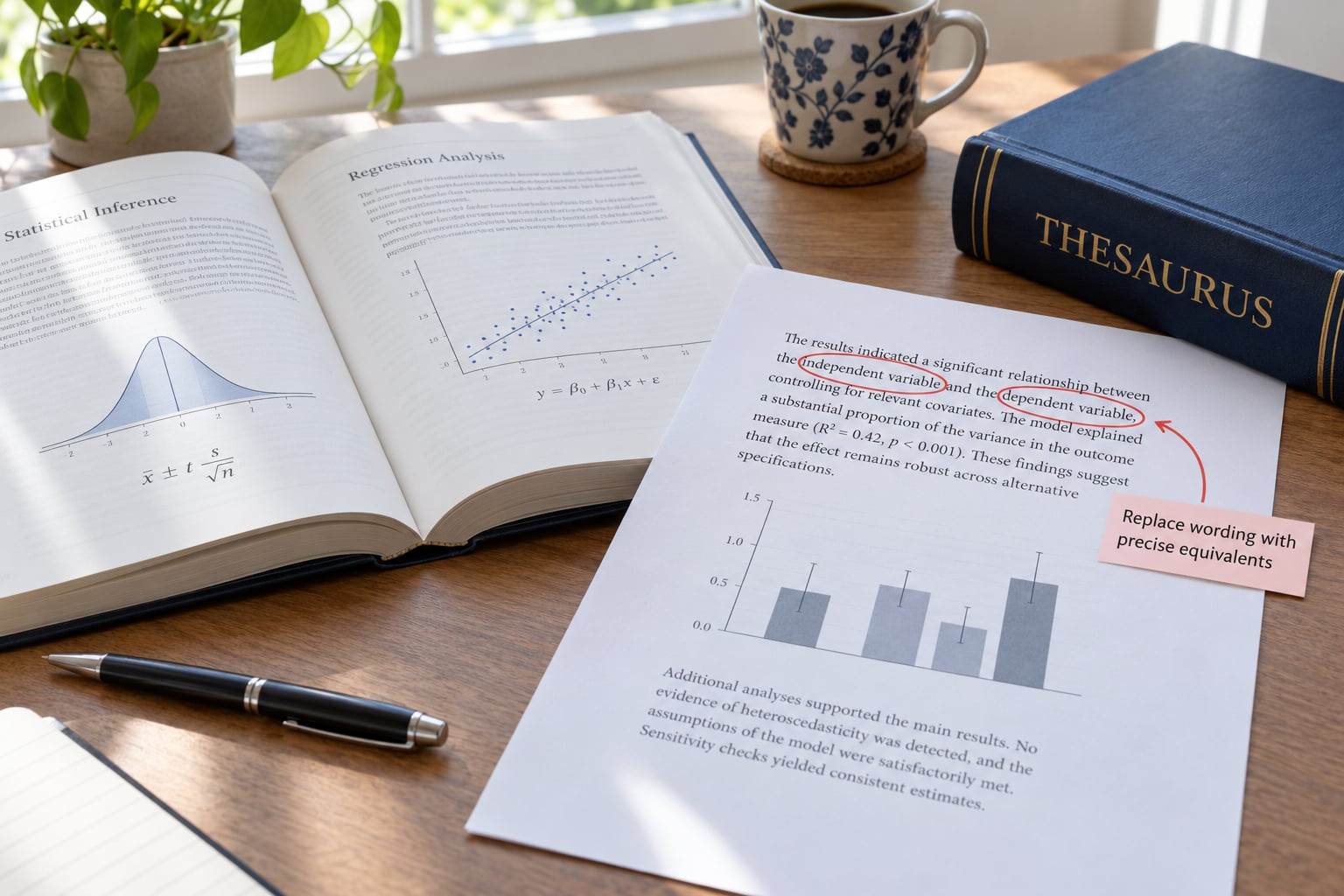
Now swap individual words, but only where the substitute carries the same weight. “Significant increase” can become “meaningful rise” if the original was statistically significant and the context makes that clear. It cannot become “slight improvement” if the effect was large, and “significant” without a stated meaning is one of the most common ways paraphrases distort results.
Technical terms stay exactly as they are. If the source says “attentional functioning”, “self-efficacy” or “composite reliability”, you keep those words, even when a plainer everyday synonym exists, because a plainer synonym usually names a different construct. Accepting a slightly higher similarity score in exchange for technical accuracy is the right trade; students and researchers on forums consistently say this, and supervisors rarely complain about repeated discipline terminology.
A small set of phrases carries a lot of trouble. “Caused” and “led to” imply causation the design may not support, so “was associated with” or “coincided with” is often the honest version. “Proved” overstates a single study. “Proves”, “confirms” and “establishes” all claim more than one study can deliver on its own.
Reporting verbs and citation phrases work well here, because they front-load the attribution: “according to”, “as X argues”, “the study by X suggests”, “X reports”, “X concludes”, “the authors emphasise”. Avoid the informal ones: believe, love, like, try, feel. In APA 7th edition these take the author’s name and year in the sentence, which also removes the awkward pile of parenthetical citations that readers find hard to parse.
5. Check for subtle meaning changes
Put the original and your paraphrase side by side and check six things. Any one of them changing means the paraphrase is wrong, whatever the similarity score says.
- Certainty: did a finding described as suggestive become a settled one?
- Causation: did an association become a cause?
- Magnitude: is the effect size, percentage or gap still the same?
- Comparison group: is it still the right baseline?
- Time frame: is a snapshot still described as a change over time?
- Statistical significance: is the threshold, or the absence of one, still visible?
If you cannot answer “yes, it still means that” for every line, the paraphrase is not finished.
6. Cite the source and verify the final sentence
A paraphrase always needs an in-text citation. No quotation marks, because you are not using their exact words, but full attribution regardless of how much you rewrote it. Citation does not make an uncredited idea yours, and it does not rescue a paraphrase that changed the scope of the claim.
In APA 7th edition, a paraphrase usually carries the author and year at the point where the idea appears: (Ramirez et al., 2023). Parenthetical citations belong at the level of the single idea, so if your sentence pulls from two studies, cite both there rather than saving one for the end of the paragraph. Add a page or paragraph number when the finding sits in a specific place and the reader might want to check it.
If you combine a short quoted phrase with your own wording, that phrase goes in quotation marks and still needs the citation. Quoting two or three words for precision is legitimate and often the better choice.
Finish by reading the sentence aloud. If you stumble, the structure is too close to the original. Then check the numbers against the source one last time, because a transposed figure in a results section is the kind of error that gets picked up in viva or peer review.
Worked Example: One Finding, Three Versions
Original sentence from a study: “Participants in the intervention group reported significantly lower anxiety scores than the control group (p = .03), although the difference was not statistically significant at the .01 level.”
Flawed paraphrase, the common version: “The study found that the intervention group’s anxiety scores were significantly much lower, meaning the intervention worked.”
That version drops the threshold, adds an interpretation the authors never made, and turns one comparison into a verdict. A similarity checker might not flag it. Your examiner will.
Fixed paraphrase: “Anxiety scores were lower among participants who received the intervention than among those in the control group, and the difference met the conventional significance threshold at p = .03 but not at p = .01 (Ramirez et al., 2023).”
What changed: the comparison is intact, both thresholds are visible, no causal claim appears, and the attribution sits with the researchers. What did not change is the finding. This is how to paraphrase research findings correctly in practice: the structure moves, the evidence does not.
Common Mistakes and How to Fix Them
Replacing every word. A paraphrase where nothing matches the original is usually a summary wearing the wrong label, and in a results section it usually drops detail you needed. Fix: change structure first, then change only the words that need changing.
Inflating significance. “Significant” becomes “dramatic”, “marked” or “substantial”. A significant result with a small effect is not a large finding. Fix: keep the number and let it carry the weight.
Dropping the limitations. “The study found” quietly becomes “research shows” when the limitations sentence goes missing. Fix: retain the caveat whenever it changes how far the claim travels.
Overstating causality. Correlation sentences get rewritten with “caused”, “led to” or “drives”. Fix: keep the design honest with “was associated with”, or state the design alongside the claim.
Citing only the source name in the sentence. “Smith says” without a year, or a reference list entry with no in-text citation, leaves the reader unable to tell whose idea is whose. Fix: name plus year in text, full entry in the reference list.
Scope creep. This is the damaging one. “Some participants”, “in this sample” or “a specific measure” becomes “all users” or “researchers agree”. Fix: check the quantifier word by word against the original.
Forcing synonyms on technical terms. Everyday words replacing discipline vocabulary make your writing look less competent and can misname the construct. Fix: keep the term, change the sentence around it.
Paraphrasing everything. Pages of rewritten prose read as evasive, and one guide puts a rough ceiling of 5 to 10 percent of a paper on direct quotation. Fix: quote the finding, the definition and the phrase that carries the argument, and paraphrase the rest.
Using an AI paraphraser as the last step. Machine output flattens hedges, shifts voice and sometimes invents a small detail, and many institutions treat AI-generated text in submitted work as misconduct regardless of the citation. Fix: if you use a tool to unblock a stuck sentence, rewrite that sentence yourself afterwards and follow your institution’s disclosure rules.
Self-Check Before You Submit
Run this on every paraphrased finding. It takes under a minute each.
- The numbers match the source exactly, including decimals and the comparison group.
- Direction is unchanged: higher has not become lower.
- Significance wording is unchanged, or the threshold is stated.
- Any limitation that limits the claim is still present.
- No causal verb appears unless the design supports one.
- Scope matches: subgroup, sample and time frame are not widened.
- Technical terms are the original author’s, not thesaurus substitutes.
- An in-text citation with author and year sits at the idea, not just in the reference list.
- Quote marks appear around any words lifted verbatim.
- The sentence reads aloud without a stumble and without its source beside it.
One last habit is worth more than all ten lines. Write your version of the finding first, in your own voice, before you open the source again. It is harder to accidentally absorb the author’s phrasing when you are not editing theirs.
Frequently Asked Questions
Can I change the wording of statistical findings without changing their meaning?
Yes, but only within a narrow band. Direction, significance level, effect size, comparison group, time frame and scope all carry meaning and must stay put. You can change the sentence structure, the word order, the voice and the grammatical form of most words. Keep the actual figures and any technical term exactly as the original author used it, and add an in-text citation because the idea is still theirs.
How do I paraphrase a result that includes p-values or significance levels?
Keep the number and say what it means in plain terms rather than replacing it. A result reported as significant at p = .03 can be described as meeting the conventional significance threshold, while noting it did not reach the stricter .01 level. Dropping the value entirely turns a statistical claim into a practical one, which is a different and stronger statement.
Is it plagiarism if I rewrite a research finding in my own words?
No. Paraphrasing with attribution is a recognised and expected way to report another study, and it needs an in-text citation every time. It becomes plagiarism when the rewrite is presented as your own analysis without citation, or when it is so close to the original that reading it adds nothing. The citation does not excuse a paraphrase that changed the meaning of the finding.
How much detail should I keep when paraphrasing a research result?
Enough for the claim to survive. Keep the outcome, the direction, the strength of the evidence and any caveat that limits how far it generalises. Drop method detail that your argument does not need, sample description you have already given, and background the reader can get from the citation. A paraphrase is usually about the same length as the original or slightly shorter.
When should I quote a research finding instead of paraphrasing it?
Quote when the author’s exact wording is the finding, such as a definition, a named construct, a memorable phrase or a conclusion whose precision depends on its phrasing. Also quote a short phrase inside a paraphrase when your own wording would weaken it. In a results section you will paraphrase nearly everything, but in theory or methodology sections quoting is often the better choice.
Conclusion
Start with the finding itself, not with synonyms. Identify exactly what was measured and in whom, lock down the direction, the numbers, the significance and the limitations, then rebuild the sentence around that fixed core so the wording and structure are genuinely yours. Keep the technical terms as the original author wrote them, attach the citation at the level of the single idea, and read the result aloud before you move on. Meaning first, wording second. A paraphrase that sounds different but claims more is the failure mode worth guarding against, and it is the one no similarity score will warn you about.