
Learning how to write research objectives and hypotheses comes down to one chain of logic: state the problem, say what you will do about it, then state what you expect to find and how the data would prove you wrong. Most drafts break because those three sentences point at different studies. Once they line up, the rest of the proposal writes itself.
The whole process takes an afternoon for a master’s project, longer for a doctoral one where supervisors push back on wording three or four times before it settles. The hard part is not length. It is cutting every objective down to something you could actually answer with the data you can actually collect.
Table of Contents
- 1What You Need Before You Write Anything
- 2Step-by-Step: How to Write Research Objectives and Hypotheses
- 3Step 1: Start With the Research Problem Behind Your Objectives and Hypotheses
- 4Step 2: Write Clear General and Specific Objectives
- 5Step 3: Identify the Main Variables and Expected Relationship
- 6Step 4: Convert the Main Objective into Testable Hypotheses
- 7Step 5: Match the Hypothesis to the Study Design and Analysis
- 8Step 6: Check Alignment, Clarity, and Feasibility
- 9Common Mistakes and How to Fix Them
- 10Frequently Asked Questions
- 11Are research objectives and hypotheses the same?
- 12Which comes first, a research objective or a hypothesis?
- 13Do qualitative studies need hypotheses?
- 14How many objectives and hypotheses should a dissertation have?
- 15What is the difference between a research aim and a research objective?
- 16How do I know if my hypothesis is testable?
- 17Conclusion
What You Need Before You Write Anything
Six things should be settled on paper before you draft a single objective. If any of them is still vague, the objectives will be vague too, because vague inputs produce vague outputs.
The research problem. A problem you can state in one or two sentences, naming who has it, where it occurs, and what is currently unknown. If you cannot say what is unresolved, you do not have a problem yet.
The research gap. This comes from your literature review. A gap is a specific thing earlier studies have not done, not a general claim that little research exists. “No study has examined nightly phone use and sleep onset latency in first-year undergraduates in Ireland” is a gap. “Not enough research” is not.
Your study design. Quantitative experimental, correlational, comparative, cross-sectional; qualitative grounded theory, case study, phenomenology. This decides whether you need hypotheses at all, and how specific they can be.
Your variables, in conceptual form. The constructs you care about, such as screen time or perceived stress, before you worry about which instrument measures them. Operationalisation comes later.
Your target population and setting. Who you can realistically recruit, and where. “University students” is weak; “full-time undergraduates aged 18 to 22 at a mid-sized urban university” tells you what your results can mean.
Available evidence. Data sources, instruments, and roughly what sample you can achieve. This is what stops you writing an objective that sounds admirable and cannot be tested.
Hold off on picking a statistical test at this stage. Students routinely write “to test using a chi-square test” and then discover their variables are continuous. The test follows the design and the data, not the other way round.
Step-by-Step: How to Write Research Objectives and Hypotheses
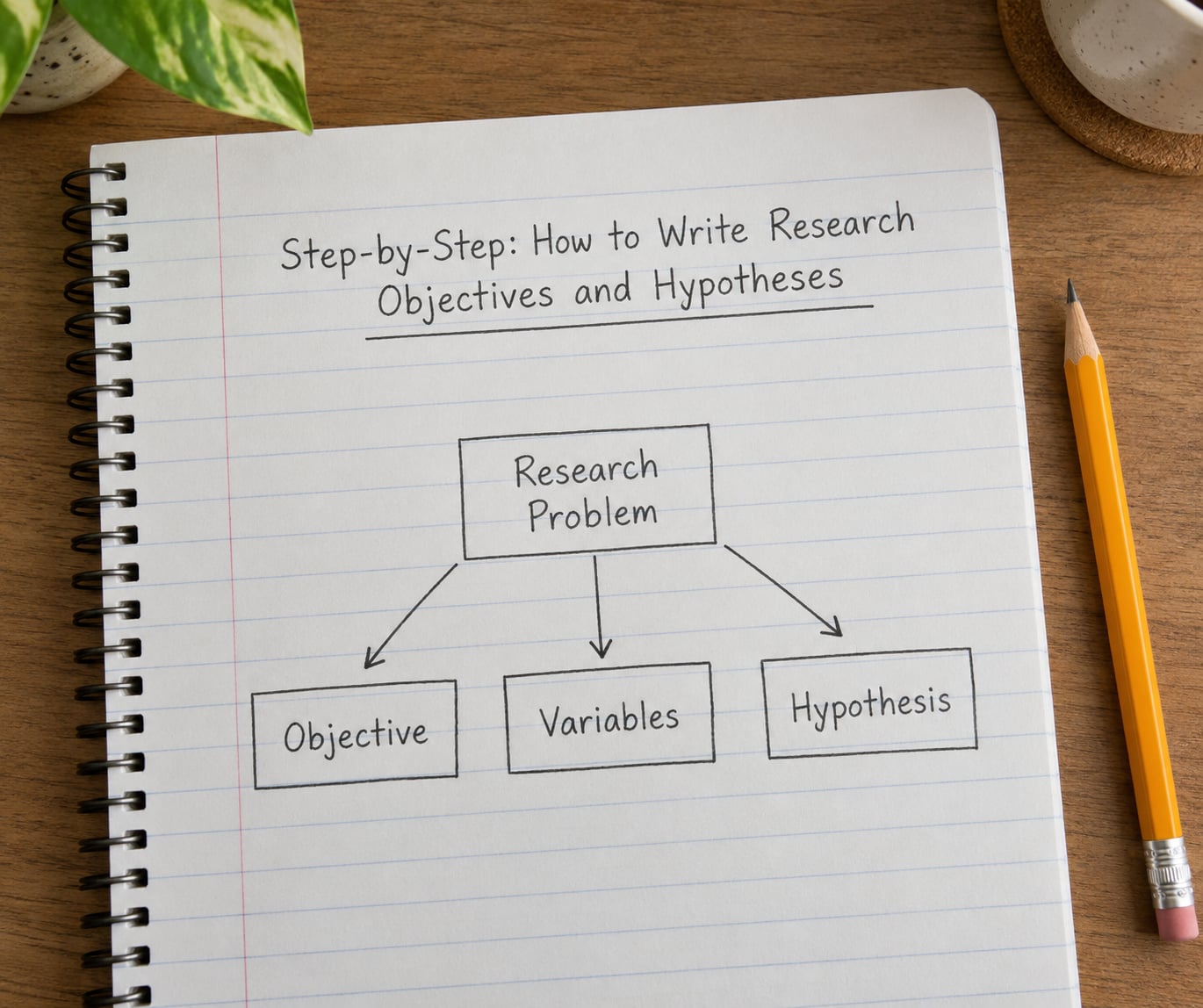
The process below runs in order and each step feeds the next. I have seen more than a few students jump to step four with a topic they have not yet defined, and that is exactly where the mismatched-wording problems start.
Step 1: Start With the Research Problem Behind Your Objectives and Hypotheses
An objective is a response to a problem, so write the problem first in one or two plain sentences. Name the population, the context, and the main constructs involved. Then state what is currently unknown, which is the gap your study addresses.
Weak: “There is a lot of stress among students and not much research has been done.”
Stronger: “Self-reported stress has risen among undergraduates, yet few studies have tested whether bedtime phone use is associated with sleep quality in that group. The direction and size of any such relationship is unclear.”
The second version gives you a population, a variable pair, and a stated unknown. Every objective you write afterwards should trace back to it.
Step 2: Write Clear General and Specific Objectives
The general objective states the overall purpose in one sentence and does not name a method. The specific objectives break that purpose into the discrete things you will actually do.
General objective: “To examine the relationship between bedtime phone use and sleep quality among university students.”
Specific objectives: identify how many students report nightly phone use after 11pm, measure sleep quality with a validated scale, determine whether bedtime phone use predicts sleep quality, and compare average sleep quality between high-use and low-use students.
Use measurable action verbs: identify, examine, compare, measure, determine, quantify, assess. Avoid verbs that promise more than a study can deliver, such as prove, solve, or improve. You are not going to solve insomnia.
One warning from the forums worth repeating: supervisors on AskAcademia and r/PhD most often reject drafts because objectives are “too broad” or “not measurable.” Specific and measurable are usually the same fix.
Step 3: Identify the Main Variables and Expected Relationship
List the constructs in plain language and label them. The predictor you manipulate or measure first is the independent variable. The outcome you are trying to explain is the dependent variable. Mediators sit in between, moderating variables change the strength of a relationship, and confounders are third variables you must control or acknowledge.
In the running example, bedtime phone use is the independent variable and sleep quality is the dependent variable. Depression severity might moderate the relationship, and caffeine intake could confound it. Naming these before you write stops the classic mismatch where a hypothesis names a variable the survey never measured.
Then write the expected relationship as a plain sentence, before any formal notation. “More bedtime phone use is associated with poorer sleep quality” is a directional expectation. “Bedtime phone use and sleep quality are related, in an unknown direction” is non-directional. You cannot pick which yet, so hold the sentence loose for now.
Step 4: Convert the Main Objective into Testable Hypotheses
Derive a hypothesis only from an objective you can actually test. Each specific objective that makes a claim about a relationship or a difference yields one directional or non-directional hypothesis plus its null counterpart.
Alternative (directional): “Students who report using a phone within one hour of bedtime have significantly lower sleep quality scores than students who do not.”
Null: “There is no significant difference in sleep quality scores between students who report bedtime phone use and those who do not.”
For a correlation objective, write it as an association: “Higher reported bedtime phone use is associated with higher sleep disturbance scores.” Its null states no association.
A hypothesis has to be falsifiable. If no possible result could count as evidence against it, it is an assumption, not a hypothesis. “People who sleep well will report better wellbeing” fails that test, because a person sleeping badly could still report good wellbeing.
Step 5: Match the Hypothesis to the Study Design and Analysis
Design and hypothesis have to agree. An experimental design supports causal language because you assign the condition. A correlational design only supports association, so writing “phone use causes poor sleep” there is a mismatch your examiner will catch.
Descriptive objectives produce no hypothesis; they produce a description. Comparative objectives can take a hypothesis stating a difference between groups. Correlational objectives take a hypothesis about association. Experimental objectives take one about the effect of a manipulated condition. A regression or mediation analysis supports a hypothesis about a direct, indirect, or conditional effect.
Qualitative studies are the exception and the source of a lot of unnecessary anxiety. Grounded theory, phenomenology, and most case studies do not need hypotheses at all; they need research questions and interview or observation protocols. Proposing hypotheses for a phenomenological study is a category error, and if your supervisor asks for one, ask what prediction it would let you test.
Step 6: Check Alignment, Clarity, and Feasibility
Run a final pass with four checks, one line at a time.
Coverage: read each hypothesis and point to the objective it answers. Any hypothesis without a parent objective is an orphan and should go. Any objective with no hypothesis is fine if it is descriptive.
Measurability: every variable in a hypothesis must be measurable with data you will collect. If your survey did not record screen time, a hypothesis about screen time is untestable.
Clean wording: cut circular statements, where a hypothesis just restates the objective using the same words, and double-barrelled claims that pack two relationships into one sentence. “Students with poor sleep and low attendance will perform worse” needs splitting into two.
Feasibility: read each objective and ask whether your sample size, timeline, and access make it achievable. Studies get rejected from grant schemes and ethics boards for this reason alone.
A useful format is a short matrix, one row per objective: objective, hypothesis, data source, and analysis. If a row stays empty for two columns, that objective is not yet workable.
Common Mistakes and How to Fix Them
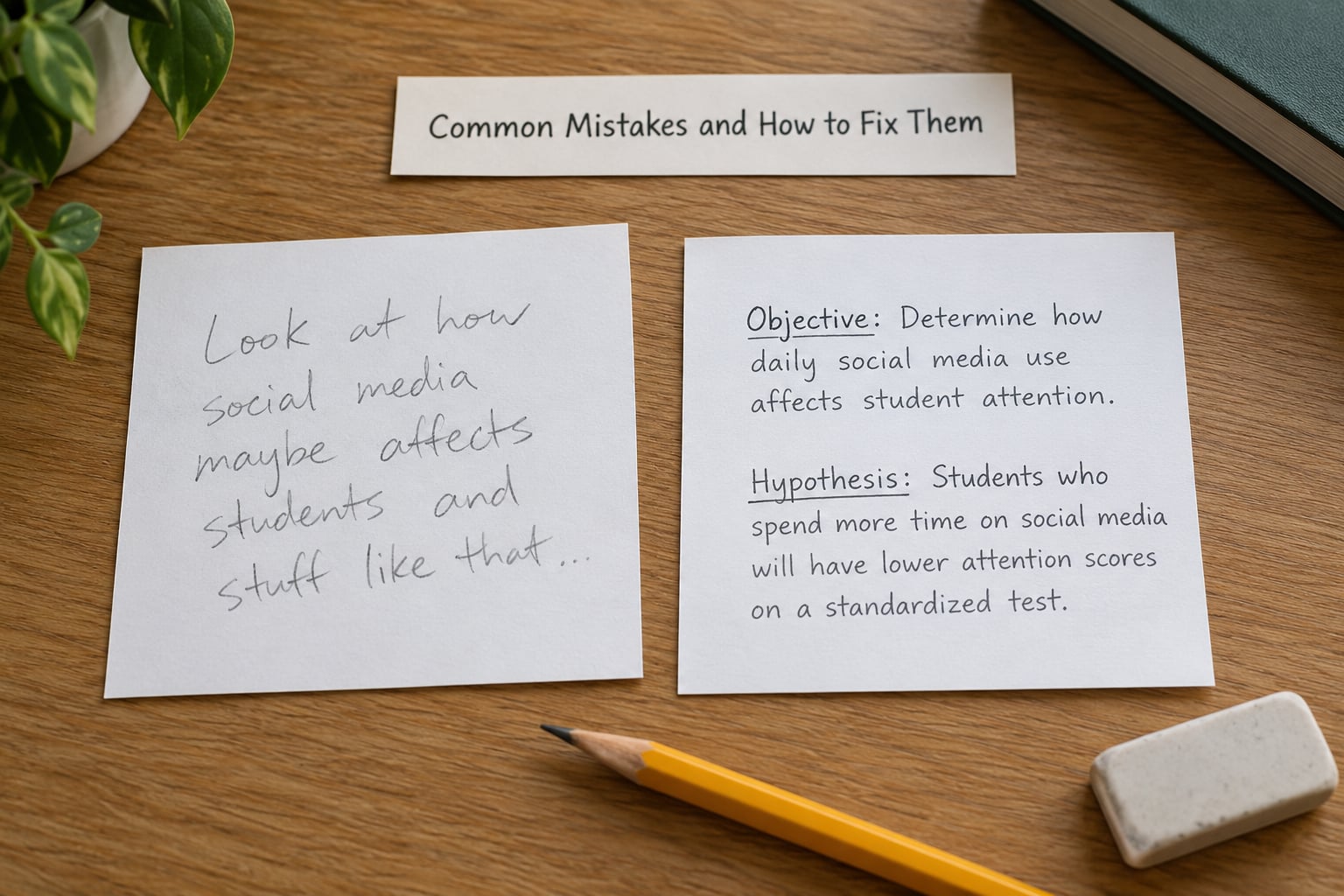
These six come up in nearly every draft I see, and each has a quick correction.
Confusing the aim with the objective. An aim is the broad purpose and stays general. An objective is a specific task. Fix: change “to improve student wellbeing” into “to measure the association between registration of sleep support and reported wellbeing among first-year undergraduates.”
Writing vague objectives. “To explore the topic of social media” gives a reviewer nothing to assess. Fix: add a population, a construct, and a measured outcome, then swap “explore” for “examine” or “measure.”
Using hypotheses where none belong. Exploratory and qualitative work often has no testable prediction. Fix: keep research questions, drop the hypothesis section, and say in your methods why a deductive test was not appropriate.
Making untestable claims. “This study will prove that exercise reduces anxiety in all adults” cannot be supported by one sample. Fix: narrow the population, drop the absolute verb, and match the claim to the design you actually have.
Mismatching variables. A hypothesis about a moderator the model never measured, or a causal claim inside a correlational study. Fix: list every variable in the hypothesis, then tick it off against your data collection plan.
Swapping the null and alternative. The alternative states the expected effect; the null states no effect or no relationship, and it is the one that gets tested first. Fix: read them side by side and ask which one predicts a difference.
Frequently Asked Questions
Are research objectives and hypotheses the same?
No. An objective states what the study intends to do, such as examining whether bedtime phone use relates to sleep quality. A hypothesis states the specific expected result that the analysis will test. A descriptive study can have objectives with no hypotheses at all, while a correlational study usually has one hypothesis per testable objective.
Which comes first, a research objective or a hypothesis?
The objective comes first, and the hypothesis is derived from it. If you write a hypothesis first, it tends to drift from what the study actually collects. Write the research problem, then the objectives, then convert each testable objective into an alternative hypothesis and its matching null.
Do qualitative studies need hypotheses?
Usually not. Grounded theory, phenomenology, ethnography, and most case studies generate concepts from data rather than testing a prediction, so research questions are the right instrument there. Some qualitative studies do state hypotheses, particularly mixed-methods designs with a quantitative strand, and case-comparison work can carry them defensibly.
How many objectives and hypotheses should a dissertation have?
Most successful proposals carry one general objective and three to five specific ones, with a hypothesis for each specific objective that makes a testable claim. Master’s projects often need only two or three. If you have more than six specific objectives, the study is usually doing two projects at once.
What is the difference between a research aim and a research objective?
An aim is the broad purpose of the study and stays general for the whole project. An objective is one specific, measurable step toward that aim, and each one maps to a piece of data you collect. A practical rule: an aim cannot be finished, an objective can be marked complete or incomplete.
How do I know if my hypothesis is testable?
Ask two things. Is every variable in it measurable with data your design will collect, and could a realistic result count as evidence against it? If a variable is not in your instrument or data plan, or if no outcome would disconfirm the statement, rewrite it. Unfalsifiable claims are assumptions, not hypotheses.
Conclusion
Three things to do first. Write the research problem in two sentences, including the population and the specific gap. Then write one general objective and three to five specific ones using measurable verbs. Finally, derive a hypothesis only for each objective your design can actually test, and check each one against your data plan before you submit.
Everything else in a proposal, from the method to the analysis plan, gets easier once that chain holds. If an objective cannot be traced to the problem or a hypothesis cannot be traced to an objective, fix the chain before you start collecting anything.